 뒤로
뒤로Chapter 1: Introduction to Medical Terminology – Structured Study Notes
스터디 가이드 - 스마트 노트
 자료에 맞춘 맞춤형 노트, 핵심 정의, 예시, 맥락을 확장해 제공합니다.
Introduction to Medical Terminology
Overview of Medical Terminology
Medical terminology is a specialized language used in healthcare settings to convey precise information about the human body, diseases, procedures, and treatments. Understanding medical terms is essential for effective communication among healthcare professionals and for accurate documentation.
Three Types of Medical Terms:
Terms built from Latin and Greek word parts: e.g., cardiology, tonsillectomy
Eponyms: Terms based on a person's name, e.g., Parkinson disease, Alzheimer disease
Modern English words: e.g., magnetic resonance imaging (MRI), irritable bowel syndrome (IBS)
Importance: Allows detailed and efficient communication in medical contexts.
Elements of Medical Terms
Most medical terms are constructed from Latin and Greek word parts. Learning these elements is similar to learning a new language, requiring memorization and practice.
Word Roots: The foundation of most medical terms, often referring to a body structure, organ, or system.
Suffixes: Added to the end of terms to indicate conditions, procedures, diseases, or diagnostic methods.
Prefixes: Added to the beginning of terms to indicate abnormal conditions, positions, numbers, or times.
Combining Vowels: Usually 'o', used to connect word parts for easier pronunciation.
Word Roots
Word roots provide the essential meaning of medical terms. They often refer to anatomical structures or systems.
Examples: cardi (heart), oste (bone), gastr (stomach)
Combining Form: Word root + combining vowel (e.g., cardi/o)
Suffixes
Suffixes modify the meaning of the word root, often indicating a procedure, condition, or disease.
Examples: -itis (inflammation), -ectomy (removal), -logy (study of)
Inflammation: Tissue response to injury, characterized by redness, pain, swelling, and heat.
When written alone, a hyphen is placed at the front (e.g., -itis).
Prefixes
Prefixes are placed at the beginning of medical terms to provide additional information about the word root.
Examples: hypo- (below, insufficient), hyper- (above, excessive), poly- (many)
When written alone, a hyphen is placed at the end (e.g., hypo-).
Combining Vowels
Combining vowels are used to connect word roots and suffixes or two word roots, making terms easier to pronounce.
Most common combining vowel: o
Placed between a word root and a suffix (if the suffix begins with a consonant) or between two word roots.
Never used between a prefix and a word root.
Combining form: word root plus combining vowel, written as root/vowel (e.g., cardi/o).
Common Combining Forms for Organs and Regions
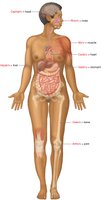
Combining forms are used to refer to specific anatomical regions or organs.
Head: cephal/o
Nose: rhin/o
Muscle: my/o
Heart: cardi/o
Liver: hepat/o
Stomach: gastr/o
Bone: oste/o
Joint: arthr/o
Strategies for Analyzing Medical Terms
Analyzing medical terms involves breaking them down into their component parts and understanding their meanings.
Divide the word into individual parts.
Define each part.
Combine the definitions to interpret the term.
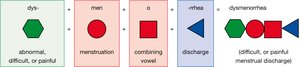
Example: dysmenorrhea
dys-: abnormal, difficult, or painful
men/o: menstruation
-rrhea: discharge
Definition: Difficult or painful menstrual discharge
Building Medical Terms
To construct medical terms, start with the definition you need, identify the appropriate word parts, and combine them according to the rules.
Example: Blood condition of insufficient sugar
hypo-: insufficient
glyc/o: sugar
-emia: blood condition
Term: hypoglycemia
Rules for Pluralizing Medical Terms
Medical terms follow specific rules for forming plurals, often based on Latin or Greek origins.
Examples include changing -a to -ae, -us to -i, -um to -a, etc.
Refer to Table 1-5 for detailed rules (not included here).
Pronouncing Medical Terms
Correct pronunciation is important for clear communication. Hints and guidelines are provided to assist with pronunciation (see Table 1-6).
Abbreviations in Medical Terminology
Abbreviations are commonly used in medical records to save time. Only approved abbreviations should be used to avoid confusion.
If an abbreviation might be unclear, spell out the term.
Formal healthcare facilities maintain lists of approved abbreviations.
Appendix II provides a comprehensive list of abbreviations and those to avoid.
Summary Table: Common Combining Forms
Region/Organ | Combining Form |
|---|---|
Head | cephal/o |
Nose | rhin/o |
Muscle | my/o |
Heart | cardi/o |
Liver | hepat/o |
Stomach | gastr/o |
Bone | oste/o |
Joint | arthr/o |
Example Equation: Word Formation
Medical terms can be represented as equations, combining prefixes, roots, combining vowels, and suffixes.
Example:
Meaning: Difficult or painful menstrual discharge
Additional info: Academic context and examples have been expanded for clarity and completeness.
