 뒤로
뒤로Introduction to Medical Terminology: Structure, Meaning, and Usage
스터디 가이드 - 스마트 노트
 자료에 맞춘 맞춤형 노트, 핵심 정의, 예시, 맥락을 확장해 제공합니다.
Chapter 1: Medical Language – Its Structure and Meaning
Introduction to Medical Language
Medical language is the specialized language used in healthcare settings. It consists of words and terms that describe the human body, diseases, procedures, and treatments. Understanding medical language is essential for effective communication among healthcare professionals.
Medical words are constructed from word parts, much like assembling pieces of a puzzle.
Correct assembly of these parts allows for accurate interpretation and communication.

Medical Language Skills
Proficiency in medical language requires mastery of five key skills:
Reading medical words
Hearing medical words
Thinking, analyzing, and understanding medical words
Writing (or typing) and spelling medical words
Speaking and pronouncing medical words


The Origins of Medical Language
Etymology is the study of word origins. Most medical terms are derived from Greek and Latin, reflecting the historical contributions of these cultures to medicine. Some terms are identical to their original forms, while others have been adapted. A smaller number of terms come from other languages.
Greek and Latin roots are foundational in naming anatomical structures, diseases, and treatments.
Medical Nouns and Word Parts
Singular and Plural Nouns
Medical nouns follow specific rules for forming plurals, depending on their language of origin:
English nouns: Add -s (e.g., gland → glands) or change -y to -ies (e.g., artery → arteries).
Greek and Latin nouns: Follow unique pluralization rules (not detailed here; refer to textbook for specifics).
Word Parts: The Building Blocks of Medical Terms
Medical words are constructed from three main types of word parts:
Prefix: An optional word beginning that modifies the meaning.
Combining form: The foundation of the word, usually indicating a body part or system.
Suffix: The word ending that modifies or clarifies the meaning.
Combining Forms
The combining form is the core of most medical words. It consists of a root, a forward slash, a combining vowel (usually 'o'), and a hyphen when written separately.
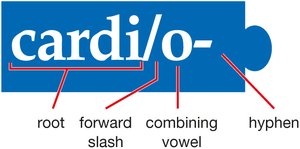
Combining forms can be nearly identical to their medical meaning, related, or not directly related.
Some body parts have multiple combining forms due to both Greek and Latin origins.
Suffixes
A suffix is a word part at the end of most medical words. It modifies the meaning of the combining form and begins with a hyphen when written separately.

Suffixes can indicate adjectives, processes, diseases, procedures, or medical specialties/specialists.


Prefixes
A prefix, if present, appears at the beginning of a medical word and modifies the meaning of the combining form. Prefixes can indicate location, direction, amount, number, speed, degree, or quality.

Analyzing and Building Medical Words
Defining Medical Words
To define a medical word, follow these steps:
Divide the word into its combining form, suffix, and prefix (if present).
Determine the meaning of each word part.
Put the meanings in order: suffix, prefix (if present), then combining form.
Add connecting words to make a clear definition.




Building Medical Words
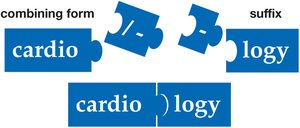
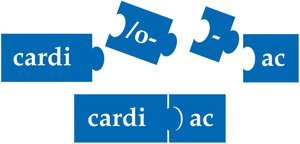
Building medical words is the reverse process of defining them. The steps depend on whether the suffix begins with a consonant or vowel, and whether a prefix is present.
If the suffix begins with a consonant, retain the combining vowel.
If the suffix begins with a vowel, drop the combining vowel.
If a prefix is present, it is placed at the beginning.







Spelling and Pronunciation
Correct spelling and pronunciation of medical words are essential for clear communication in healthcare. This requires memorizing word parts and the rules for joining them, as well as practicing pronunciation.
Knowing the definition is most important, but correct pronunciation ensures understanding among professionals.
Summary Table: Types of Word Parts in Medical Terminology
Word Part | Position | Function | Example |
|---|---|---|---|
Prefix | Beginning (optional) | Modifies meaning (location, number, etc.) | intra- (within) |
Combining Form | Foundation | Indicates body part/system | cardi/o- (heart) |
Suffix | Ending | Clarifies meaning (condition, procedure, specialty) | -logy (study of) |
Additional info: Mastery of medical terminology is foundational for all subsequent study in health sciences and clinical practice. Understanding the structure and logic of medical words enables students to decode unfamiliar terms and communicate effectively in professional settings.
