 뒤로
뒤로Medical Terminology: The Reproductive System (Female and Male) – Study Notes
스터디 가이드 - 스마트 노트
 자료에 맞춘 맞춤형 노트, 핵심 정의, 예시, 맥락을 확장해 제공합니다.
Ch. 10 Reproductive System
Overview of the Female Reproductive System
The female reproductive system is responsible for the secretion of sex hormones, ovum production, gestation, childbirth, and nourishment of the newborn. It includes both internal and external genitalia, as well as accessory organs such as the breasts.
External Genitalia: Includes the labia majora, labia minora, clitoris, and vulva. These structures protect the vaginal orifice and urinary meatus.
Internal Genitalia: Located inside the pelvic cavity, these organs receive semen during intercourse and serve as the birth canal.
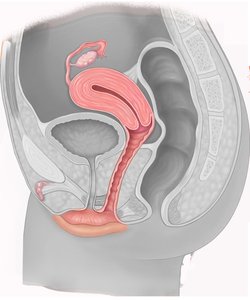
Main Organs of the Female Reproductive System
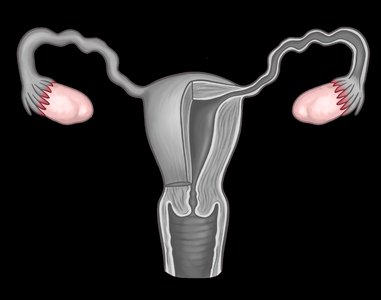
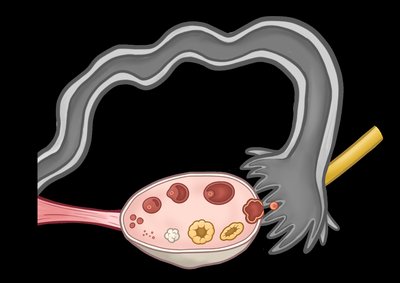
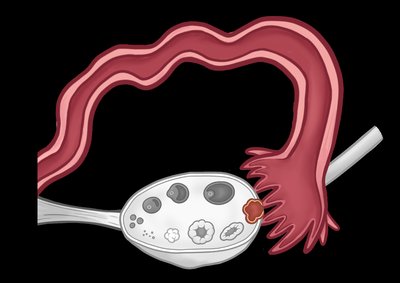
Ovaries: Small, almond-shaped organs located on both sides of the uterus. They produce sex hormones (estrogen and progesterone) and ova (eggs). Ovaries are attached to the uterus by the ovarian ligament and to the pelvis by the suspensory ligament. Ovulation is the process by which an ovary releases an ovum, stimulated by FSH and LH approximately every 28 days.
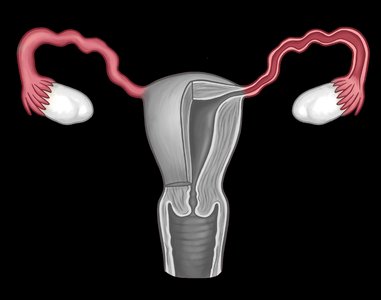
Uterine (Fallopian) Tubes: Also called oviducts, these tubes run from the top of the uterus to near the ovaries. Fimbriae are finger-like projections at the ends of each tube that catch the released ovum and propel it toward the uterus. Fertilization typically occurs in the distal part of the tube.
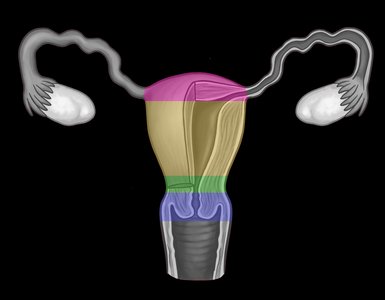
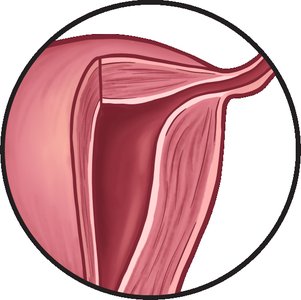
Uterus: A hollow, pear-shaped organ with thick muscular walls and a mucous lining. It is divided into four regions: fundus, corpus (body), isthmus, and cervix. The uterine wall consists of three layers: perimetrium (outer), myometrium (muscular middle), and endometrium (inner mucous lining).
Vagina: Muscular canal that serves as the birth canal and receives semen during intercourse.
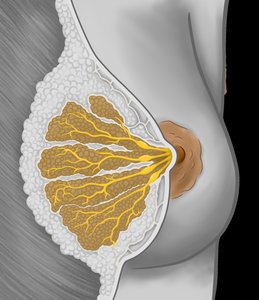
Breasts (Mammary Glands): Accessory organs that play a role in reproduction and nourishment of the newborn. Lactation is the production of milk by lactiferous glands, which is transported to the nipple via lactiferous ducts. The areola is the pigmented area around the nipple.
Word Building: Female Reproductive System
Medical terminology for the female reproductive system uses specific combining forms, prefixes, and suffixes to describe anatomy, processes, and pathology.
Combining Form | Definition |
|---|---|
episi/o, vulv/o | vulva |
colp/o | vagina |
hyster/o, metr/o, metri/o, uter/o | uterus |
salping/o | fallopian tube |
o/o, ov/o, ov/i, oophor/o, ovar/i | ovum, ovary |
Common suffixes and prefixes include:
Suffix/Prefix | Definition |
|---|---|
-arche | beginning |
-cyesis | pregnancy |
-gravida | pregnant woman |
-partum | childbirth |
-tocia | labor, childbirth |
-salpinx | fallopian tube |
primi- | first |
Processes and Pathology
nat/o: birth
men/o: menstruation
pareun/o: sexual intercourse
Examples of pathology include:
Dysmenorrhea: Painful menstrual flow with cramps.
Endometriosis: Condition where endometrial tissue grows outside the uterus.
Salpingo-oophorectomy: Surgical removal of fallopian tubes and ovaries.
Vocabulary: Pregnancy, Pathology, and Contraception
Medical Term | Definition |
|---|---|
Colostrum | Yellowish mammary fluid secreted after birth, rich in antibodies |
Meconium | First bowel movement of a newborn |
Eclampsia | Pregnancy-induced hypertension with risk of seizures |
Lochia | Vaginal discharge after childbirth |
Mittelschmerz | Abdominal pain during ovulation |
Placenta previa | Placenta covers the birth canal |
Intrauterine Device (IUD) | T-shaped contraceptive device placed in the uterus |



Diagnostic and Laboratory Terms (Female)
Medical Term | Definition |
|---|---|
Apgar Score | Evaluation of a newborn’s adjustment to extrauterine life |
Coombs’ Test | Detects antibodies in maternal blood for hemolytic anemia |
Conization | Surgical removal of a cone-shaped piece of cervix |
Goodell’s Sign | Softening of the uterine cervix during pregnancy |
Naegele’s Rule | Estimates due date: LMP + 7 days + 9 months |
Pap Smear | Microscopic examination of cervical cells for cancer screening |
Rh factor | Inherited protein on RBCs, important for maternal-fetal compatibility |
Pregnanediol | Urinary metabolite of progesterone, used to assess pregnancy risk |
Overview of the Male Reproductive System
Introduction to Male Reproductive System
The male reproductive system is responsible for producing sperm and male sex hormones. It includes both internal and external genitalia.
External Genitalia: Penis and scrotum, located outside the pelvic cavity.
Internal Genitalia: Testes, epididymis, vas deferens, seminal vesicles, prostate gland, and bulbourethral glands, located inside the pelvic cavity.
Main Organs of the Male Reproductive System
Penis: Organ of copulation containing erectile tissue. The urethra runs through the penis, delivering semen and urine outside the body. The glans penis is the head, covered by foreskin (prepuce).
Scrotum: Pouch-like structure holding and protecting the testes, regulating their temperature.
Testes: Oval organs producing sperm and testosterone. The tunica albuginea divides the testes into lobes containing seminiferous tubules, the site of spermatogenesis.
Epididymis: Highly coiled tube on the posterior side of each testis, storing and maturing sperm.
Vas Deferens: Muscular tube carrying sperm from the epididymis into the pelvic cavity.
Seminal Vesicles: Glands posterior to the bladder, producing fructose-rich seminal fluid.
Prostate Gland: Surrounds the initial portion of the urethra, secreting alkaline fluid to neutralize acidic pH.
Bulbourethral (Cowper) Glands: Small glands inferior to the prostate, producing lubricating fluid for the urethra.
Word Building: Male Reproductive System
Combining Form | Definition |
|---|---|
pen/o, phall/o | penis |
balan/o | glans penis |
orch/o, orchi/o, orchid/o | testis |
didym/o | testis (twin) |
zo/o | animal, life (as in spermatozoa) |
phim/o | muzzle, constriction of an orifice |
Pathology and Clinical Disorders (Male)
Medical Term | Definition |
|---|---|
Condyloma | Soft, gray, knuckle-like growth caused by HPV |
Peyronie Disease | Scarring and plaque buildup causing abnormal curvature of the penis |
Priapism | Prolonged erection lasting more than 4 hours |
Testicular Torsion | Twisting of the testicle, cutting off blood flow |
Trichomoniasis | STI caused by a protozoan, often asymptomatic in males |
Diagnostic and Laboratory Terms (Male)
Medical Term | Definition |
|---|---|
Prostate-Specific Antigen (PSA) | Blood test for prostate disorders |
Androgen Deprivation Therapy (ADT) | Reduces male hormones to treat prostate cancer |
Venereal Disease Research Laboratory (VDRL) | Screening test for syphilis |
Fluorescent Treponemal Antibody Absorption (FTA-ABS) | Confirmatory test for syphilis |
Summary Table: Key Structures and Functions
Structure | Function |
|---|---|
Ovary | Produces ova and sex hormones |
Uterine Tube | Transports ovum, site of fertilization |
Uterus | Site of fetal development |
Vagina | Birth canal, receives semen |
Testis | Produces sperm and testosterone |
Epididymis | Stores and matures sperm |
Vas Deferens | Transports sperm |
Seminal Vesicle | Produces seminal fluid |
Prostate | Secretes alkaline fluid |
Bulbourethral Gland | Lubricates urethra |
Additional info: These notes provide a comprehensive overview of the reproductive system, including terminology, anatomy, physiology, pathology, and diagnostic procedures, suitable for exam preparation in a Medical Terminology course.
