Which of the following reactions produces the most molecules of ATP during aerobic metabolism? a. Glucose → Glucose 6-phosphate b. Phosphoenolpyruvic acid → Pyruvic acid c. Glucose → Pyruvic acid d. Acetyl CoA → CO2 + H2O e. Succinic acid → Fumaric acid
검증된 단계별 안내
1
Step 1: Understand the context of aerobic metabolism and ATP production. Aerobic metabolism involves the complete oxidation of glucose to CO₂ and H₂O, generating ATP through glycolysis, the Krebs cycle, and oxidative phosphorylation.
Step 2: Analyze each reaction option to identify where ATP is produced or consumed. For example, phosphorylation of glucose to glucose 6-phosphate (option a) consumes ATP, while conversion of phosphoenolpyruvic acid to pyruvic acid (option b) produces ATP via substrate-level phosphorylation.
Step 3: Consider the overall ATP yield from each step or pathway segment. The conversion of glucose to pyruvic acid (option c) includes glycolysis, which produces a net gain of ATP molecules, while the conversion of acetyl CoA to CO₂ and H₂O (option d) represents the Krebs cycle and oxidative phosphorylation, which generate a large amount of ATP.
Step 4: Recall that the Krebs cycle and oxidative phosphorylation (option d) produce the most ATP molecules per molecule of substrate compared to glycolysis or individual substrate-level phosphorylation steps.
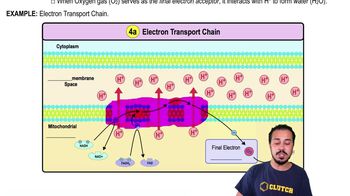
Step 5: Conclude that the reaction producing the most ATP molecules during aerobic metabolism is the one involving acetyl CoA being fully oxidized to CO₂ and H₂O, as this process drives the electron transport chain and oxidative phosphorylation, yielding the highest ATP output.
비슷한 문제에 대한 검증된 영상 답변:
이 영상 해법은 위 문제에 도움이 된다고 튜터들이 추천한 것입니다.
영상 길이:
1m
영상 재생:
0 댓글
주요 개념
질문에 올바르게 답하기 위해 반드시 이해해야 하는 핵심 개념들은 다음과 같습니다.
Aerobic Metabolism and ATP Production
Aerobic metabolism refers to the process by which cells convert glucose and other substrates into energy using oxygen. It involves glycolysis, the Krebs cycle, and oxidative phosphorylation, producing ATP as the main energy currency. Understanding which step yields the most ATP requires knowledge of these pathways and their energy outputs.
Glycolysis is the breakdown of glucose into pyruvic acid, producing a net gain of 2 ATP molecules per glucose. Key reactions include glucose phosphorylation and conversion of phosphoenolpyruvate to pyruvate, with substrate-level phosphorylation generating ATP directly in these steps.
The Krebs cycle oxidizes acetyl CoA to CO₂, generating NADH and FADH₂, which donate electrons to the electron transport chain. This process produces the majority of ATP during aerobic respiration through oxidative phosphorylation, making reactions in the Krebs cycle critical for maximal ATP yield.

 1:57분
1:57분 검증된 단계별 안내
 06:44
06:44