Skip to main content
Microbiology
나의 코스
배우기
시험 준비
AI 튜터
학습 가이드
교과서적 해결책
플래시카드
탐험해 보세요
앱을 사용해 보세요
나의 코스
배우기
시험 준비
AI 튜터
학습 가이드
교과서적 해결책
플래시카드
탐험해 보세요
앱을 사용해 보세요
뒤로
Introduction to Microscopes definitions
카드를 뒤집기 위해 탭할 수 있습니다.
Microscope
카드를 뒤집기 위해 탭할 수 있습니다.
👆
Microscope
An optical instrument enabling visualization of objects too small for the unaided human eye, such as cells and microbes.
진행 상황 추적
컨트롤 버튼이 '내비게이션' 모드로 변경되었습니다.
1/15
관련 플래시카드
관련 실천
추천 영상
Introduction to Microscopes quiz #1
Introduction to Microscopes
40 용어
Introduction to Microscopes quiz #2
Introduction to Microscopes
40 용어
Introduction to Microscopes quiz #3
Introduction to Microscopes
9 용어
Introduction to Microscopes
9. Microscopes
5 문제점
주제
Monica
Magnification, Resolution, & Contrast
9. Microscopes
7 문제점
주제
Nicole
9. Microscopes - Part 1 of 3
6 주제
12 문제점
장
Nicole
9. Microscopes - Part 2 of 3
8 주제
10 문제점
장
Nicole
9. Microscopes - Part 3 of 3
1 주제
3 문제점
장
06:13
Introduction to Microscopes
3736
views
72
rank
1
comments
이 집합의 용어 (15)
하이드의 정의
Microscope
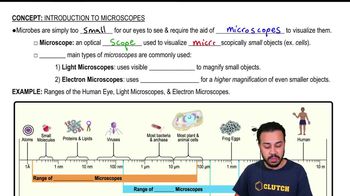
An optical instrument enabling visualization of objects too small for the unaided human eye, such as cells and microbes.
Light Microscope
A device using visible light to magnify and resolve objects like most bacteria, archaea, and animal cells.
Electron Microscope
A complex, high-powered tool employing electrons to reveal structures as small as viruses, proteins, and some atoms.
Magnification
The process by which an instrument increases the apparent size of a tiny object for detailed observation.
Visible Light
The portion of the electromagnetic spectrum utilized by certain microscopes to illuminate and enlarge specimens.
Eukaryotic Cell
A larger cell type characterized by the presence of a nucleus, found in plants and animals.
Prokaryotic Cell
A smaller cell type lacking a nucleus, typical of bacteria and archaea.
Virus
A microscopic infectious agent, much smaller than cells, generally only observable with electron microscopes.
Protein
A macromolecule composed of amino acids, often requiring electron microscopy for visualization due to its small size.
Lipid
A small biological molecule forming cell membranes, typically visible only with advanced electron microscopy.
Atom
The smallest unit of matter, lying beyond the resolution of light microscopes but sometimes detectable with electron microscopes.
Human Eye
A biological organ capable of detecting objects down to a certain size, but unable to resolve most microbes.
Angstrom
A unit of length equal to one ten-billionth of a meter, used to measure extremely small objects like atoms.
Cell
The fundamental structural and functional unit of life, often requiring magnification for observation.
Archaea
A group of prokaryotic microorganisms, generally smaller than eukaryotic cells and visible with light microscopes.
 뒤로뒤로
뒤로뒤로
 06:13
06:13