Skip to main content
Microbiology
나의 코스
배우기
시험 준비
AI 튜터
학습 가이드
교과서적 해결책
플래시카드
탐험해 보세요
앱을 사용해 보세요
나의 코스
배우기
시험 준비
AI 튜터
학습 가이드
교과서적 해결책
플래시카드
탐험해 보세요
앱을 사용해 보세요
뒤로
Introduction to Microscopes quiz #3
카드를 뒤집기 위해 탭할 수 있습니다.
The lens that is within the eyepiece of the light microscope is called the:
카드를 뒤집기 위해 탭할 수 있습니다.
👆
The lens that is within the eyepiece of the light microscope is called the:
It is called the ocular lens.
진행 상황 추적
컨트롤 버튼이 '내비게이션' 모드로 변경되었습니다.
1/9
관련 플래시카드
관련 실천
추천 영상
Introduction to Microscopes quiz #1
Introduction to Microscopes
40 용어
Introduction to Microscopes quiz #2
Introduction to Microscopes
40 용어
Introduction to Microscopes definitions
Introduction to Microscopes
15 용어
Introduction to Microscopes
9. Microscopes
5 문제점
주제
Monica
Magnification, Resolution, & Contrast
9. Microscopes
7 문제점
주제
Nicole
9. Microscopes - Part 1 of 3
6 주제
12 문제점
장
Nicole
9. Microscopes - Part 2 of 3
8 주제
10 문제점
장
Nicole
9. Microscopes - Part 3 of 3
1 주제
3 문제점
장
06:13
Introduction to Microscopes
3736
views
72
rank
1
comments
이 집합의 용어 (9)
하이드의 정의
The lens that is within the eyepiece of the light microscope is called the:
It is called the ocular lens.
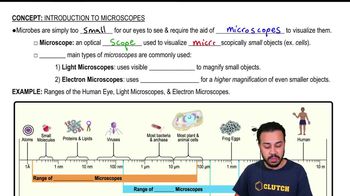
What is the main difference between light microscopes and electron microscopes?
Light microscopes use visible light for magnification, while electron microscopes use electrons for much higher magnification.
Why are microscopes necessary for studying microbes?
Microbes are too small to be seen with the naked eye, so microscopes are needed to visualize them.
Which type of microscope is generally required to see viruses?
Electron microscopes are generally required to see viruses because they are much smaller than bacteria and animal cells.
How do the sizes of eukaryotic cells compare to prokaryotic cells?
Eukaryotic cells are generally larger and contain a nucleus, while prokaryotic cells are smaller and lack a nucleus.
What types of objects can be visualized with a light microscope?
Light microscopes can visualize most bacteria, archaea, and animal cells, but not viruses.
What is the main limitation of the human eye in observing microscopic objects?
The human eye cannot see most plant and animal cells, bacteria, archaea, or viruses due to their small size.
What kinds of molecules can electron microscopes visualize that light microscopes cannot?
Electron microscopes can visualize smaller molecules like proteins, lipids, and even some atoms.
Why are electron microscopes more expensive and complex than light microscopes?
Electron microscopes are more powerful and require advanced technology to use electrons for magnification, making them more expensive and complex.
 뒤로뒤로
뒤로뒤로
 06:13
06:13