Skip to main content
Microbiology
나의 코스
배우기
시험 준비
AI 튜터
학습 가이드
교과서적 해결책
플래시카드
탐험해 보세요
앱을 사용해 보세요
나의 코스
배우기
시험 준비
AI 튜터
학습 가이드
교과서적 해결책
플래시카드
탐험해 보세요
앱을 사용해 보세요
뒤로
Introduction to Water definitions
카드를 뒤집기 위해 탭할 수 있습니다.
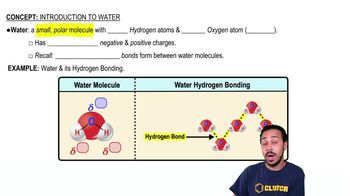
Water
카드를 뒤집기 위해 탭할 수 있습니다.
👆
Water
A small polar molecule with two hydrogens and one oxygen, exhibiting unique properties vital for life due to its structure.
진행 상황 추적
컨트롤 버튼이 '내비게이션' 모드로 변경되었습니다.
1/15
관련 플래시카드
관련 실천
추천 영상
Introduction to Water quiz
Introduction to Water
15 용어
Introduction to Water
4. Water
3 문제점
주제
Nicole
Properties of Water- Cohesion and Adhesion
4. Water
3 문제점
주제
Monica
4. Water
7 주제
14 문제점
장
Nicole
01:54
Introduction to Water
23589
views
474
rank
01:51
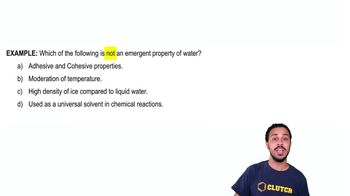
Introduction to Water Example 1
17350
views
271
rank
01:29
Introduction to Water
20525
views
347
rank
이 집합의 용어 (15)
하이드의 정의
Water
A small polar molecule with two hydrogens and one oxygen, exhibiting unique properties vital for life due to its structure.
H2O
The chemical formula representing a molecule composed of two hydrogen atoms and one oxygen atom.
Polar Molecule
A molecule with uneven charge distribution, resulting in partial positive and negative regions.
Polar Covalent Bond
A type of chemical linkage where electrons are shared unequally, creating partial charges within a molecule.
Partial Negative Charge
A region in a molecule, often around oxygen in water, where electrons are more concentrated.
Partial Positive Charge
A region in a molecule, typically around hydrogen in water, where electrons are less concentrated.
Hydrogen Bond
A weak attraction between the partial positive hydrogen of one molecule and the partial negative atom of another.
Cohesion
The tendency of like molecules, such as water, to stick together due to intermolecular attractions.
Adhesion
The attraction between water molecules and different substances, contributing to various biological processes.
Surface Tension
A phenomenon where the surface of a liquid resists external force, resulting from cohesive interactions.
Low Density in Solid Form
A property where the solid state, such as ice, is less dense than the liquid state, causing it to float.
Specific Heat
The amount of energy required to raise the temperature of a substance, unusually high in water.
Heat of Vaporization
The energy needed to convert a liquid into a gas, which is notably high for water.
Universal Solvent
A substance capable of dissolving a wide variety of solutes, a role fulfilled by water in biological systems.
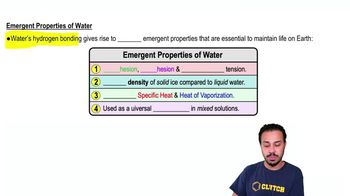
Emergent Properties
Unique characteristics arising from molecular interactions, making water essential for sustaining life.
 뒤로뒤로
뒤로뒤로
 01:54
01:54