Skip to main content
Microbiology
나의 코스
배우기
시험 준비
AI 튜터
학습 가이드
교과서적 해결책
플래시카드
탐험해 보세요
앱을 사용해 보세요
나의 코스
배우기
시험 준비
AI 튜터
학습 가이드
교과서적 해결책
플래시카드
탐험해 보세요
앱을 사용해 보세요
뒤로
Introduction to Water quiz
카드를 뒤집기 위해 탭할 수 있습니다.
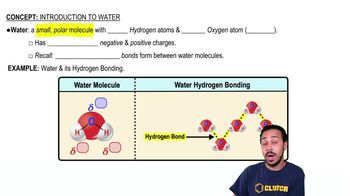
What is the chemical formula for water?
카드를 뒤집기 위해 탭할 수 있습니다.
👆
What is the chemical formula for water?
The chemical formula for water is H2O, which means it has two hydrogen atoms and one oxygen atom.
진행 상황 추적
컨트롤 버튼이 '내비게이션' 모드로 변경되었습니다.
1/15
관련 플래시카드
관련 실천
추천 영상
Introduction to Water definitions
Introduction to Water
15 용어
Introduction to Water
4. Water
3 문제점
주제
Nicole
Properties of Water- Cohesion and Adhesion
4. Water
3 문제점
주제
Monica
4. Water
7 주제
14 문제점
장
Nicole
01:54
Introduction to Water
23544
views
473
rank
01:51
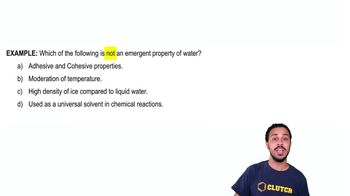
Introduction to Water Example 1
17312
views
270
rank
01:29
Introduction to Water
20483
views
346
rank
이 집합의 용어 (15)
하이드의 정의
What is the chemical formula for water?
The chemical formula for water is H2O, which means it has two hydrogen atoms and one oxygen atom.
What type of bonds are found within a water molecule?
Water molecules contain polar covalent bonds between the hydrogen and oxygen atoms.
Why is water considered a polar molecule?
Water is polar because it has partial negative and partial positive charges due to unequal sharing of electrons between oxygen and hydrogen.
Which atom in a water molecule carries a partial negative charge?
The oxygen atom in a water molecule carries a partial negative charge.
What charge do the hydrogen atoms in water have?
The hydrogen atoms in water have partial positive charges.
What type of bond forms between different water molecules?
Hydrogen bonds form between different water molecules.
What enables water molecules to form hydrogen bonds with each other?
The partial positive and negative charges on water molecules enable them to form hydrogen bonds.
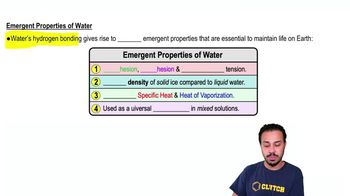
How many emergent properties of water are there that are essential for life?
There are four emergent properties of water that are essential for sustaining life on Earth.
What is the first emergent property of water mentioned in the lesson?
The first emergent property is water's ability to perform cohesion, adhesion, and to have surface tension.
How does water's density in solid form compare to its liquid form?
Water has a lower density in its solid (ice) form compared to its liquid form.
What is meant by water's high specific heat?
Water's high specific heat means it can absorb or release a large amount of heat with only a slight change in its own temperature.
What is the significance of water's high heat of vaporization?
Water's high heat of vaporization means it requires a lot of energy to change from liquid to gas, which helps regulate temperature.
Why is water called a universal solvent?
Water is called a universal solvent because it can dissolve many different substances, making it vital for biological processes.
What property allows water to stick to other substances?
Adhesion allows water to stick to other substances.
What property allows water molecules to stick to each other?
Cohesion allows water molecules to stick to each other.
 뒤로뒤로
뒤로뒤로
 01:54
01:54