 뒤로
뒤로Atomic Spectra, Quantum Numbers, and Electron Configuration Study Guide
스터디 가이드 - 스마트 노트
 자료에 맞춘 맞춤형 노트, 핵심 정의, 예시, 맥락을 확장해 제공합니다.
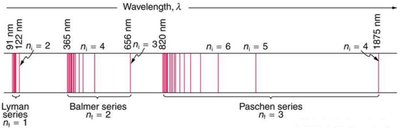
Q1. Ramalkan panjang gelombang (nm) garis emisi pada deret Balmer dengan tingkat energi asal, n2 = 6
Background
Topic: Atomic Spectra and Quantum Transitions
This question tests your understanding of the Balmer series in the hydrogen atom, which involves electron transitions from higher energy levels (n2) to n1 = 2, resulting in visible light emission.
Key Terms and Formulas
Balmer series: Transitions where electrons fall to n1 = 2.
Rydberg formula for wavelength:
Rydberg constant ():
n1 = 2 (Balmer series), n2 = 6 (given)
Step-by-Step Guidance
Identify the quantum numbers: , .
Write the Rydberg formula for the wavelength of the emitted photon: .
Substitute the values for and into the formula: .
Calculate the numerical values inside the parentheses: .
Multiply the result by the Rydberg constant to find .
Try solving on your own before revealing the answer!
Final Answer: 410 nm
Using the Rydberg formula and substituting the values:
This is the wavelength of the emission line in the Balmer series for n2 = 6.
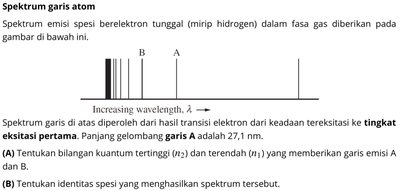
Q2. Spektrum garis atom: Tentukan bilangan kuantum tertinggi (n2) dan terendah (n1) yang memberikan garis emisi A dan B. Tentukan identitas spesies yang menghasilkan spektrum tersebut.
Background
Topic: Atomic Line Spectra and Quantum Numbers
This question tests your ability to interpret atomic emission spectra and relate them to quantum transitions, as well as to identify the atomic species based on the observed spectral lines.
Key Terms and Formulas
Quantum numbers: (lower energy level), (higher energy level)
Rydberg formula:
Atomic emission spectrum: Lines correspond to electron transitions between energy levels.
Step-by-Step Guidance
Observe the given wavelength for line A: .
Use the Rydberg formula to relate the wavelength to quantum numbers and .
Set up the equation: .
Consider that the transition is from the first excited state (highest ) to a lower .
Use the periodic table and the context (single electron species) to hypothesize the atomic species (likely hydrogen-like ions).
Try solving on your own before revealing the answer!
Final Answer:
(A) For line A, , (transition from second to first energy level). For line B, , $ n_1 = 1 $ (transition from third to first energy level).
(B) The species is a hydrogen-like ion, most likely He+ or Li2+, based on the short wavelength and the context of single electron transitions.
