 뒤로
뒤로Biomolecules: Structure, Types, and Functions
스터디 가이드 - 스마트 노트
 자료에 맞춘 맞춤형 노트, 핵심 정의, 예시, 맥락을 확장해 제공합니다.
Biochemistry Basics
Major Classes of Biomolecules
Biomolecules are essential organic molecules found in all living organisms. They play critical roles in structure, function, and regulation of the body’s cells, tissues, and organs. The four major classes of biomolecules are carbohydrates, nucleic acids, proteins, and lipids.
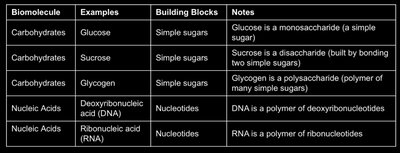
Carbohydrates
Definition: Organic molecules composed of carbon, hydrogen, and oxygen, typically with a hydrogen:oxygen atom ratio of 2:1.
Building Blocks: Simple sugars (monosaccharides).
Examples:
Glucose: A monosaccharide (simple sugar) that serves as a primary energy source.
Sucrose: A disaccharide formed by bonding two monosaccharides (glucose and fructose).
Glycogen: A polysaccharide (polymer of many simple sugars) used for energy storage in animals and some microbes.
Nucleic Acids
Definition: Polymers made of nucleotide monomers, responsible for storing and transmitting genetic information.
Building Blocks: Nucleotides (composed of a sugar, phosphate group, and nitrogenous base).
Examples:
Deoxyribonucleic acid (DNA): A polymer of deoxyribonucleotides; stores genetic information.
Ribonucleic acid (RNA): A polymer of ribonucleotides; involved in protein synthesis and gene regulation.
Proteins
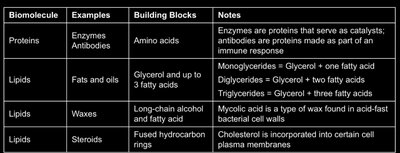
Definition: Polymers of amino acids that perform a wide variety of cellular functions, including catalysis, structure, and regulation.
Building Blocks: Amino acids.
Examples:
Enzymes: Proteins that act as biological catalysts, speeding up chemical reactions.
Antibodies: Proteins produced by the immune system to identify and neutralize foreign objects.
Lipids
Definition: Hydrophobic or amphipathic molecules, primarily composed of carbon and hydrogen, with diverse structures and functions.
Building Blocks: Glycerol and fatty acids (for fats and oils), long-chain alcohols, and fused hydrocarbon rings (for steroids).
Examples:
Fats and oils: Energy storage molecules; can be mono-, di-, or triglycerides depending on the number of fatty acids attached to glycerol.
Waxes: Composed of long-chain alcohols and fatty acids; e.g., mycolic acid in acid-fast bacterial cell walls.
Steroids: Characterized by fused hydrocarbon rings; e.g., cholesterol, which is incorporated into cell membranes.
Summary Table: Major Biomolecules
Biomolecule | Examples | Building Blocks | Notes |
|---|---|---|---|
Carbohydrates | Glucose, Sucrose, Glycogen | Simple sugars | Monosaccharides, disaccharides, and polysaccharides; energy storage and structure |
Nucleic Acids | DNA, RNA | Nucleotides | Genetic information storage and transfer |
Proteins | Enzymes, Antibodies | Amino acids | Catalysis, structure, immune response |
Lipids | Fats, Oils, Waxes, Steroids | Glycerol, fatty acids, long-chain alcohols, hydrocarbon rings | Energy storage, membrane structure, signaling |
Additional info: Understanding the structure and function of biomolecules is foundational for studying microbial metabolism, genetics, and cell structure in microbiology.
