 뒤로
뒤로Chemical Principles in Microbiology: Atoms, Bonds, and Biological Molecules
스터디 가이드 - 스마트 노트
 자료에 맞춘 맞춤형 노트, 핵심 정의, 예시, 맥락을 확장해 제공합니다.
Ch. 2 – Chemical Principles
The Structure of an Atom
Chemistry is fundamental to understanding microbiology, as all living things are composed of atoms and molecules. Atoms are the smallest units of matter that retain the properties of an element. Matter is anything that has mass and occupies space. Atoms interact to form molecules, which are essential for cellular structure and function.
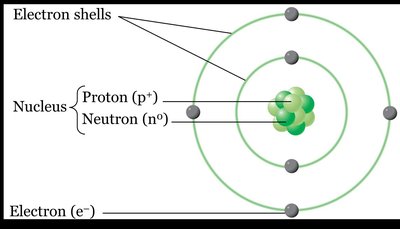
Atoms are composed of three subatomic particles: protons (positively charged), neutrons (uncharged), and electrons (negatively charged).
Protons and neutrons are located in the nucleus, while electrons move around the nucleus in electron shells.
Chemical Elements and the Periodic Table
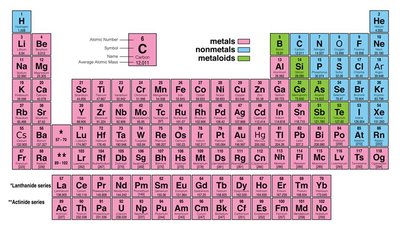
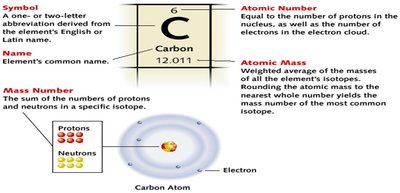
Atoms with the same number of protons are classified as the same chemical element. The atomic number is the number of protons in the nucleus, which determines the element's identity. The periodic table organizes all known elements by their atomic number and properties.
There are 118 elements, with 96 occurring naturally. About 26 are found in living organisms.
Electron Configuration
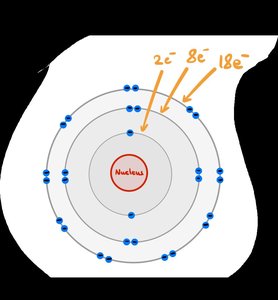
Electrons are arranged in electron shells around the nucleus, corresponding to different energy levels. The arrangement of electrons is called the electron configuration. The innermost shell has the lowest energy level and can hold up to 2 electrons, the next up to 8, and so on.
How Atoms Form Molecules: Chemical Bonds
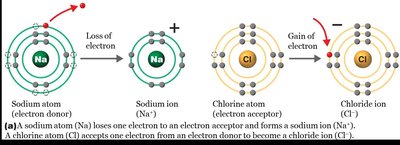
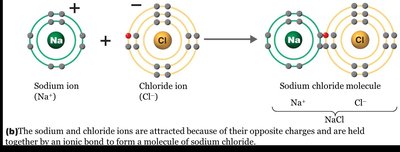
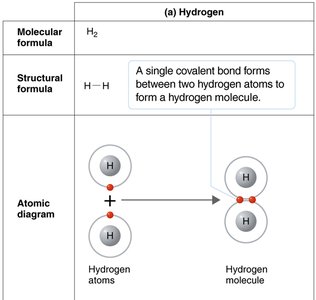
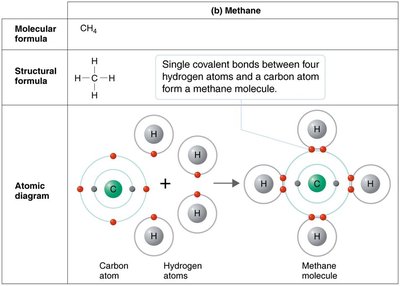
Atoms form molecules by combining to fill their outermost electron shells. The number of missing or extra electrons in the outermost shell is called the valence. Atoms achieve stability by forming chemical bonds through the interaction of valence electrons.
Ionic bonds: Formed when electrons are transferred from one atom to another, resulting in charged ions (cations and anions) that attract each other.
Covalent bonds: Formed when two atoms share one or more pairs of electrons. These are stronger and more common in biological molecules.
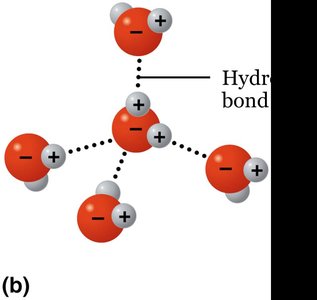
Hydrogen bonds: Weak attractions between a hydrogen atom covalently bonded to an electronegative atom (like O or N) and another electronegative atom.
Types of Chemical Reactions
Chemical reactions are essential for life and can be classified into three main types:
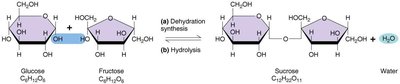
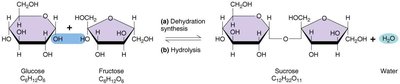
Synthesis (Combination) Reactions: Atoms or molecules combine to form larger, more complex molecules. These are important in anabolic (building) processes. Example: dehydration synthesis joins two monomers by removing water.
Decomposition Reactions: A molecule is broken down into smaller molecules or atoms. These are catabolic (bond-breaking) reactions. Example: hydrolysis adds water to break a large molecule.
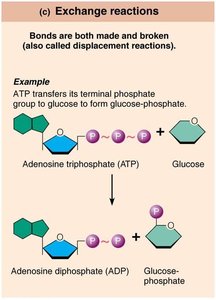
Exchange (Displacement) Reactions: Involve both synthesis and decomposition; bonds are both made and broken.
Redox Reactions
Reduction-oxidation (redox) reactions are crucial in biological systems. In these reactions, electrons are transferred between atoms:
An atom is oxidized when it loses electrons.
An atom is reduced when it gains electrons.
Redox reactions are essential for energy transfer in cells, such as during cellular respiration.
Important Biological Molecules
Biological molecules are classified as inorganic (typically lack carbon, small and simple, e.g., water) or organic (contain carbon and are structurally complex). Organic molecules have a carbon skeleton that can be straight, branched, or ring-shaped.
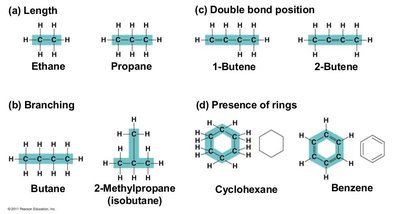
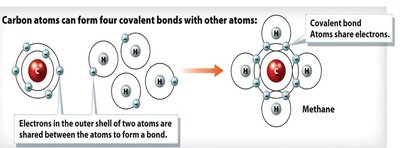
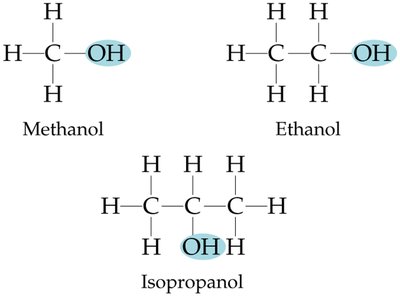
Functional Groups in Organic Molecules
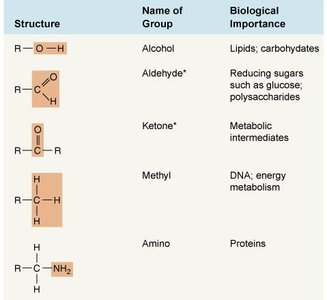
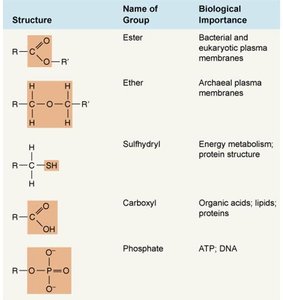
Functional groups are specific groups of atoms attached to carbon skeletons that determine the chemical properties of organic molecules. The letter R is used to represent the rest of the molecule.
Structure | Name of Group | Biological Importance |
|---|---|---|
R-OH | Alcohol | Lipids; carbohydrates |
R-CHO | Aldehyde | Reducing sugars; polysaccharides |
R-CO | Ketone | Metabolic intermediates |
R-CH3 | Methyl | DNA; energy metabolism |
R-NH2 | Amino | Proteins |
Structure | Name of Group | Biological Importance |
|---|---|---|
R-COO-R' | Ester | Bacterial and eukaryotic plasma membranes |
R-O-R' | Ether | Archaeal plasma membranes |
R-SH | Sulfhydryl | Energy metabolism; protein structure |
R-COOH | Carboxyl | Organic acids; lipids; proteins |
R-PO4 | Phosphate | ATP; DNA |

Macromolecules: Carbohydrates, Lipids, Proteins, and Nucleic Acids
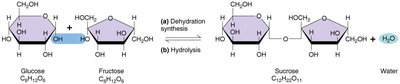
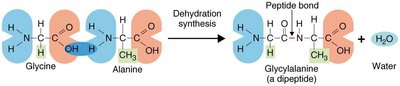
Small organic molecules can combine to form macromolecules, which are usually polymers made of repeating units called monomers. The joining of monomers often involves dehydration synthesis (removal of water), while breakdown involves hydrolysis (addition of water).
Carbohydrates
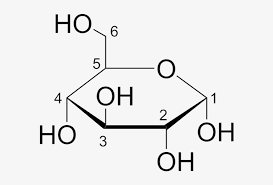
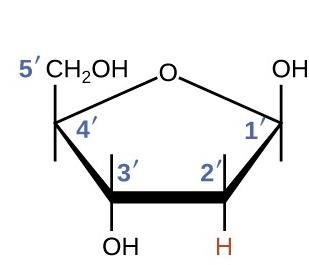
Carbohydrates serve as cell structures and energy sources. They include sugars and starches, composed of carbon, hydrogen, and oxygen (often with the formula CnH2nOn). Many carbohydrates are isomers—molecules with the same formula but different structures.
Monosaccharides: Simple sugars with 3–7 carbon atoms (e.g., glucose, deoxyribose).
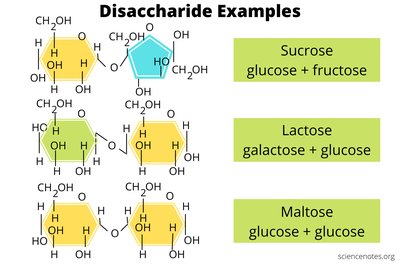
Disaccharides: Formed by joining two monosaccharides via dehydration synthesis; can be broken down by hydrolysis (e.g., sucrose, lactose, maltose).
Polysaccharides: Large molecules made of many monosaccharides (e.g., starch, glycogen, cellulose).
Lipids
Lipids are primary components of cell membranes, consisting of carbon, hydrogen, and oxygen. They are nonpolar and insoluble in water. Lipids are divided into:
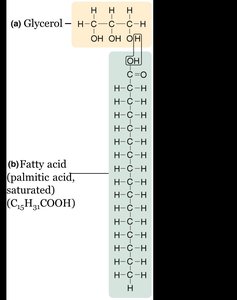
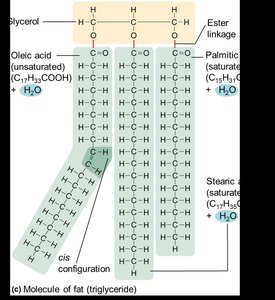
Simple lipids (fats or triglycerides): Made of glycerol and fatty acids; can be saturated (no double bonds) or unsaturated (one or more double bonds).
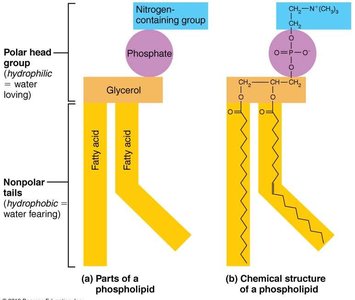
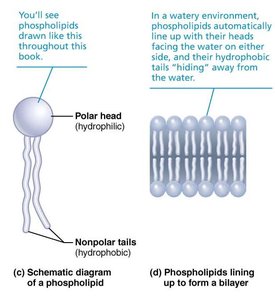
Complex lipids: Contain additional elements such as phosphorus, nitrogen, or sulfur. Phospholipids are complex lipids essential for cell membrane structure, with hydrophilic heads and hydrophobic tails.
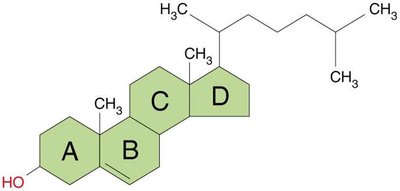
Steroids: Structurally different from other lipids; sterols (e.g., cholesterol) are important for membrane fluidity.
Proteins
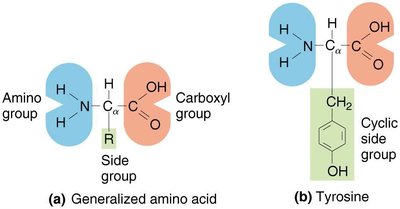
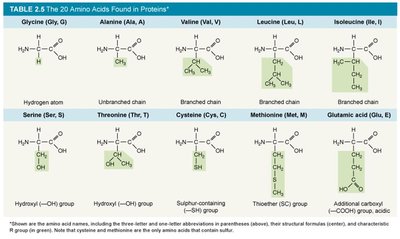
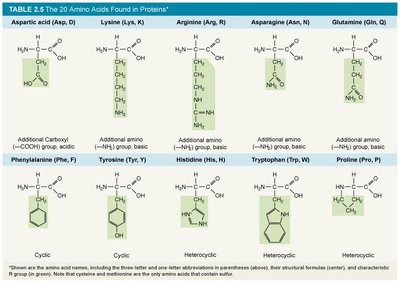
Proteins are made of carbon, hydrogen, oxygen, nitrogen, and sometimes sulfur. They are essential for cell structure and function, acting as enzymes, transporters, and structural components. Proteins are polymers of amino acids, which have a central (alpha) carbon, an amino group, a carboxyl group, and a side group (R group).
Peptide bonds link amino acids via dehydration synthesis.
Protein structure has four levels: primary (amino acid sequence), secondary (helix or sheet), tertiary (3D folding), and quaternary (multiple polypeptides).
Denaturation is the loss of protein structure and function due to environmental changes.
Conjugated proteins contain amino acids plus other organic molecules (e.g., glycoproteins, nucleoproteins).
Nucleic Acids
Nucleic acids (DNA and RNA) are polymers of nucleotides, each consisting of a five-carbon sugar, a phosphate group, and a nitrogenous base. Nucleosides are similar but lack the phosphate group.
DNA (deoxyribonucleic acid): Double helix, contains deoxyribose, bases pair as A-T and C-G, stores genetic information.
RNA (ribonucleic acid): Single-stranded, contains ribose, bases pair as A-U and C-G, involved in protein synthesis.
Adenosine Triphosphate (ATP)
ATP is the primary energy carrier in cells, composed of ribose, adenine, and three phosphate groups. It stores energy released by chemical reactions and releases energy by hydrolysis of phosphate bonds.
*Additional info: The chemical principles outlined here are foundational for understanding microbial metabolism, genetics, and cellular structure, which are explored in later chapters of microbiology.*
