 뒤로
뒤로Controlling Microbial Growth in the Environment: Physical and Chemical Methods
스터디 가이드 - 스마트 노트
 자료에 맞춘 맞춤형 노트, 핵심 정의, 예시, 맥락을 확장해 제공합니다.
Controlling Microbial Growth in the Environment
Introduction
The control of microbial growth is a fundamental aspect of microbiology, especially in healthcare, laboratory, and domestic settings. Understanding the terminology, principles, and methods used to control microorganisms and viruses is essential for ensuring safety and preventing infection.
Terminology of Microbial Control
Key Terms and Definitions
Antisepsis: Use of chemical agents on skin or tissue to inhibit or destroy microorganisms.
Antiseptic: Chemical used for antisepsis.
Aseptic: Environment or procedure free of contamination.
Aseptic technique: Procedures used to avoid contamination.
Cide/cidal: Suffix indicating agents that destroy or permanently inactivate a particular type of microbe (e.g., bactericide, fungicide).
Disinfection: Use of physical or chemical agents to inhibit or destroy microorganisms, especially pathogens; does not guarantee elimination of all pathogens.
Disinfectant: Agents such as UV light, heat, alcohol, and bleach used for disinfection on inanimate objects.
Degerming: Removal of microbes from a surface by scrubbing; the action is often more important than the chemical used.
Pasteurization: Use of heat to kill pathogens and reduce spoilage microorganisms in food and beverages.
Sanitization: Disinfecting places and utensils used by the public to reduce pathogenic microbes to accepted public health standards.
Stasis/static: Suffix indicating inhibition of microbial metabolism and growth, but not necessarily killing.
Sterilization: Removal or destruction of all microbes, including viruses and bacterial endospores, but not prions.
Basic Principles of Microbial Control
Mechanisms of Action
Alteration of Cell Walls and Membranes: Damaging the cell wall compromises cell integrity, leading to cell lysis. Disruption of cytoplasmic membranes causes leakage of cellular contents and cell death. In viruses, damage to the envelope prevents attachment and replication.
Damage to Proteins and Nucleic Acids: Denaturation of proteins (loss of 3-D structure) results in loss of function and cell death. Chemicals, radiation, and heat can also alter or destroy nucleic acids, causing fatal mutations or halting protein synthesis.
The Selection of Microbial Control Methods
Factors Affecting Efficacy
Site to be Treated: The method depends on whether the site is human, animal, or object. Harsh chemicals and heat are unsuitable for living tissues.
Relative Susceptibility of Microorganisms: Some microbes are more susceptible than others. For example, enveloped viruses are more easily inactivated than non-enveloped viruses.
Germicide Classifications:
High-level germicides: Kill all pathogens, including endospores; used for invasive instruments.
Intermediate-level germicides: Kill fungal spores, protozoan cysts, viruses, and pathogenic bacteria; used for mucous membrane contact.
Low-level germicides: Kill vegetative bacteria, fungi, protozoa, and some viruses; used for skin contact.
Environmental Conditions: Temperature, pH, and presence of organic materials affect efficacy. Organic matter should be removed before sterilization or disinfection.
Biosafety Levels: CDC established four biosafety levels (BSL-1 to BSL-4) for laboratory safety, ranging from handling non-pathogenic microbes to highly dangerous pathogens.
Physical Methods of Microbial Control
Heat-Related Methods
Heat is a common method for controlling microbial growth, acting by denaturing proteins, disrupting membranes, and damaging nucleic acids. Microorganisms vary in their susceptibility to heat, which is measured by:
Thermal death point: Lowest temperature that kills all cells in 10 minutes.
Thermal death time: Time to sterilize a volume of liquid at a set temperature.
Decimal reduction time (D value): Time required to destroy 90% of microbes in a sample.
Moist Heat Methods
Boiling: Kills vegetative cells and most viruses within 10 minutes, but not endospores.
Autoclaving: Uses pressurized steam (121ºC, 15 psi, 15 min) for true sterilization.
Pasteurization: Kills spoilage organisms without affecting taste; not sterilization. Methods include batch (63ºC, 30 min), flash (72ºC, 15 sec), and ultra-high-temperature (135ºC, 1 sec).
Ultra-high-temperature sterilization: Flash heating liquids at 140ºC for 1–3 sec, allowing indefinite storage at room temperature.
Dry Heat Methods
Dry heat: Used for materials that cannot be sterilized with moist heat; requires higher temperatures and longer times (e.g., 121ºC for 16 hours).
Incineration: Complete destruction of microbes; ultimate sterilization method.
Other Physical Methods
Refrigeration and Freezing: Decrease microbial metabolism and growth; slow freezing is more effective than quick freezing.
Desiccation and Lyophilization: Drying inhibits growth; lyophilization (freeze-drying) preserves cultures long-term.
Filtration: Physically separates microbes from fluids using filters; pore size determines effectiveness. HEPA filters are used in masks and air purification.
Osmotic Pressure: High salt or sugar concentrations inhibit microbial growth by causing cells to lose water. Fungi are more resistant than bacteria.
Radiation: Includes ionizing (electron beams, gamma rays, X rays) and nonionizing (UV light) radiation. Ionizing radiation creates ions that damage DNA; nonionizing radiation forms covalent bonds and disrupts DNA.
Chemical Methods of Microbial Control
Overview
Chemical agents affect cell walls, membranes, proteins, or DNA. Their effectiveness depends on temperature, exposure time, organic material, pH, concentration, and freshness. They are often more effective against enveloped viruses and vegetative cells.
Types of Chemical Agents
Phenol and Phenolics: Denature proteins and disrupt membranes; effective in presence of organic matter; used in healthcare and homes.
Alcohols: Denature proteins and disrupt membranes; intermediate-level disinfectant; effective against enveloped viruses, not spores.
Halogens: Damage proteins by denaturation; include iodine, chlorine, bromine, and fluorine; used in water purification and antiseptics.
Oxidizing Agents: Kill by oxidation of microbial enzymes; high-level disinfectants; include hydrogen peroxide, ozone, and peracetic acid.
Surfactants: Reduce surface tension and disrupt membranes; soaps are degerming agents, detergents are low-level antiseptics.
Heavy Metals: Denature proteins; low-level bacteriostatic and fungistatic agents; include silver, mercury, copper.
Aldehydes: Cross-link functional groups to denature proteins and inactivate nucleic acids; high-level disinfectants; include glutaraldehyde and formaldehyde.
Gaseous Agents: Sterilize heat- and water-sensitive items; denature proteins and DNA; include ethylene oxide; hazardous to users.
Enzymes: Act against microorganisms; lysozyme digests bacterial cell walls; prionzyme removes prions from instruments.
Antimicrobials: Drugs and antibiotics; discussed in detail in Chapter 10.
Development of Resistant Microbes
Concerns
Overuse of antiseptic and disinfectant products may promote the development of resistant microbes.
There is little evidence that such products significantly improve human or animal health.
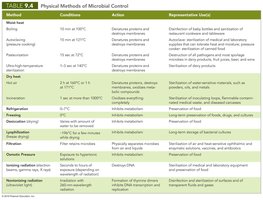
Summary Table: Physical Methods of Microbial Control
The following table summarizes the main physical methods, their conditions, actions, and representative uses:
Method | Conditions | Action | Representative Uses |
|---|---|---|---|
Boiling | 10 min at 100ºC | Denatures proteins, destroys membranes | Disinfection of baby bottles, sanitization of restaurant cookware |
Autoclaving | 121ºC, 15 psi, 15 min | Denatures proteins, destroys membranes | Sterilization of medical and laboratory supplies |
Pasteurization | Varies: 63ºC for 30 min, 72ºC for 15 sec, 135ºC for 1 sec | Denatures proteins, destroys membranes | Pasteurization of milk, fruit juices, beer, wine |
Dry heat | 2 hr at 160ºC or 1 hr at 171ºC | Denatures proteins, oxidizes chemicals | Sterilization of water-sensitive materials, powders, oils |
Refrigeration | 4ºC | Inhibits metabolism | Preservation of food |
Freezing | -20ºC | Inhibits metabolism | Long-term preservation of food, drugs, cultures |
Lyophilization | -196ºC | Inhibits metabolism | Long-term storage of bacterial cultures |
Filtration | Varies by pore size | Physically separates microbes | Sterilization of air, heat-sensitive solutions |
Osmotic Pressure | High salt or sugar | Inhibits metabolism | Preservation of food (jams, jellies, salted fish) |
Radiation | Ionizing: < 1 nm; Nonionizing: > 1 nm | Destroys DNA | Sterilization of medical and laboratory equipment |
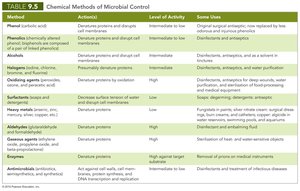
Summary Table: Chemical Methods of Microbial Control
The following table summarizes the main chemical methods, their actions, level of activity, and uses:
Method | Action(s) | Level of Activity | Some Uses |
|---|---|---|---|
Phenol | Denatures proteins, disrupts cell membranes | Intermediate to low | Original surgical antiseptic, now replaced by newer agents |
Alcohols | Denature proteins, disrupt cell membranes | Intermediate | Disinfectants, antiseptics, water purification |
Halogens | Denature proteins | Intermediate | Disinfectants, antiseptics, water purification |
Oxidizing agents | Denature proteins by oxidation | High | Disinfectants, antiseptics for deep wounds, water purification, sterilization of food processing and medical equipment |
Surfactants | Reduce surface tension, disrupt membranes | Low | Soaps and detergents, degerming agents |
Heavy metals | Denature proteins | Low | Fungistats in paints, silver nitrate for newborns, surgical dressings |
Aldehydes | Denature proteins | High | Sterilization of heat- and water-sensitive objects |
Gaseous agents | Denature proteins | High | Sterilization of heat- and water-sensitive objects |
Enzymes | Denature proteins | High target specificity | Removal of prions on medical instruments |
Antimicrobials | Act against cell walls, membranes, proteins, DNA | Varies | Disinfectants and treatment of infectious diseases |
