 뒤로
뒤로Fundamentals of the Nervous System and Nervous Tissue: Structured Study Notes
스터디 가이드 - 스마트 노트
 자료에 맞춘 맞춤형 노트, 핵심 정의, 예시, 맥락을 확장해 제공합니다.
Fundamentals of the Nervous System
Functions of the Nervous System
The nervous system is the primary controlling and communicating system of the body. It enables rapid and specific communication between cells through electrical and chemical signals, resulting in almost immediate responses.
Sensory Input: Information is gathered by sensory receptors from both internal and external environments.
Integration: The nervous system processes and interprets sensory input, making decisions based on this information.
Motor Output: Activation of effector organs (muscles and glands) produces a response.
Divisions of the Nervous System
The nervous system is divided into two principal parts:
Central Nervous System (CNS): Composed of the brain and spinal cord. It serves as the integration and control center, interpreting sensory input and dictating motor output.
Peripheral Nervous System (PNS): Consists of cranial nerves, spinal nerves, and ganglia. It connects the CNS to the rest of the body.
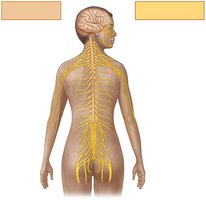
Functional Divisions of the PNS
The PNS is further divided into functional divisions:
Sensory (Afferent) Division:
Somatic sensory fibers: Convey impulses from skin, skeletal muscles, and joints to the CNS.
Visceral sensory fibers: Convey impulses from visceral organs to the CNS.
Motor (Efferent) Division:
Somatic Nervous System (SNS): Conducts impulses from the CNS to skeletal muscle (voluntary control).
Autonomic Nervous System (ANS): Regulates smooth muscle, cardiac muscle, and glands (involuntary control). The ANS is subdivided into:
Sympathetic Division: Mobilizes body systems during activity.
Parasympathetic Division: Conserves energy and promotes housekeeping functions during rest.
Nervous Tissue Cells
Principal Cell Types
Nervous tissue consists of two main cell types:
Neuroglia (Glial Cells): Small cells that support, protect, and insulate neurons.
Neurons (Nerve Cells): Excitable cells that transmit electrical signals.
Neuroglia of the CNS
Astrocytes: Most abundant; support and brace neurons, anchor them to nutrient supply lines.
Microglial Cells: Monitor neuron health, migrate toward injured cells, and transform into macrophages for defense.
Ependymal Cells: Line central cavities of the brain and spinal cord; form a permeable barrier between cerebrospinal fluid and tissue fluid.
Oligodendrocytes: Form insulating myelin sheaths around CNS nerve fibers.
Neuroglia of the PNS
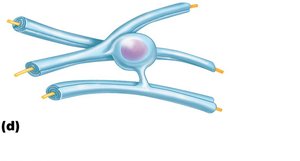
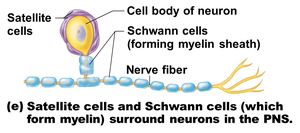
Satellite Cells: Surround neuron cell bodies in the PNS; function similar to astrocytes.
Schwann Cells: Surround all peripheral nerve fibers and form myelin sheaths in thicker nerve fibers; function similar to oligodendrocytes.
Neurons: Structure and Function
Neuron Structure
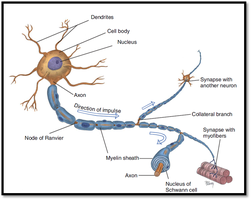
Neurons are the structural units of the nervous system. They are large, highly specialized cells that conduct messages in the form of impulses. Each neuron consists of a cell body and one or more processes.
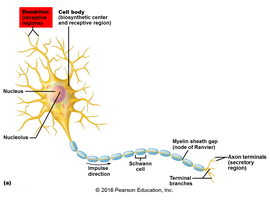
Cell Body (Soma or Perikaryon): Contains the nucleus and nucleolus. Clusters in CNS are called nuclei; clusters in PNS are called ganglia.
Processes: Armlike extensions from the cell body. CNS contains both cell bodies and processes; PNS contains mainly processes.
Bundles of Processes: In CNS, called tracts; in PNS, called nerves.
Dendrites and Axons
Dendrites: Short, tapering, and highly branched processes. They are the main receptive (input) region of the neuron, conveying incoming messages toward the cell body as graded potentials.
Axon: Each neuron has one axon, which may be long (nerve fiber), short, or absent. Axons transmit impulses away from the cell body. Axon terminals release neurotransmitters into the extracellular space, which can excite or inhibit other neurons.
Myelin Sheath
Myelinated Fibers: Conduct impulses rapidly due to the presence of a myelin sheath.
Nonmyelinated Fibers: Conduct impulses more slowly.
Myelination in the PNS: Myelin sheath is formed by Schwann cells, wrapping around the axon. Gaps between Schwann cells are called nodes of Ranvier.
Myelination in the CNS: Myelin sheath is formed by oligodendrocytes, which can wrap multiple axons. White matter consists of myelinated fibers; gray matter consists of neuron cell bodies and nonmyelinated fibers.
Classification of Neurons
Structural Classification
Neurons are classified based on the number of processes:
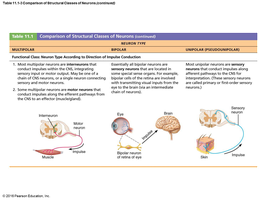
Multipolar: Three or more processes (one axon, two or more dendrites). Most common; major neuron type in CNS.
Bipolar: Two processes (one axon, one dendrite). Rare; found in retina and olfactory mucosa.
Unipolar: One T-like process; found mainly in PNS (dorsal root ganglia and sensory ganglia).
Functional Classification
Neurons are also classified by the direction of impulse conduction:
Sensory (Afferent) Neurons: Transmit impulses from sensory receptors toward the CNS. Almost all are unipolar; cell bodies located in PNS ganglia.
Motor (Efferent) Neurons: Carry impulses from CNS to effectors. Multipolar; most cell bodies located in CNS.
Interneurons (Association Neurons): Lie between motor and sensory neurons, shuttling signals through CNS pathways. Most are multipolar and entirely within CNS; constitute 99% of body’s neurons.
Neuron Type | Structural Features | Functional Role |
|---|---|---|
Multipolar | Three or more processes | Motor neurons, interneurons |
Bipolar | Two processes | Sensory neurons (retina, olfactory) |
Unipolar | One T-like process | Sensory neurons (PNS) |
Key Terms
Neuron: Excitable cell that transmits electrical signals.
Neuroglia: Supporting cells in nervous tissue.
Myelin Sheath: Insulating layer around axons.
Node of Ranvier: Gap in myelin sheath.
Ganglia: Clusters of neuron cell bodies in PNS.
Nuclei: Clusters of neuron cell bodies in CNS.
