 뒤로
뒤로MCB 2010 Final Exam Review: Microbiology Study Guidance
스터디 가이드 - 스마트 노트
 자료에 맞춘 맞춤형 노트, 핵심 정의, 예시, 맥락을 확장해 제공합니다.
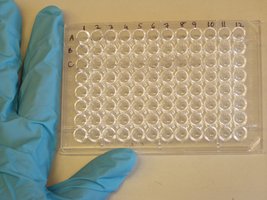
Q1. What is pictured in the image below?
Background
Topic: Laboratory Techniques – ELISA (Enzyme-Linked Immunosorbent Assay)
This question tests your ability to recognize and interpret common laboratory equipment used in microbiology, specifically for immunological assays.
Key Terms:
ELISA plate: A flat plate with multiple wells used for enzyme-linked immunosorbent assays.
Wells: Small circular depressions where samples and reagents are added.
Immunoassay: A test that uses antibodies and color change to identify a substance.
Step-by-Step Guidance
Observe the structure: The plate has multiple wells arranged in rows and columns, which is typical for ELISA plates.
Consider the context: ELISA plates are used to detect the presence of antigens or antibodies in samples.
Think about the labeling: Rows and columns are often labeled for sample identification and controls.
Recall the purpose: ELISA plates are used in diagnostic tests for infections, immune responses, and more.
Try solving on your own before revealing the answer!
Final Answer:
The image shows an ELISA plate, which is used in the laboratory for enzyme-linked immunosorbent assays. Each well can be used to test a different sample or control for the presence of specific antigens or antibodies. This plate is a standard tool in microbiology for diagnostic and research purposes.
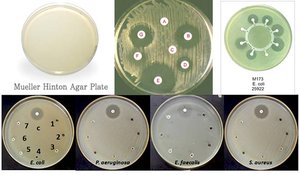
Q2. A Mueller-Hinton agar plate was inoculated with a lawn of Escherichia coli. Antibiotic (antimicrobial) disks were then placed on top of the agar media. Plates were incubated at 37°C for 24 hrs. The E. coli would be considered resistant to which antibiotic?
Background
Topic: Antibiotic Susceptibility Testing – Kirby Bauer Disk Diffusion Method
This question tests your understanding of how to interpret results from the Kirby Bauer method, which is used to determine bacterial resistance or susceptibility to antibiotics.
Key Terms and Concepts:
Zone of inhibition: The clear area around an antibiotic disk where bacteria do not grow.
Resistant: Bacteria grow up to the edge of the disk, indicating the antibiotic is not effective.
Susceptible: A large zone of inhibition indicates the antibiotic is effective.
Mueller-Hinton agar: Standard medium for antibiotic testing.
Step-by-Step Guidance
Examine the plate: Look for antibiotic disks surrounded by clear zones (zones of inhibition).
Identify disks with little or no clear zone: These indicate resistance, as bacteria grow right up to the disk.
Compare the size of the zones: The largest zones indicate susceptibility, while the smallest or absent zones indicate resistance.
Focus on the E. coli plate: Find which disks have minimal or no zone of inhibition.
Try solving on your own before revealing the answer!
Final Answer:
On the E. coli plate, the antibiotics with little to no clear zone of inhibition (such as disks 6 and 7) indicate resistance. E. coli would be considered resistant to the antibiotics represented by these disks, as bacterial growth is present up to the edge of the disk.
Zones of inhibition are used to determine effectiveness: the smaller the zone, the less effective the antibiotic.
