 뒤로
뒤로Metabolic Diversity of Microorganisms: Energy, Redox, and Major Pathways
스터디 가이드 - 스마트 노트
 자료에 맞춘 맞춤형 노트, 핵심 정의, 예시, 맥락을 확장해 제공합니다.
Metabolic Diversity of Microorganisms
Foundational Principles of Metabolic Diversity: Energy and Redox
Microorganisms exhibit a remarkable diversity of metabolic strategies, all governed by fundamental principles of energy conservation and redox balance. This diversity is driven by the modularity of metabolic reactions, allowing for the evolution of new pathways through horizontal gene transfer and enzyme modification.
Energy Conservation: All cells conserve energy by coupling electron flow to ATP synthesis. Electron flow involves redox reactions, where electrons are transferred from donors to acceptors. The tendency to donate or accept electrons is defined by the reduction potential (E0'). The greater the difference in E0' between donor and acceptor, the more energy is available.
Redox Balance: Cells must regenerate oxidized electron carriers to maintain redox balance, either by donating electrons to external acceptors (respiration) or to metabolic intermediates (fermentation).
Metabolic Modularity: The modular nature of metabolic pathways allows for a wide variety of electron donors and acceptors, supporting diverse metabolic lifestyles.
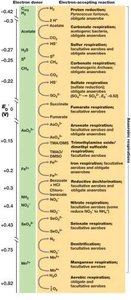
Key Point: The diversity of respiration reactions is illustrated by the range of electron donors and acceptors used by different microorganisms, each with distinct reduction potentials.
Chemotrophic Metabolism
Fermentation: Does not require an external electron acceptor. ATP is generated primarily by substrate-level phosphorylation, and redox balance is achieved by excreting reduced metabolic intermediates as fermentation products.
Respiration: Requires an external electron acceptor. ATP is generated by oxidative phosphorylation via the electron transport chain, which creates a proton motive force (pmf) used by ATP synthase. Chemolithotrophs use inorganic electron donors for respiration.
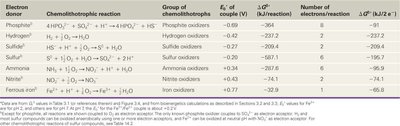
Table Purpose: This table compares the energy yields from the oxidation of various inorganic electron donors, highlighting the diversity of chemolithotrophic metabolisms.
Reducing Power and Redox Balance
Cells require reducing power for biosynthesis, typically in the form of low-potential electron carriers such as NAD(P)H and reduced ferredoxin. Redox balance is achieved by donating electrons to external acceptors (respiration) or metabolic intermediates (fermentation).
Reverse Electron Transport: Endergonic reduction of NAD(P)+ driven by dissipation of the proton motive force.
Electron Bifurcation: Endergonic reduction of a low-potential acceptor (e.g., ferredoxin) is coupled to the exergonic reduction of a higher-potential acceptor (e.g., NAD+), increasing energy yields in fermentation.
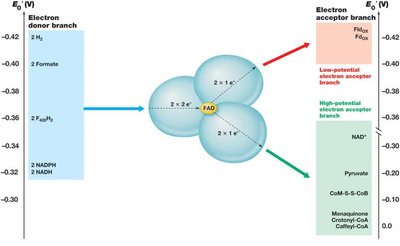
Key Point: Electron bifurcation allows cells to drive endergonic reactions by coupling them to exergonic ones, enhancing energy conservation.
Assimilative and Dissimilative Processes
Assimilative Processes: Incorporate inorganic nutrients (e.g., N2, NO3-, SO42-, CO2) into cell material for biosynthesis, consuming energy and reducing power.
Dissimilative Processes: Use inorganic compounds as electron acceptors for energy conservation, with reduced products excreted from the cell.
Example: CO2 fixation is the most important assimilative process, with diverse pathways among microorganisms.
Autotrophic Pathways
The Calvin Cycle
The Calvin cycle is the most widespread and globally significant pathway for CO2 fixation, used by all oxygenic phototrophs and many chemolithotrophs. The key enzyme is RubisCO, which catalyzes the reduction of CO2 to glyceraldehyde-3-phosphate.
Requires 12 NADPH and 18 ATP to synthesize one fructose-6-phosphate from CO2.
Carboxysomes are protein microcompartments that contain RubisCO and protect it from O2 inhibition.
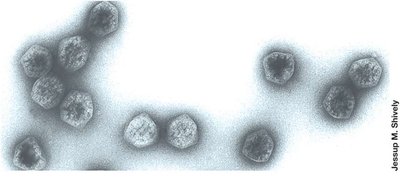
Key Point: Carboxysomes enhance the efficiency of the Calvin cycle by concentrating CO2 and protecting RubisCO.
The Reverse Citric Acid Cycle (rTCA)
The reverse citric acid cycle is used by green sulfur bacteria and some chemolithotrophs to fix CO2 by reversing the steps of the citric acid cycle. It is more efficient than the Calvin cycle, requiring fewer ATP per fixed CO2.
Requires unique enzymes not found in the standard citric acid cycle.
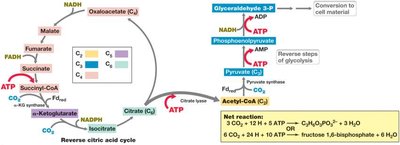
Key Point: The rTCA cycle is an ancient and efficient pathway for autotrophic CO2 fixation.
Phototrophy
Photosynthesis and Chlorophylls
Photosynthesis is the process by which light energy is used to drive biosynthesis. Photosynthetic organisms are typically autotrophs, reducing CO2 to organic compounds. There are two main types of photosynthesis: oxygenic (producing O2) and anoxygenic (not producing O2).
Chlorophylls: Light-sensitive pigments that absorb light and initiate energy conversion. Chlorophyll a is the principal pigment in oxygenic phototrophs, while bacteriochlorophylls are found in anoxygenic phototrophs.
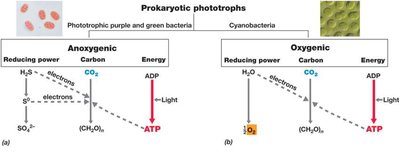
Key Point: The type of electron donor distinguishes oxygenic (H2O) from anoxygenic (e.g., H2S) photosynthesis.
Chlorophyll and Bacteriochlorophyll Structure and Function
Both are tetrapyrroles with magnesium at the center, but differ in side chains and absorption spectra.
Pigment diversity allows phototrophs to absorb different wavelengths and coexist in the same habitat.
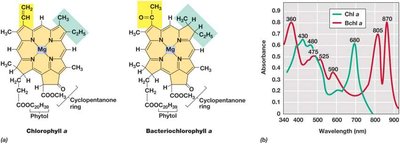
Key Point: Structural differences in chlorophylls and bacteriochlorophylls underlie their distinct absorption properties.
Photosynthetic Membranes and Light-Harvesting Complexes
Chlorophylls are organized in photocomplexes within membranes. Reaction centers participate directly in energy conservation, while antenna pigments funnel light energy to reaction centers.
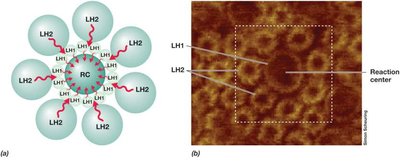
Key Point: The spatial arrangement of pigments optimizes light capture and energy transfer.
Photosynthetic Membranes in Eukaryotes and Prokaryotes
In eukaryotes, photosynthesis occurs in chloroplasts with thylakoid membranes. In prokaryotes, pigments are integrated into internal membrane systems.
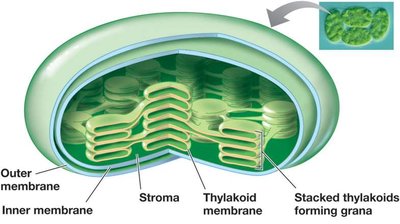
Key Point: The compartmentalization of photosynthetic machinery supports efficient energy conversion.
Carotenoids and Phycobilins
Carotenoids
Accessory pigments that absorb blue light and protect cells from photooxidative damage. They can transfer absorbed energy to reaction centers.
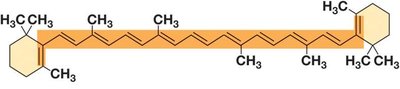
Key Point: Carotenoids are essential for photoprotection and light harvesting in photosynthetic organisms.
Phycobiliproteins and Phycobilisomes
Main light-harvesting systems in cyanobacteria and red algae, composed of bilins bound to proteins. Aggregated as phycobilisomes, they allow growth at low light intensities.
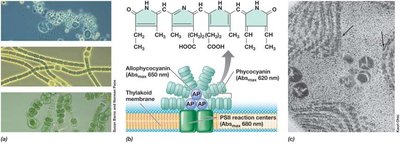
Key Point: Phycobilisomes expand the range of usable light wavelengths for photosynthesis.
Anoxygenic and Oxygenic Photosynthesis
Anoxygenic Photosynthesis
Electrons flow through a membrane-bound electron transport chain, generating a proton motive force. Two classes of reaction centers exist: Q-type (quinone) and FeS-type (iron-sulfur).
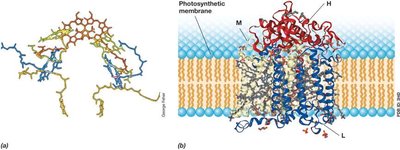
Key Point: The structure of reaction centers determines the pathway of electron flow and energy conservation.
Oxygenic Photosynthesis
Uses both FeS-type (PSI) and Q-type (PSII) reaction centers in the "Z scheme." PSII splits water, generating O2 and electrons, which are transferred to PSI and ultimately reduce NADP+ to NADPH.
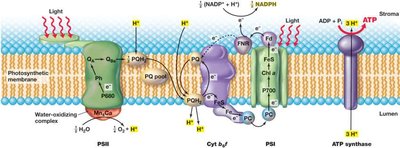
Key Point: Oxygenic photosynthesis is characterized by noncyclic electron flow and the production of both ATP and NADPH.
Respiratory Processes Defined by Electron Donor
Oxidation of Sulfur Compounds
Reduced sulfur compounds (e.g., H2S, S0, S2O32-) are used as electron donors by sulfur bacteria. The Sox system oxidizes these compounds directly to sulfate, releasing protons and acidifying the environment.
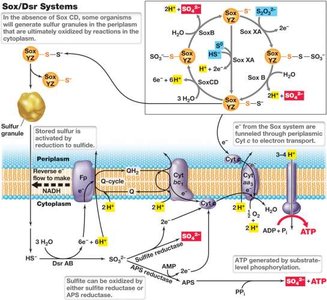
Key Point: The Sox system is central to sulfur oxidation and energy conservation in sulfur-oxidizing bacteria.
Iron (Fe2+) Oxidation
Ferrous iron is oxidized to ferric iron by iron bacteria, often in acidic environments. Electron transport involves cytochromes and rusticyanin, generating a proton motive force for ATP synthesis.
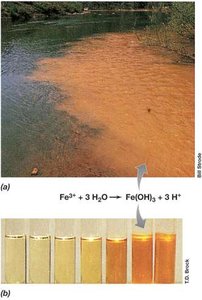
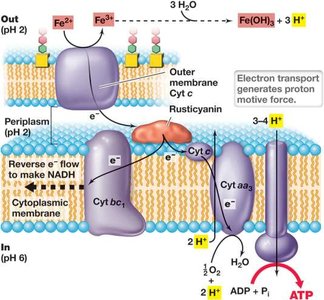
Key Point: Iron oxidation supports autotrophic growth in acidophilic bacteria and is important in biogeochemical cycling of iron.
Tables
Electron donor | Chemolithotrophic reaction | Group of chemolithotrophs | E0' of couple (V) | ΔG0' (kJ/reaction) | Number of electrons/reaction | ΔG0' (kJ/2 e-) |
|---|---|---|---|---|---|---|
Phosphite | 4HPO32- + SO42- → 4HPO42- + H2O | Phosphite oxidizers | -0.65 | -284 | 8 | -71 |
Hydrogen | H2 + 1/2O2 → H2O | Hydrogen oxidizers | -0.42 | -237.2 | 2 | -237.2 |
Sulfide | HS- + 2O2 + H2O → SO42- + 2H+ | Sulfur oxidizers | -0.27 | -798.2 | 2 | -399.1 |
Ammonia | NH3 + 1.5O2 → NO2- + H2O + H+ | Ammonia oxidizers | +0.43 | -349.5 | 6 | -116.5 |
Ferrous iron | Fe2+ + 1/4O2 + H+ → Fe3+ + 1/2H2O | Iron oxidizers | +0.77 | -65.8 | 1 | -65.8 |
Additional info: Table values are representative and may vary with environmental conditions.
