 뒤로
뒤로Microbial Growth and Its Control – Study Notes
스터디 가이드 - 스마트 노트
 자료에 맞춘 맞춤형 노트, 핵심 정의, 예시, 맥락을 확장해 제공합니다.
Microbial Growth and Its Control
Introduction
This chapter explores the fundamental principles of microbial growth, including the nutritional requirements of microorganisms, methods for culturing and quantifying microbial populations, and the dynamics of microbial growth in various environments. Understanding these concepts is essential for microbiology students, as they underpin laboratory techniques and applications in medicine, industry, and environmental science.
Feeding the Microbe: Cell Nutrition
Macronutrients and Micronutrients
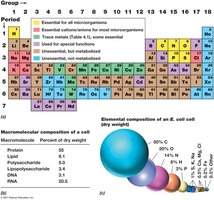
Macronutrients are elements required in large amounts for microbial growth, including carbon (C), oxygen (O), nitrogen (N), hydrogen (H), phosphorus (P), and sulfur (S), which together make up about 96% of the dry weight of a bacterial cell.
Micronutrients are needed in trace amounts and include metals such as iron (Fe), which are essential for enzyme function and cellular respiration.
Other important elements include potassium (K), magnesium (Mg), calcium (Ca), and sodium (Na), which play roles in enzyme activity, stabilization of cellular structures, and osmotic balance.
Growth factors are organic compounds such as vitamins, amino acids, purines, and pyrimidines that some microbes cannot synthesize and must obtain from their environment.
Carbon, Nitrogen, and Other Macronutrients
Heterotrophs require organic carbon sources, obtaining carbon from the breakdown or uptake of organic molecules.
Autotrophs use carbon dioxide (CO2) as their carbon source, synthesizing organic molecules via processes such as photosynthesis.
Nitrogen is essential for proteins and nucleic acids; microbes may use ammonia (NH3), nitrate (NO3−), organic nitrogen, or nitrogen gas (N2).
Phosphorus is mainly assimilated as inorganic phosphate (PO43−), crucial for nucleic acids and phospholipids.
Sulfur is required for certain amino acids and vitamins, and can be assimilated from sulfate (SO42−), sulfide (H2S), or organic sources.
Growth Media and Laboratory Culture
Types of Culture Media
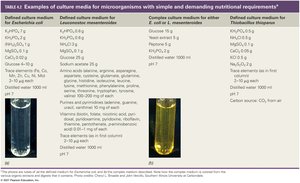
Defined media: The exact chemical composition is known; used for precise physiological studies.
Complex media: Contain extracts or digests of natural products (e.g., yeast, meat); composition is not fully defined.
Selective media: Contain substances that inhibit the growth of some organisms while allowing others to grow.
Differential media: Contain indicators (often dyes) that reveal differences in metabolic reactions among microbes.
Medium Type | Composition | Purpose |
|---|---|---|
Defined | Known chemicals (e.g., glucose, salts) | Physiological studies |
Complex | Yeast/meat extracts, peptones | Routine cultivation |
Selective | Inhibitors (e.g., antibiotics) | Isolation of specific microbes |
Differential | Indicators (e.g., pH dyes) | Distinguish metabolic traits |
Laboratory Culture Techniques
Media can be liquid or solid (solidified with agar).
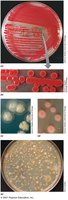
Microbial colonies on solid media can be used to assess purity and identify species based on morphology.
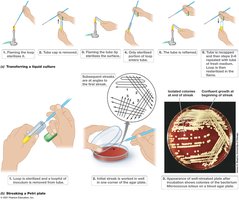
Aseptic technique is essential to prevent contamination during microbial transfer and culture.
The streak plate method is commonly used to isolate pure cultures.
Measuring Microbial Growth
Microscopic Counts
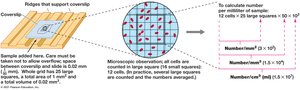
Microscopic cell counts involve direct observation and enumeration of cells using a counting chamber (e.g., Petroff–Hausser chamber).
Stains (e.g., DAPI) can be used to visualize cells and distinguish between live and dead cells or different phylogenetic groups.
Limitations include inability to distinguish live from dead cells without special stains and potential for counting errors due to clumping.
Viable Counting Methods
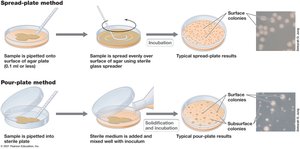
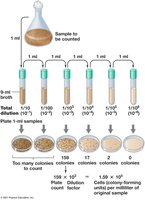
Viable (plate) counts measure the number of living, reproducing cells by counting colonies formed on agar plates.
Two main methods: spread-plate and pour-plate techniques.
Results are reported as colony-forming units (CFU) to account for cell clumps.
Serial dilutions are often necessary to obtain countable plates (30–300 colonies).
Plate counts are widely used in food, water, and clinical microbiology due to their sensitivity and specificity.
The "great plate count anomaly" refers to the observation that direct microscopic counts often reveal more cells than can be cultured, due to differing growth requirements among microbes.
Turbidimetric Measures
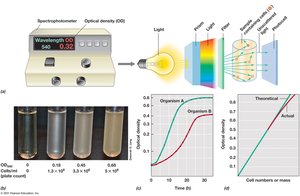
Cell suspensions scatter light, causing turbidity that can be measured with a spectrophotometer.
Optical density (OD) at a specific wavelength is proportional to cell number within certain limits.
A standard curve is required to relate OD to actual cell numbers.
Turbidimetric methods are rapid and non-destructive but cannot distinguish live from dead cells and may be inaccurate for clumped or biofilm-forming organisms.
Dynamics of Microbial Growth
Binary Fission and the Microbial Growth Cycle
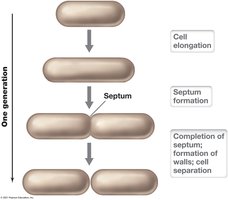
Binary fission is the primary mode of cell division in bacteria, resulting in two genetically identical daughter cells.
The generation time is the time required for a population to double in number; it varies by species and environmental conditions.
During division, a septum forms to separate the daughter cells.
The Microbial Growth Curve
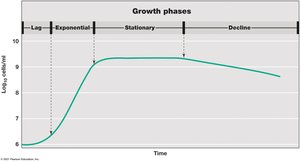
In batch culture (closed system), microbial populations exhibit a characteristic growth curve with four phases:
Lag phase: Cells adapt to new conditions; little or no cell division occurs.
Exponential (log) phase: Cells divide at a constant, maximum rate; population doubles at regular intervals.
Stationary phase: Growth rate slows and stabilizes due to nutrient depletion or waste accumulation; cell division balances cell death.
Death (decline) phase: Cells die at an exponential rate as conditions deteriorate.
Quantitative Aspects of Microbial Growth
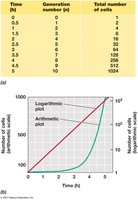
Exponential growth can be described mathematically:
Where N is the final cell number, N0 is the initial cell number, and n is the number of generations.
Growth data are often plotted on a logarithmic scale to visualize exponential increases.
Continuous Culture
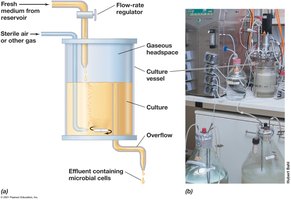
Continuous culture systems, such as the chemostat, maintain microbial populations in exponential growth by continuously adding fresh medium and removing spent medium.
Allows independent control of growth rate (via dilution rate) and cell density (via limiting nutrient concentration).
Used for physiological studies, microbial ecology, and industrial applications.
Biofilm Growth
Biofilm Formation and Properties
Planktonic cells grow freely in suspension, while sessile cells attach to surfaces and form biofilms.
Biofilms are structured communities of cells embedded in a self-produced polysaccharide matrix.
Biofilm development involves attachment, colonization, growth, and dispersal stages.
Biofilms exhibit properties distinct from planktonic cells, including increased resistance to antibiotics and environmental stresses.

Biofilms in Nature and Medicine
Biofilms are implicated in persistent infections (e.g., joint infections, dental plaque) and industrial problems (e.g., pipe fouling, corrosion).
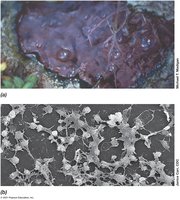
Microbial mats are multilayered biofilms with different microbial communities in each layer, found in environments such as hot springs and intertidal zones.
Alternatives to Binary Fission
Budding and Other Division Mechanisms
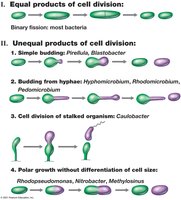
While binary fission produces nearly identical daughter cells, some bacteria divide by budding, resulting in unequal cell sizes or morphologies.
Other mechanisms include division from hyphae, stalked cell division, and polar growth without differentiation of cell size.
Additional info: Understanding microbial growth and its control is foundational for applications in clinical diagnostics, biotechnology, and environmental microbiology. Mastery of these concepts enables effective cultivation, enumeration, and management of microbial populations in diverse settings.
