뒤로
뒤로Microbial Metabolism: Chemical Reactions, Pathways, and Regulation
스터디 가이드 - 스마트 노트
 자료에 맞춘 맞춤형 노트, 핵심 정의, 예시, 맥락을 확장해 제공합니다.
Microbial Metabolism
Introduction to Metabolism
Microbial metabolism encompasses all the controlled biochemical reactions that occur within a microorganism. These reactions are essential for acquiring nutrients, generating energy, synthesizing macromolecules, and supporting growth and reproduction.
Metabolism: The sum of all chemical reactions in a cell.
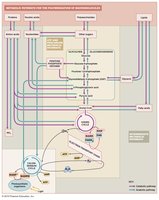
Metabolic processes are guided by eight key statements, including nutrient acquisition, energy generation and storage, macromolecule synthesis, and cell growth and division.
Basic Chemical Reactions
Catabolism and Anabolism
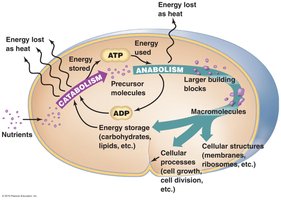
Metabolic reactions are divided into two major classes: catabolism and anabolism.
Catabolic pathways: Break down larger molecules into smaller products, releasing energy (exergonic). Some energy is stored as ATP, while most is lost as heat. Catabolism produces precursor metabolites for anabolism.
Anabolic pathways: Synthesize large molecules from smaller products of catabolism, requiring energy input (endergonic). Energy is supplied by ATP hydrolysis or sunlight.
Oxidation and Reduction (Redox) Reactions
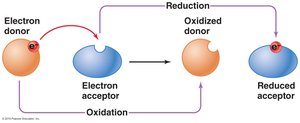
Redox reactions involve the transfer of electrons from an electron donor to an electron acceptor. These reactions are fundamental to energy transfer in cells.
Oxidation: Loss of electrons, hydrogen atoms, or gain of oxygen atoms.
Reduction: Gain of electrons or hydrogen atoms.
Redox reactions always occur simultaneously (OIL RIG: Oxidation Is Loss, Reduction Is Gain).
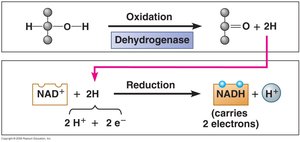
Cells use electron carriers such as NAD+, NADP+, and FAD to shuttle electrons during metabolic reactions.
Adenosine Triphosphate (ATP)
ATP is the primary energy currency of the cell, capturing and transferring chemical energy released during catabolism.
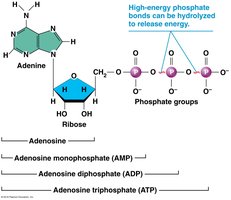
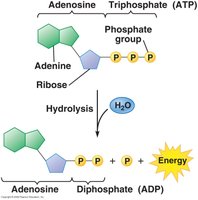
ATP consists of adenine, ribose, and three phosphate groups.
Hydrolysis of ATP releases energy by removing phosphate groups, converting ATP to ADP or AMP.
Phosphorylation Mechanisms
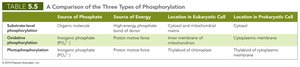
Cells regenerate ATP from ADP by phosphorylation, which can occur via three mechanisms:
Type | Source of Phosphate | Source of Energy | Location in Eukaryotes | Location in Prokaryotes |
|---|---|---|---|---|
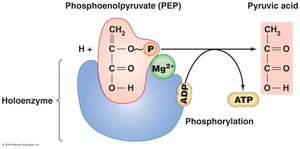
Substrate-level phosphorylation | Organic molecule | High-energy phosphate from substrate | Cytosol, mitochondria | Cytosol |
Oxidative phosphorylation | Inorganic phosphate (Pi) | Proton motive force | Inner mitochondrial membrane | Cytoplasmic membrane |
Photophosphorylation | Inorganic phosphate (Pi) | Light energy (proton motive force) | Thylakoid of chloroplast | Thylakoid of cyanobacteria membrane |
Enzymes and Catalysis
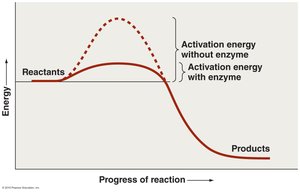
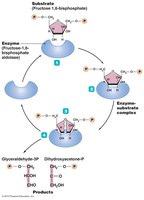
Enzymes are biological catalysts that speed up chemical reactions by lowering activation energy without being consumed. Most enzymes are proteins, but some RNA molecules (ribozymes) also have catalytic activity.
Enzymes are specific to their substrates and reactions.
Enzyme names often end in -ase and reflect their substrate or function.
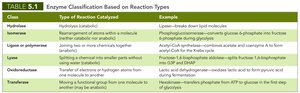
Class | Type of Reaction Catalyzed | Examples |
|---|---|---|
Hydrolases | Hydrolysis (addition of water) | Lipase, protease |
Isomerases | Rearrangement of atoms | Phosphoglucoisomerase |
Ligases/Polymerases | Joining molecules | DNA ligase, RNA polymerase |
Lyases | Splitting without water | Aldolase |
Oxidoreductases | Redox reactions | Lactic acid dehydrogenase |
Transferases | Transfer functional groups | Hexokinase |
Enzyme Structure and Function
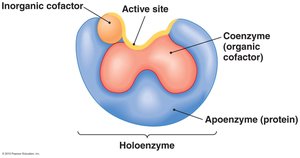
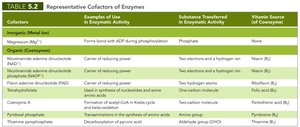
Many enzymes require nonprotein cofactors (inorganic ions or organic coenzymes) for activity. The combination of an apoenzyme (protein) and its cofactor forms a holoenzyme (active enzyme).
Cofactor | Example of Use | Substance Transferred | Vitamin Source |
|---|---|---|---|
Inorganic (Metal ion) | Iron in ATP synthesis | Phosphate | None |
NAD+ | Carrier of reducing power | Two electrons, hydrogen ion | Niacin (B3) |
NADP+ | Carrier of reducing power | Two electrons, hydrogen ion | Niacin (B3) |
FAD | Carrier of reducing power | Two hydrogen atoms | Riboflavin (B2) |
Coenzyme A | Transfer of acetyl groups | Acetyl group | Pantothenic acid (B5) |
Pyridoxal phosphate | Transfer of amino groups | Amino group | Pyridoxine (B6) |
Enzyme Activity and Regulation
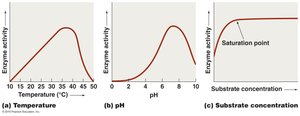
Enzymes lower the activation energy required for reactions, increasing reaction rates. Their activity is influenced by temperature, pH, substrate concentration, and the presence of inhibitors.
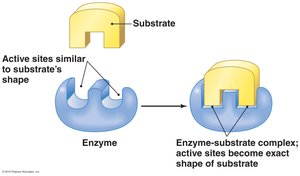
Enzyme-substrate specificity is explained by the induced fit model.
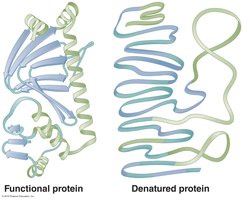
Enzyme activity increases with temperature and substrate concentration up to an optimal point, after which denaturation or saturation occurs.
pH changes can also denature enzymes by disrupting hydrogen bonds.
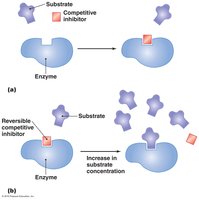
Enzyme inhibitors can be competitive (bind active site) or noncompetitive (bind allosteric site).
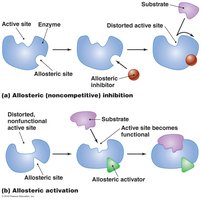
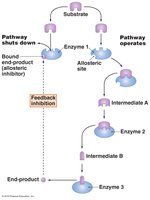
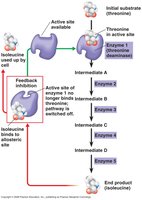
Feedback inhibition: End-product of a pathway inhibits an earlier enzyme, regulating pathway activity.
Carbohydrate Catabolism
Glycolysis
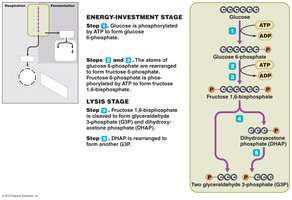
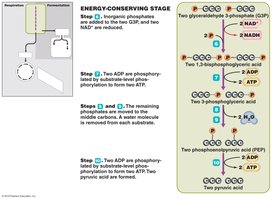
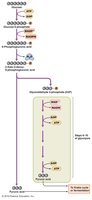
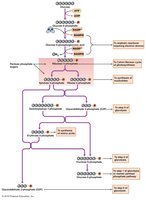
Glycolysis is the central pathway for glucose catabolism, occurring in the cytoplasm and producing pyruvate, ATP, and NADH.
Divided into three stages: energy-investment, lysis, and energy-conserving.
Net gain: 2 ATP, 2 NADH, 2 pyruvate per glucose.
Cellular Respiration
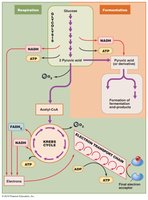
Cellular respiration is the complete oxidation of glucose to CO2 and H2O, generating ATP through glycolysis, the Krebs cycle, and the electron transport chain (ETC).
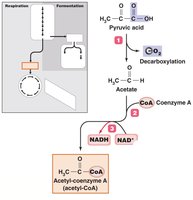
Synthesis of Acetyl-CoA: Pyruvate is decarboxylated and combined with CoA, producing acetyl-CoA, CO2, and NADH.
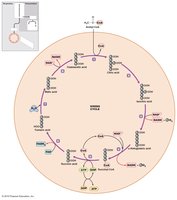
Krebs Cycle: Acetyl-CoA enters the cycle, generating ATP, NADH, FADH2, and CO2.
Electron Transport Chain (ETC): Electrons from NADH and FADH2 are transferred through a series of carriers, generating a proton gradient used to produce ATP via oxidative phosphorylation.
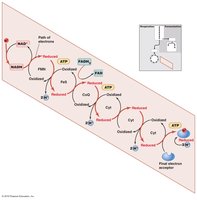
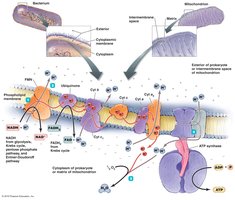
ATP Synthase: Enzyme complex that synthesizes ATP as protons flow down their gradient.
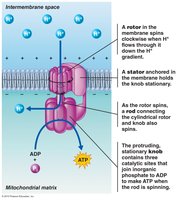
Total ATP yield per glucose: ~38 in prokaryotes, ~36 in eukaryotes.
Alternative Pathways and Fermentation
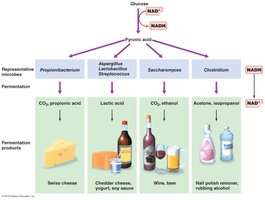
Some microbes use alternative pathways for glucose catabolism or fermentation when oxygen is absent.
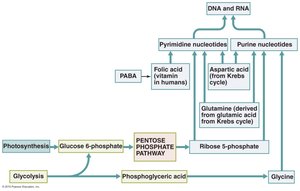
Pentose Phosphate Pathway: Generates NADPH and precursor metabolites for biosynthesis.
Entner-Doudoroff Pathway: Alternative to glycolysis, used by some bacteria.
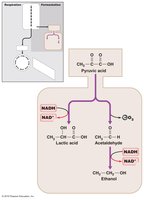
Fermentation: Anaerobic process regenerating NAD+ for glycolysis, producing organic acids or alcohols as end products.
Other Catabolic Pathways
Lipid and Protein Catabolism
Microbes can catabolize lipids and proteins for energy and precursor metabolites.
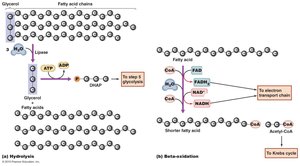
Lipases: Hydrolyze fats into glycerol and fatty acids. Fatty acids undergo beta-oxidation to form acetyl-CoA.
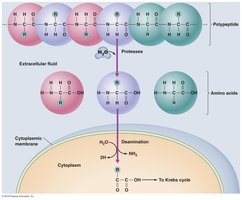
Proteases: Break down proteins into amino acids, which are deaminated and converted into Krebs cycle intermediates.
Photosynthesis
Light-Dependent and Light-Independent Reactions
Photosynthetic organisms convert light energy into chemical energy, synthesizing carbohydrates from CO2 and H2O.
Chlorophylls: Pigments that capture light energy.
Photosystems: Complexes of chlorophyll and proteins embedded in membranes (thylakoids).
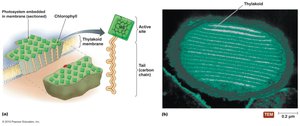
Light-dependent reactions generate ATP and NADPH via cyclic and noncyclic photophosphorylation.
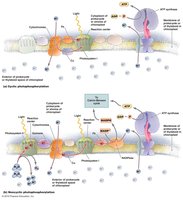
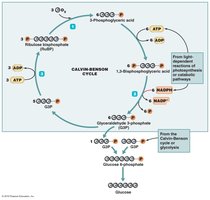
Light-independent reactions (Calvin-Benson Cycle) use ATP and NADPH to fix carbon and synthesize glucose.
Other Anabolic Pathways
Gluconeogenesis, Lipogenesis, and Amino Acid Synthesis
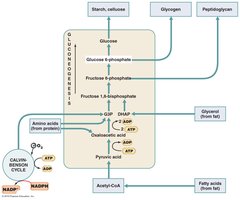
Anabolic pathways synthesize complex molecules from simpler precursors, often reversing catabolic pathways.
Gluconeogenesis: Synthesis of glucose from noncarbohydrate sources.
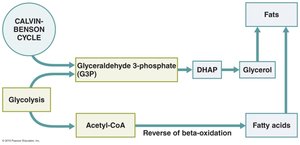
Lipogenesis: Synthesis of fatty acids and triglycerides from acetyl-CoA.
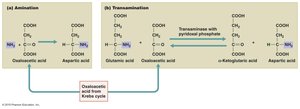
Amino acid synthesis: Formation of amino acids via amination or transamination.
Nucleotide synthesis: Formation of nucleotides from glycolysis and Krebs cycle intermediates.
Integration and Regulation of Metabolic Function
Metabolic Regulation
Cells regulate metabolism to maximize growth and efficiency by controlling enzyme production, activity, and compartmentalization.
Regulation occurs at the level of gene expression and enzyme activity (allosteric regulation, feedback inhibition).
Cells preferentially use the most energy-efficient substrates and pathways available.