 뒤로
뒤로Microbial Nutrition, Growth, and Culturing: Chapter 6 Study Notes
스터디 가이드 - 스마트 노트
 자료에 맞춘 맞춤형 노트, 핵심 정의, 예시, 맥락을 확장해 제공합니다.
Microbial Nutrition and Metabolism
Growth Requirements
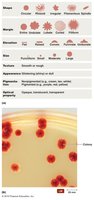
Microbial growth refers to the increase in population size of microbes, primarily through reproduction. Growth results in the formation of discrete colonies or biofilms, which are aggregations of cells arising from a single parent cell or a collection of microbes living on a surface in a complex community.
Colony: Aggregation of cells from a single parent cell.
Biofilm: Collection of microbes living on a surface in a complex community.
Major Nutritional Requirements
Microbes require a variety of nutrients for energy and to build cellular structures. The most common elements are carbon, oxygen, nitrogen, and hydrogen. All cells need a carbon source, energy source, and a source of electrons or hydrogen atoms for metabolism.
Classification by Carbon and Energy Source
Organisms are classified based on their carbon and energy sources:
Autotrophs: Use CO2 as a carbon source; produce organic compounds from inorganic molecules.
Heterotrophs: Require organic compounds for carbon.
Chemotrophs: Obtain energy from redox reactions of inorganic or organic compounds.
Phototrophs: Use light as their energy source.
Four basic groups based on carbon and energy sources:
Photoautotrophs
Photoheterotrophs
Chemoautotrophs
Chemoheterotrophs
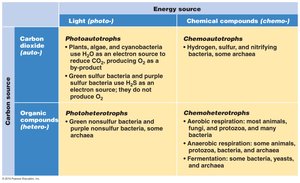
Classification by Electron Source
Organotrophs: Acquire electrons from organic molecules.
Lithotrophs: Acquire electrons from inorganic molecules (e.g., nitrate ions, hydrogen sulfide, iron).
Oxygen Requirements
Oxygen is essential for obligate aerobes but toxic for obligate anaerobes due to reactive oxygen species. Organisms are classified based on their oxygen requirements:
Obligate aerobes: Require oxygen as the final electron acceptor.
Obligate anaerobes: Oxygen is toxic; lack enzymes to detoxify reactive oxygen species.
Facultative anaerobes: Can perform both respiration and fermentation.
Aerotolerant anaerobes: Perform fermentation but can detoxify oxygen.
Microaerophiles: Require low oxygen concentrations.
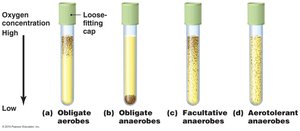
Toxic Forms of Oxygen
Singlet oxygen (1O2): Produced during photochemical reactions; detoxified by carotenoids.
Superoxide radicals (O2-): Detoxified by superoxide dismutase.
Peroxide anion (O22-): Detoxified by catalase or peroxidase.
Hydroxyl radical: Most reactive; detoxified by catalase and peroxidase.
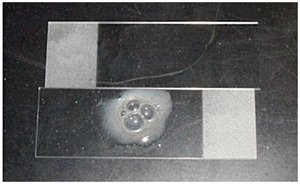
Nitrogen, Trace Elements, and Growth Factors
Nitrogen is a growth-limiting nutrient, essential for biosynthesis. Most cells recycle nitrogen from amino acids and nucleotides. Some bacteria fix atmospheric nitrogen (N2) into ammonia (NH3).
Trace elements: Phosphorus, sulfur, calcium, manganese, magnesium, copper, iron.
Growth factors: Organic compounds microbes cannot synthesize (e.g., vitamins, amino acids, purines, pyrimidines, cholesterol, NADH, heme).
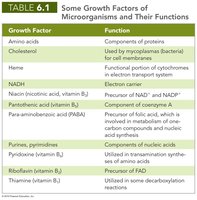
Physical Requirements for Growth
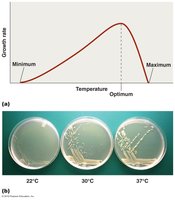
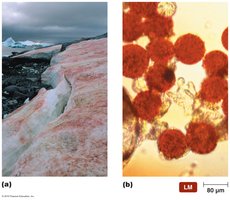
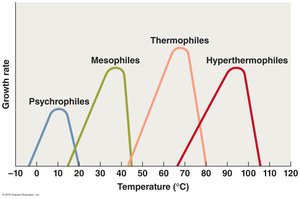
Temperature: Affects protein structure and membrane fluidity. Categories: Psychrophiles (<15°C), Mesophiles (20–40°C), Thermophiles (>45°C), Hyperthermophiles (>80°C).
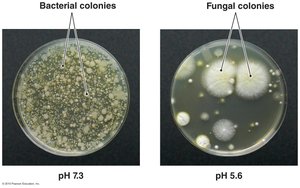
pH: Neutrophiles (pH 6.5–7.5), Acidophiles (low pH), Alkalinophiles (high pH).
Osmotic pressure: Halophiles require high salt concentrations.
Hydrostatic pressure: Barophiles live under extreme pressure.
Associations and Biofilms
Microbial Relationships
Microorganisms interact in various ways:
Antagonistic: One organism harms or kills another.
Synergistic: Members benefit more together than alone.
Symbiotic: Organisms are interdependent.
Biofilm Formation
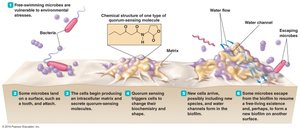
Biofilms are complex communities of microorganisms that communicate and coordinate via quorum sensing. Biofilms form on surfaces and are responsible for many bacterial diseases.
Cells adhere to surfaces and form a sticky extracellular matrix.
Microenvironments develop within the biofilm.
Quorum sensing regulates gene expression based on cell density.
Culturing Microorganisms
Isolation and Cultivation
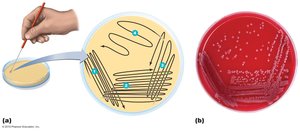
Microorganisms must be isolated and cultivated for diagnosis and research. Cultures can be grown on solid or liquid media. Pure cultures arise from a single colony-forming unit (CFU).
Streak plate: Most common isolation technique; dilutes sample to isolate CFUs.
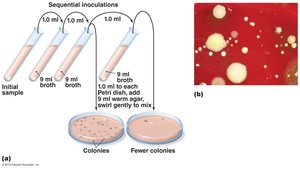
Pour plate: Uses serial dilutions; colonies form above and below the medium surface.
Types of Culture Media
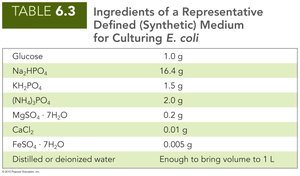
Defined media: Exact composition known.
Complex media: Contains nutrients from partial digestion; supports a variety of microbes.
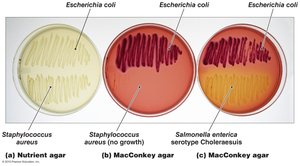
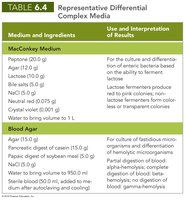
Selective media: Favors or inhibits growth of specific microbes.
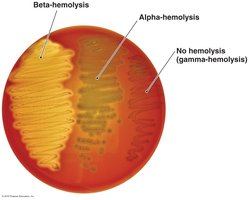
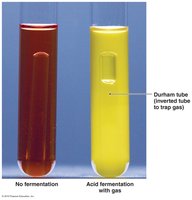
Differential media: Produces visible changes to distinguish microbes.
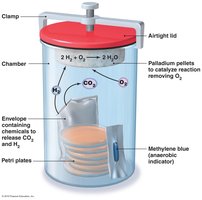
Anaerobic media: Protects cells from oxygen.
Transport media: Used for clinical specimens.
Growth of Microbial Populations
Binary Fission and Growth Curves
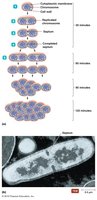
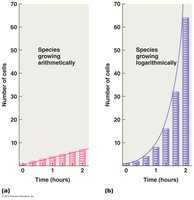
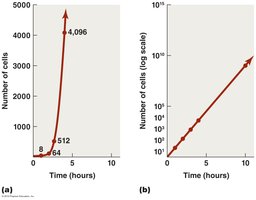
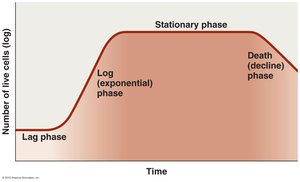
Most unicellular microorganisms reproduce by binary fission, resulting in exponential population growth. The growth curve includes lag, log, stationary, and death phases.
Generation time: Time required for a population to double.
Exponential growth: Population increases rapidly.
Growth curve: Lag phase (no reproduction), log phase (rapid growth), stationary phase (equal birth and death), death phase (decline).
Estimating Microbial Population Size
Direct Counting Methods
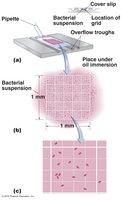
Microscopic counts: Count cells directly using a cell counter.
Electronic counters: Count cells as they interrupt an electrical current (Coulter counter, flow cytometry).
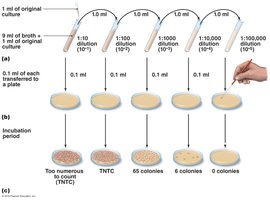
Serial dilution and viable plate counts: Stepwise dilution and plating to count colonies.
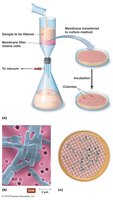
Membrane filtration: Filter large samples and count colonies.
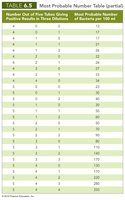
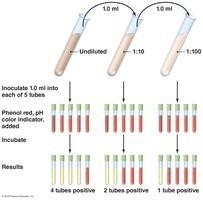
Most probable number (MPN): Statistical estimation based on dilution.
Indirect Counting Methods
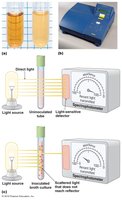
Turbidity: Measured using a spectrophotometer; more turbid means more cells.
Metabolic activity: Changes in nutrient utilization, waste production, or pH.
Dry weight: Organisms are filtered, dried, and weighed.
Genetic methods: PCR and DNA hybridization for unculturable prokaryotes.
Summary Table: Growth Factors of Microorganisms
Growth Factor | Function |
|---|---|
Amino acids | Components of proteins |
Cholesterol | Used by mycoplasmas for cell membranes |
Heme | Functional portion of cytochromes in electron transport system |
NADH | Electron carrier |
Pantothenic acid (vitamin B5) | Component of coenzyme A |
Para-aminobenzoic acid (PABA) | Precursor of folic acid, which is involved in metabolism of one-carbon compounds and nucleic acid synthesis |
Purines, pyrimidines | Components of nucleic acids |
Pyridoxine (vitamin B6) | Used in amino acid metabolism |
Riboflavin (vitamin B2) | Precursor of FAD |
Thiamine (vitamin B1) | Utilized in some decarboxylation reactions |
Summary Table: Clinical Specimens and Collection Methods
Type or Location of Specimen | Collection Method |
|---|---|
Skin, accessible membrane | Sterile swab brushed across surface |
Blood | Needle aspiration from vein |
Cerebrospinal fluid | Needle aspiration from subarachnoid space |
Stomach | Intubation with tube |
Urine | Catheter inserted into bladder |
Lungs | Collection of sputum or aspiration |
Diseased tissue | Surgical removal (biopsy) |
Key Equations
Exponential Growth Equation: Where is the population at time , is the initial population, and is the number of generations.
Generation Time: Where is generation time, is total time, and is number of generations.
Conclusion
Understanding microbial nutrition, growth requirements, and culturing techniques is fundamental for microbiology. These concepts are essential for diagnosing diseases, studying microbial ecology, and industrial applications.
