 뒤로
뒤로Step-by-Step Guidance for Gram Stain Questions
스터디 가이드 - 스마트 노트
 자료에 맞춘 맞춤형 노트, 핵심 정의, 예시, 맥락을 확장해 제공합니다.
Q1. Which of the following answers lists the steps of gram-staining in the correct order?
Background
Topic: Gram Stain Procedure
This question tests your knowledge of the sequence of steps in the Gram stain, a fundamental microbiology technique used to differentiate bacteria based on cell wall structure.
Key Terms and Steps:
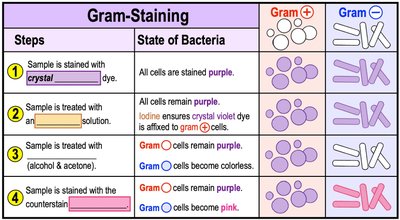
Primary stain: Crystal violet
Mordant: Iodine solution
Decolorizer: Alcohol or acetone
Counterstain: Safranin
Step-by-Step Guidance
Recall the purpose of each reagent: Crystal violet stains all cells, iodine binds the dye, alcohol removes dye from gram-negative cells, and safranin stains gram-negative cells pink.
Arrange the steps logically: Start with the primary stain, then add the mordant, followed by the decolorizer, and finally the counterstain.
Compare the answer choices to the correct sequence you have constructed.
Identify which answer choice matches the correct order of steps.
Try solving on your own before revealing the answer!
Final Answer: a) Stain with primary stain (crystal violet), add iodine, add decolorizer, stain with counterstain (safranin).
This is the correct sequence for the Gram stain procedure. Each step is essential for differentiating gram-positive and gram-negative bacteria.
Q2. Which of the following reagents is used to stain gram negative cells pink (or red) in the gram stain?
Background
Topic: Gram Stain Reagents
This question tests your understanding of which chemical is responsible for coloring gram-negative cells during the Gram stain process.
Key Terms:
Safranin: Counterstain that colors gram-negative cells pink/red.
Crystal violet: Primary stain for all cells.
Iodine: Mordant that fixes the dye.
Decolorizer: Removes dye from gram-negative cells.
Step-by-Step Guidance
Recall what happens after decolorization: Gram-negative cells lose the crystal violet stain.
Consider which reagent is applied last and what its effect is on gram-negative cells.
Identify the reagent that imparts a pink/red color to gram-negative cells.
Try solving on your own before revealing the answer!
Final Answer: b) Safranin.
Safranin is the counterstain that colors gram-negative cells pink or red after decolorization.
Q3. Which of the following statements is false?
Background
Topic: Gram Stain Interpretation
This question tests your ability to distinguish between true and false statements about the Gram stain process and its reagents.
Key Terms:
Crystal violet: Stains cells purple.
Alcohol: Decolorizes, does not kill bacteria.
Gram-positive: Retains purple stain.
Iodine: Mordant, affixes dye.
Step-by-Step Guidance
Review each statement and recall the function of each reagent in the Gram stain.
Identify which statement does not accurately describe the Gram stain process.
Focus on the role of alcohol: Is it used to kill bacteria or to decolorize?
Try solving on your own before revealing the answer!
Final Answer: b) Alcohol is used to kill the bacteria that are not stained.
This statement is false. Alcohol is used as a decolorizer, not to kill bacteria.
Q4. Results from a gram stain show that these bacteria are:
Background
Topic: Gram Stain Results Interpretation
This question tests your ability to interpret Gram stain results based on the color observed under the microscope.
Key Terms:
Gram-positive: Stained purple.
Gram-negative: Stained pink/red.
Step-by-Step Guidance
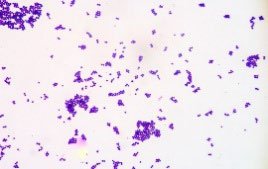
Observe the color of the bacteria in the image: Are they purple or pink?
Recall which type of bacteria retains the purple stain after the Gram stain procedure.
Match the observed color to the correct Gram classification.
Try solving on your own before revealing the answer!
Final Answer: b) Gram positive.
The bacteria are stained purple, indicating they are gram-positive.
Q5. A scientist has a sample with two different species of bacteria. The first species is Staphylococcus aureus, a gram-positive bacterium. The second species is Escherichia coli, a gram-negative bacterium. The scientist gram-stains his sample of bacteria. What colors will the two species of bacteria be after staining?
Background
Topic: Gram Stain Color Outcomes
This question tests your understanding of how different bacterial species appear after Gram staining, based on their cell wall structure.
Key Terms:
Staphylococcus aureus: Gram-positive, retains purple stain.
Escherichia coli: Gram-negative, stained pink by safranin.
Step-by-Step Guidance
Recall the Gram stain results for each type: Gram-positive bacteria retain the crystal violet and appear purple; gram-negative bacteria lose the crystal violet and are stained pink by safranin.
Match the color outcome to each species based on their Gram classification.
Compare the answer choices to your reasoning.
Try solving on your own before revealing the answer!
Final Answer: b) Staphylococcus aureus: purple; Escherichia coli: pink.
Staphylococcus aureus (gram-positive) will be purple, and Escherichia coli (gram-negative) will be pink after Gram staining.
