 뒤로
뒤로The Control of Microbial Growth: Principles and Methods
스터디 가이드 - 스마트 노트
 자료에 맞춘 맞춤형 노트, 핵심 정의, 예시, 맥락을 확장해 제공합니다.
The Control of Microbial Growth
Introduction
The control of microbial growth is essential in healthcare, food safety, laboratory work, and public health. This chapter explores the terminology, principles, and methods used to inhibit or destroy microorganisms, including both physical and chemical approaches.
Terminology of Microbial Control
Key Definitions
Sepsis: Refers to bacterial contamination, especially in clinical settings.
Asepsis: The absence of significant contamination; aseptic techniques are used to prevent microbial contamination of wounds and sterile environments.
Sterilization: The removal or destruction of all microbial life, including endospores.
Disinfection: The destruction of harmful microorganisms, but not necessarily endospores.
Antisepsis: The destruction of harmful microorganisms on living tissue (e.g., applying antibiotic cream to skin).
Degerming: Mechanical removal of microbes from a limited area (e.g., alcohol swab, handwashing).
Sanitization: Lowering microbial counts on objects to safe public health levels (e.g., restaurant dishwashers).
Germicide (biocide): Agents that kill microbes (except endospores).
Bacteriostasis: Inhibiting, not killing, microbes to slow or prevent growth.
The Rate of Microbial Death
Principles of Microbial Death
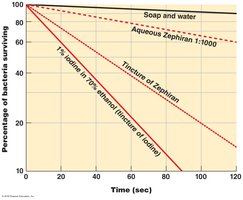
Microbial death occurs at a constant rate, often plotted as a straight line on a logarithmic scale. The effectiveness of antimicrobial treatments depends on several factors:
Number of microbes: Larger populations require more time to eliminate.
Environment: Organic matter, temperature, and biofilms can protect microbes from agents.
Time of exposure: Sufficient contact time is necessary for effectiveness.
Microbial characteristics: Species differ in susceptibility due to cell structure and life history.
Actions of Microbial Control Agents
Mechanisms of Action
Alteration of membrane permeability: Damages the plasma membrane, causing leakage of cell contents.
Damage to proteins/enzymes: Denaturation or inactivation of essential proteins.
Damage to nucleic acids: Disrupts genetic material, preventing replication and function.
Physical Methods of Microbial Control
Overview
Physical methods are often used for non-living materials and include heat, filtration, cold, desiccation, osmotic pressure, and radiation.
1. Heat
Denatures enzymes and proteins, leading to cell death.
Thermal death point (TDP): Lowest temperature at which all cells in a liquid culture are killed in 10 minutes.
Thermal death time (TDT): Minimum time for all bacteria in a liquid culture to be killed at a given temperature.
Moist Heat
Boiling: 100°C for 10 minutes kills most pathogens, but not endospores.
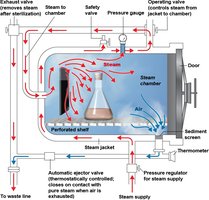
Autoclaving: Steam under pressure (121°C at 15 psi for 15 min) kills all organisms and endospores. Steam must contact all surfaces.
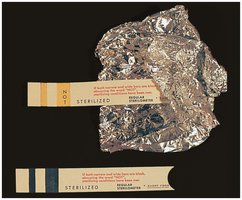
Sterilization Indicators
Indicators are used to confirm successful sterilization in autoclaves and other devices.
Pasteurization
Mild heating reduces spoilage organisms and pathogens in food without damaging taste.
Common protocols: 63°C for 30 min, HTST (72°C for 15 sec), UHT (140°C for 4 sec).
Dry Heat
Kills by oxidation (e.g., flaming, incineration, hot-air sterilization at 170°C for 2 hours).
2. Filtration
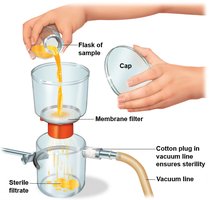
Filtration removes microbes from liquids or gases using membranes with small pores. Used for heat-sensitive materials (e.g., culture media, vaccines).
HEPA filters: Remove microbes >0.3 µm from air.
Membrane filters: Trap microbes as small as 0.01 µm, including some viruses.
3. Cold
Low temperatures are bacteriostatic, slowing metabolism and growth.
Refrigeration: 0–7°C slows most microbes except psychrophiles.
Freezing: Ice crystals disrupt cell structure.
Lyophilization: Freeze-drying removes water under vacuum, preserving cells for long-term storage.
4. Desiccation
Removal of water prevents metabolism and reproduction, but many microbes remain viable and can resume growth when rehydrated.
5. Osmotic Pressure
High salt or sugar concentrations create a hypertonic environment, causing plasmolysis (cell membrane shrinks away from cell wall).
Common in food preservation; less effective against molds and yeasts.
6. Radiation
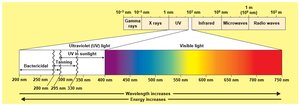
Radiation damages cellular components, especially DNA. Effectiveness depends on penetration, mass, and exposure time.
Ionizing radiation: (X-rays, gamma rays, electron beams) produces hydroxyl radicals that damage DNA and other molecules.
Nonionizing radiation: (UV light) causes thymine dimers in DNA, inhibiting replication. Most effective at ~260 nm; requires direct exposure.
Principles of Effective Disinfection
Factors Affecting Disinfection
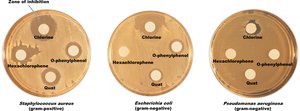
Type of microbe: Gram-positive bacteria are generally more susceptible than gram-negative. Pseudomonads, mycobacteria, endospores, cysts, and some viruses are more resistant.
Environment: Organic matter, temperature, and pH can affect efficacy.
Concentration and contact time: Follow manufacturer recommendations for best results.
Testing Disinfectant Effectiveness
Use-dilution test: Metal cylinders with dried bacteria are exposed to disinfectant, then transferred to culture media to check for survival.
Disk-diffusion method: Filter paper disks soaked in chemicals are placed on agar plates; zones of inhibition indicate effectiveness.
Chemical Methods of Microbial Control
Major Chemical Agents
Phenol and phenolics
Biguanides
Halogens
Alcohols
Heavy metals
Surface-active agents
Quaternary ammonium compounds
Chemical food preservatives
Aldehydes
Gaseous chemosterilizers
Peroxygens (oxidizing agents)
1. Phenol and Phenolics
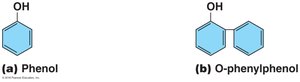
Disrupt plasma membranes and denature proteins.
Active in the presence of organic matter; used for cleaning body fluids.
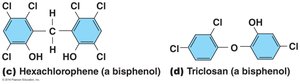
Phenol is rarely used due to irritation and odor; derivatives like hexachlorophene, Lysol, and triclosan are common.
2. Biguanides
Chlorhexidine is used for surgical hand scrubs and preoperative skin preparation.
Disrupts plasma membranes of vegetative bacteria and fungi; not effective against spores and some viruses.
3. Halogens
Iodine: Used as tincture (in alcohol) or iodophor (with organic molecules). Effective against many microbes; less irritating in iodophor form.
Chlorine: Used as bleach (hypochlorous acid), in water treatment, and as chloramine (chlorine + ammonia) for slow release.
Halogens are oxidizing agents that disrupt proteins and membranes.
4. Alcohols
Denature proteins and dissolve membrane lipids.
Effective against bacteria, enveloped viruses, and fungi; not effective against endospores or nonenveloped viruses.
Common types: ethanol and isopropanol; 70% concentration is most effective.
5. Heavy Metals
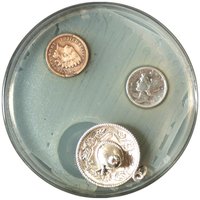
Denature proteins by binding to functional groups.
Examples: silver nitrate (wound dressings), mercuric chloride (paint), copper sulfate (algicide), zinc chloride (mouthwash).
6. Surface-Active Agents
Soaps and detergents reduce surface tension, aiding in mechanical removal (degerming) rather than killing microbes.
Some soaps contain added antiseptics like triclosan.
7. Quaternary Ammonium Compounds (Quats)
Detergents with positively charged ammonium ions; effective against gram-positive bacteria.
Not effective against endospores, some gram-negative bacteria, or in the presence of organic matter.
Examples: Zephiran, Cepacol.
8. Chemical Food Preservatives
Organic acids and salts inhibit microbial metabolism and endospore germination.
Sorbic acid, benzoic acid, and calcium propionate prevent molds in acidic foods; nitrites/nitrates prevent endospore germination in meats.
9. Aldehydes
Inactivate proteins by cross-linking functional groups.
Used for preserving specimens and disinfecting medical equipment (e.g., formaldehyde, glutaraldehyde).
10. Chemical Sterilization
Gaseous sterilants (e.g., ethylene oxide) cause alkylation, cross-linking nucleic acids and proteins.
Used for heat-sensitive materials in closed chambers.
11. Peroxygens (Oxidizing Agents)
Disrupt multiple cell components; not useful on wounds due to catalase in tissues.
Used for disinfecting surfaces and packaging (e.g., hydrogen peroxide, peracetic acid, benzoyl peroxide).
