Ch. 1 - A Brief History of Microbiology
Bauman - Microbiology with Diseases by Taxonomy 6th Edition
Bauman6th EditionMicrobiology with Diseases by TaxonomyISBN: 9780134832302당신이 사용하는 게 아니라요?교과서 변경
1장, 문제 9

List Koch’s postulates, and explain why they are significant.

검증된 단계별 안내
1
Step 1: Understand that Koch's postulates are a set of criteria established to link a specific microorganism to a particular disease, providing a systematic method to identify the causative agent of an infectious disease.
Step 2: List the four classical Koch's postulates as follows: 1. The microorganism must be found in all organisms suffering from the disease, but not in healthy organisms. 2. The microorganism must be isolated from a diseased organism and grown in pure culture. 3. The cultured microorganism should cause disease when introduced into a healthy organism. 4. The microorganism must be re-isolated from the experimentally infected host and identified as being identical to the original specific causative agent.
Step 3: Explain the significance of Koch's postulates in microbiology: they provide a foundational framework for establishing a causal relationship between a microbe and a disease, which is essential for diagnosis, treatment, and prevention.
Step 4: Discuss limitations of Koch's postulates, such as their inapplicability to viruses (which require host cells to grow), asymptomatic carriers, and diseases caused by multiple pathogens or complex interactions.
Step 5: Emphasize how Koch's postulates have guided the development of modern microbiology and infectious disease research, even though they have been modified or supplemented with molecular techniques in contemporary science.

비슷한 문제에 대한 검증된 영상 답변:

이 영상 해법은 위 문제에 도움이 된다고 튜터들이 추천한 것입니다.
영상 길이:
2m
도움이 되었나요?

주요 개념

질문에 올바르게 답하기 위해 반드시 이해해야 하는 핵심 개념들은 다음과 같습니다.

Koch’s Postulates

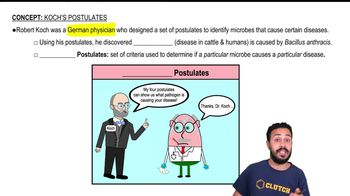
Koch’s postulates are four criteria established to link a specific microorganism to a particular disease. They include isolating the microbe from a diseased host, growing it in pure culture, reproducing the disease in a healthy host using the cultured microbe, and re-isolating the same microbe from the experimentally infected host.
추천 영상:
01:36
Koch's Postulates

Significance of Koch’s Postulates

Koch’s postulates provide a systematic method to identify the causative agents of infectious diseases. They helped establish the germ theory of disease, enabling scientists to prove that specific microbes cause specific illnesses, which is fundamental for diagnosis, treatment, and prevention.
추천 영상:
01:36
Koch's Postulates

Limitations and Modern Adaptations

While foundational, Koch’s postulates have limitations, such as difficulty applying them to viruses or asymptomatic carriers. Modern molecular techniques, like PCR and genetic sequencing, have adapted these principles to identify pathogens that cannot be cultured or cause disease only in humans.
추천 영상:
09:20
Review of Adaptive Immunity