Ch. 13 - Characterizing and Classifying Viruses, Viroids, and Prions
Bauman - Microbiology with Diseases by Taxonomy 6th Edition
Bauman6th EditionMicrobiology with Diseases by TaxonomyISBN: 9780134832302당신이 사용하는 게 아니라요?교과서 변경
13장, 문제 1

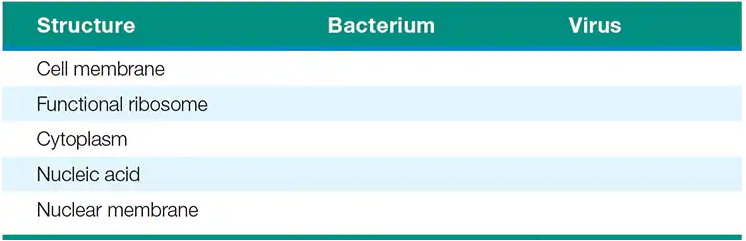
Compare and contrast a bacterium and a virus by writing either “Present” or “Absent” for each of the following structures.
Comparison table listing cell membrane, functional ribosome, cytoplasm, nucleic acid, and nuclear membrane as present or absent in bacterium and virus.

검증된 단계별 안내
1
Step 1: Understand the basic differences between bacteria and viruses. Bacteria are prokaryotic cells with cellular structures, while viruses are acellular entities that require a host to replicate.
Step 2: For the 'Cell membrane' structure, recognize that bacteria have a cell membrane as part of their cellular structure, so mark 'Present' for bacterium. Viruses do not have a cell membrane, so mark 'Absent' for virus.
Step 3: For 'Functional ribosome', bacteria have ribosomes to synthesize proteins, so mark 'Present' for bacterium. Viruses lack ribosomes and rely on the host's ribosomes, so mark 'Absent' for virus.
Step 4: For 'Cytoplasm', bacteria contain cytoplasm as the site of metabolic activity, so mark 'Present' for bacterium. Viruses do not have cytoplasm, so mark 'Absent' for virus.
Step 5: For 'Nucleic acid', both bacteria and viruses contain nucleic acid (DNA or RNA) as their genetic material, so mark 'Present' for both bacterium and virus. For 'Nuclear membrane', bacteria lack a nuclear membrane because they are prokaryotes, so mark 'Absent' for bacterium. Viruses also lack a nuclear membrane, so mark 'Absent' for virus.

비슷한 문제에 대한 검증된 영상 답변:

이 영상 해법은 위 문제에 도움이 된다고 튜터들이 추천한 것입니다.
영상 길이:
1m
도움이 되었나요?

주요 개념

질문에 올바르게 답하기 위해 반드시 이해해야 하는 핵심 개념들은 다음과 같습니다.

Cell Membrane

The cell membrane is a lipid bilayer that surrounds the cytoplasm of cells, controlling the movement of substances in and out. Bacteria, as living cells, have a cell membrane, while viruses lack this structure because they are not cellular and rely on host cells for replication.
추천 영상:
가이드 코스
03:59
Archaeal Cell Membranes

Functional Ribosome

Ribosomes are cellular structures responsible for protein synthesis. Bacteria contain functional ribosomes to produce their own proteins, whereas viruses do not have ribosomes and depend entirely on the host cell's ribosomes to translate their genetic material into proteins.
추천 영상:
가이드 코스
01:51
Prokaryotic Ribosomes

Nucleic Acid and Nuclear Membrane

Nucleic acids (DNA or RNA) carry genetic information in both bacteria and viruses. Bacteria have nucleic acid enclosed within a cytoplasm but lack a nuclear membrane, as they are prokaryotes. Viruses contain nucleic acid but do not have a nuclear membrane or cytoplasm, as they are acellular entities.
추천 영상: