Ch. 2 - The Chemistry of Microbiology
Bauman - Microbiology with Diseases by Taxonomy 6th Edition
Bauman6th EditionMicrobiology with Diseases by TaxonomyISBN: 9780134832302당신이 사용하는 게 아니라요?교과서 변경
2장, 문제 1

Which of the following structures have no electrical charge?


a. Protons
b. Electrons
c. Neutrons
d. Ions

검증된 단계별 안내
1
Understand the basic charges of subatomic particles: protons, electrons, and neutrons are fundamental components of atoms.
Recall that protons carry a positive electrical charge, electrons carry a negative electrical charge, and neutrons have no electrical charge.
Recognize that ions are atoms or molecules that have gained or lost electrons, resulting in a net electrical charge (either positive or negative).
Identify which of the listed options have no electrical charge by comparing their charge properties.
Conclude that the structure with no electrical charge is the neutron, as it is electrically neutral.

비슷한 문제에 대한 검증된 영상 답변:

이 영상 해법은 위 문제에 도움이 된다고 튜터들이 추천한 것입니다.
영상 길이:
2m
도움이 되었나요?

주요 개념

질문에 올바르게 답하기 위해 반드시 이해해야 하는 핵심 개념들은 다음과 같습니다.

Atomic Particles and Their Charges

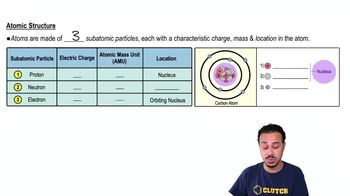
Atoms consist of protons, neutrons, and electrons. Protons carry a positive charge, electrons carry a negative charge, and neutrons have no electrical charge, making them neutral particles within the atom.
추천 영상:
04:48
Atomic Structure

Neutrons as Neutral Particles

Neutrons are subatomic particles found in the nucleus of an atom that do not possess any electrical charge. Their neutrality helps stabilize the nucleus by offsetting the repulsive forces between positively charged protons.
추천 영상:
04:48
Atomic Structure

Ions and Electrical Charge

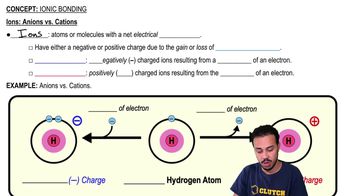
Ions are atoms or molecules that have gained or lost electrons, resulting in a net electrical charge. Positively charged ions are called cations, while negatively charged ions are called anions, meaning ions always carry an electrical charge.
추천 영상:
04:34
Ionic Bonding