Dimorphic fungi exist as _____ forms in the environment and as _____ forms in their hosts.
Ch. 22 - Pathogenic Fungi
22장, 문제 1
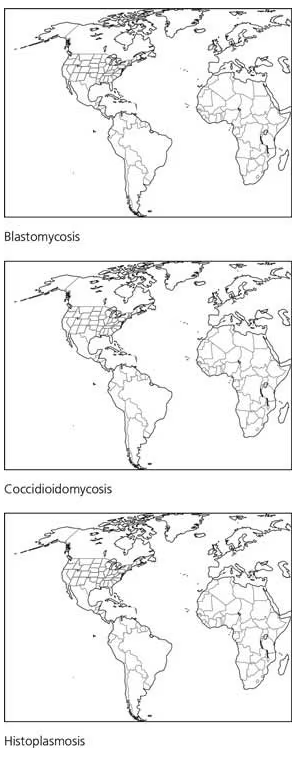
Color each map below to show the general area where each disease is endemic.

검증된 단계별 안내1
Step 1: Understand the endemic regions for each disease. Blastomycosis is primarily found in the eastern United States and parts of Canada, especially around the Ohio and Mississippi River valleys and the Great Lakes region.
Step 2: For Blastomycosis, color the areas around the Ohio and Mississippi River valleys, the Great Lakes region, and parts of southeastern Canada on the first map.
Step 3: Coccidioidomycosis, also known as Valley fever, is endemic to the southwestern United States, particularly in California, Arizona, Nevada, New Mexico, Texas, and parts of northern Mexico.
Step 4: For Coccidioidomycosis, color the southwestern United States and northern Mexico regions on the second map.
Step 5: Histoplasmosis is commonly found in the Ohio and Mississippi River valleys, similar to Blastomycosis, but also extends into parts of Central and South America and Africa.
Step 6: For Histoplasmosis, color the Ohio and Mississippi River valleys on the third map, and also include parts of Central America and regions in Africa where the disease is known to be endemic.

비슷한 문제에 대한 검증된 영상 답변:
이 영상 해법은 위 문제에 도움이 된다고 튜터들이 추천한 것입니다.
영상 길이:
2m도움이 되었나요?
주요 개념
질문에 올바르게 답하기 위해 반드시 이해해야 하는 핵심 개념들은 다음과 같습니다.
Endemic Regions of Fungal Diseases
Endemic regions are geographic areas where specific diseases regularly occur. Understanding the endemic zones of fungal diseases like Blastomycosis, Coccidioidomycosis, and Histoplasmosis helps in diagnosis and epidemiology. These fungi thrive in particular environmental conditions, influencing their geographic distribution.
추천 영상:
Stages of Infectious Disease Progression
Blastomycosis and Its Geographic Distribution
Blastomycosis is caused by Blastomyces dermatitidis, primarily found in moist soil and decomposing organic matter. It is endemic in the eastern and central United States, especially around the Ohio and Mississippi River valleys and the Great Lakes region. Recognizing this distribution aids in identifying potential exposure risks.
추천 영상:
Types of Flagellar Distribution on Bacteria
Coccidioidomycosis and Histoplasmosis Distribution
Coccidioidomycosis, caused by Coccidioides species, is endemic in arid regions of the southwestern United States and parts of Mexico. Histoplasmosis, caused by Histoplasma capsulatum, is common in the Ohio and Mississippi River valleys. Both fungi are soil-associated, but their differing environmental preferences define their distinct endemic areas.
추천 영상:
Types of Flagellar Distribution on Bacteria
관련 실천
교과서 질문
1240
views
교과서 질문
The true fungal pathogens are _____ , _____ , _____ , and_____ (give genus and specific epithet).
1330
views
교과서 질문
Indicate whether each statement is true or false. If the statement is false, change the underlined word or phrase to make the statement true.
_____ On the whole, fungal infections are relatively easy to treat.
713
views
교과서 질문
A fungus that can infect both healthy and immunocompromised patients is called
a(n) _______.
a. true pathogen
b. opportunistic pathogen
c. commensal organism
d. symbiotic organism
1069
views
교과서 질문
Amphotericin B is considered the “gold standard” of antifungal agents. Technically, its mode of action works against most fungal infections. Why, then, isn’t it prescribed for most fungal infections?
1214
views
교과서 질문
Identify these fungal genera.
a.
b.
c.
1380
views