

Ch. 25 - Pathogenic RNA Viruses
Bauman - Microbiology with Diseases by Taxonomy 6th Edition
Bauman6th EditionMicrobiology with Diseases by TaxonomyISBN: 9780134832302당신이 사용하는 게 아니라요?교과서 변경
25장, 문제 2

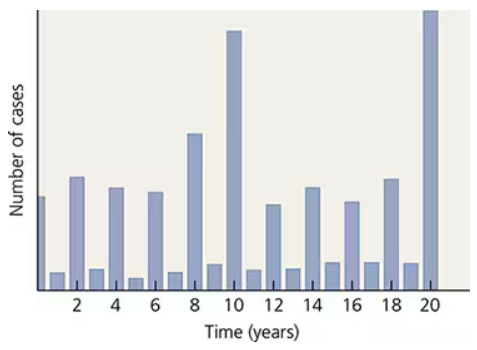
Label the flu epidemics. How can you best explain the biennial fluctuation in the number of cases? How can you explain the epidemics?
Bar graph showing flu case numbers fluctuating biennially over 20 years with peaks at years 10 and 20.

검증된 단계별 안내
1
Step 1: Identify the pattern of flu epidemics by observing the bar graph. Notice that the number of flu cases peaks significantly every 10 years (at years 10 and 20), indicating major epidemic events at these points.
Step 2: Label the flu epidemics as occurring at these peak years (year 10 and year 20) where the number of cases is highest, representing epidemic outbreaks.
Step 3: To explain the biennial fluctuation (every two years) in the number of cases, consider the concept of herd immunity and virus mutation. After a major epidemic, many individuals gain immunity, causing a drop in cases the following year.
Step 4: Over the next couple of years, immunity in the population wanes or the virus undergoes antigenic drift (small genetic changes), allowing the virus to infect more people again, leading to smaller outbreaks in the years between major epidemics.
Step 5: The major epidemics every 10 years can be explained by larger antigenic shifts or the emergence of new flu strains to which the population has little or no immunity, causing widespread infection and a large increase in cases.

비슷한 문제에 대한 검증된 영상 답변:

이 영상 해법은 위 문제에 도움이 된다고 튜터들이 추천한 것입니다.
영상 길이:
2m
도움이 되었나요?

주요 개념

질문에 올바르게 답하기 위해 반드시 이해해야 하는 핵심 개념들은 다음과 같습니다.

Epidemiology of Influenza

Influenza epidemics occur when a significant portion of the population becomes infected in a short period. These outbreaks are influenced by factors such as virus mutation, population immunity, and environmental conditions. Understanding the timing and scale of epidemics helps in predicting and managing flu seasons.
추천 영상:
05:27
Animal Viruses: Antigenic Drift vs. Antigenic Shift

Antigenic Drift and Shift

Influenza viruses undergo frequent genetic changes through antigenic drift (small mutations) and antigenic shift (major changes). These changes can lead to new virus strains that evade existing immunity, causing periodic epidemics. Antigenic drift explains seasonal flu variations, while antigenic shift can trigger pandemics.
추천 영상:
05:27
Animal Viruses: Antigenic Drift vs. Antigenic Shift

Population Immunity and Biennial Fluctuation

The biennial fluctuation in flu cases is often due to the build-up and waning of herd immunity. After a large epidemic, many individuals gain immunity, reducing cases the following year. As immunity declines or new strains emerge, susceptibility increases, leading to another epidemic every two years.
추천 영상:
03:19
Immune Tolerance
관련 실천
교과서 질문

The patient in room 519 exhibits yellowing skin and eyes, and it is suspected among the nursing staff that the diagnosis will be some kind of viral hepatitis. Make a chart of five kinds of hepatitis mentioned in this chapter, the infecting pathogen, how the patient might have become infected, and the relative degree of seriousness.

749
views
교과서 질문

Young Luis has skin lesions. His mother knows from microbiology class that five childhood diseases can produce spots. Name those five diseases and the viruses that cause each. List some questions to ask to determine which of these viruses Luis has.

1091
views
교과서 질문

The smallest animal viruses are in the family ___________.


a. Caliciviridae

b. Astroviridae

c. Togaviridae

d. Picornaviridae

1293
views
교과서 질문

What viral family causes each of these diseases? (A family may be used more than once.)


1. _____Myocarditis

2. _____Colorado tick fever

3. _____Rabies

4. _____Influenza

5. _____Dengue fever

6. _____German measles

7. _____Acute gastroenteritis

8. _____Ebola virus

9. _____RSV

10. _____Western equine encephalitis

11. _____No known disease


A. Rhabdoviridae

B. Paramyxoviridae

C. Reoviridae

D. Coronaviridae

E. Togaviridae

F. Flaviviridae

G. Orthomyxoviridae

H. Orphan virus

I. Caliciviridae

J. Filoviridae

K. Picornaviridae

1126
views
교과서 질문

_____All infections of polio are crippling.

1348
views
교과서 질문

What do viruses in the families Picornaviridae, Caliciviridae, Astroviridae, Coronaviridae, Togaviridae, Flaviviridae, and Retroviridae have in common?


a. They are arboviruses.

b. They are nonpathogenic.

c. They have positive single-stranded RNA genomes.

d. They have negative single-stranded RNA genomes.

1269
views