Ch. 3 - Cell Structure and Function
Bauman - Microbiology with Diseases by Taxonomy 6th Edition
Bauman6th EditionMicrobiology with Diseases by TaxonomyISBN: 9780134832302당신이 사용하는 게 아니라요?교과서 변경
3장, 문제 1

Match the structures with their descriptions following. A letter may be used more than once or not at all, and more than one letter may be correct for each blank.


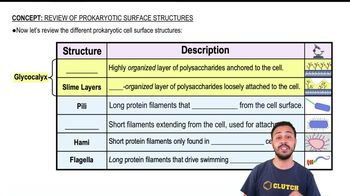
  ____ Glycocalyx
  ____ Flagella
  ____ Axial filaments
 ____ Cilia
  ____ Fimbriae
  ____ Pili
  ____ Hami


A. Bristlelike projections found in quantities of 100 or more
B. Long whip
C. Responsible for conjugation
D. “Sweet cup” composed of polysaccharides and/or polypeptides
E. Numerous “grappling-hook” projections
F. Responsible for motility of spirochetes
G. Extensions not used for cell motility
H. Made of tubulin in eukaryotes
I. Made of flagellin in bacteria

검증된 단계별 안내
1
Step 1: Understand each structure and its general characteristics. For example, Glycocalyx is an outer coating often composed of polysaccharides and/or polypeptides, which corresponds to a 'sweet cup' description.
Step 2: Match Glycocalyx with description D, since it is known as a 'sweet cup' composed of polysaccharides and/or polypeptides.
Step 3: Identify Flagella as long whip-like structures responsible for motility, which matches descriptions B (long whip) and I (made of flagellin in bacteria).
Step 4: Axial filaments are unique to spirochetes and are responsible for their motility, so match them with F (responsible for motility of spirochetes).
Step 5: For Cilia, which are bristlelike projections found in large numbers (100 or more) and made of tubulin in eukaryotes, match with A (bristlelike projections found in quantities of 100 or more) and H (made of tubulin in eukaryotes).

비슷한 문제에 대한 검증된 영상 답변:

이 영상 해법은 위 문제에 도움이 된다고 튜터들이 추천한 것입니다.
영상 길이:
1m
도움이 되었나요?

주요 개념

질문에 올바르게 답하기 위해 반드시 이해해야 하는 핵심 개념들은 다음과 같습니다.

Bacterial Surface Structures

Bacterial surface structures include various appendages like flagella, fimbriae, pili, and glycocalyx, each serving distinct functions such as motility, attachment, or protection. Understanding these structures helps in identifying their roles and matching them to descriptions based on morphology and function.
추천 영상:
가이드 코스
03:52
Review of Prokaryotic Surface Structures

Motility Mechanisms in Bacteria

Motility in bacteria is primarily facilitated by flagella and axial filaments. Flagella are long, whip-like structures made of flagellin that rotate to propel the cell, while axial filaments, found in spirochetes, wrap around the cell and enable corkscrew movement.
추천 영상:
가이드 코스
03:49
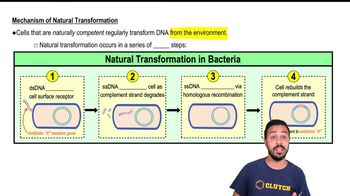
Mechanism of Natural Transformation

Functions of Specialized Appendages

Specialized appendages like pili and fimbriae have roles beyond motility; pili are involved in conjugation (DNA transfer), while fimbriae aid in attachment to surfaces. Hami are unique grappling-hook-like structures used by some archaea for attachment, highlighting diversity in microbial appendages.
추천 영상:
가이드 코스
06:04
Functional Groups