Ch. 5 - Microbial Metabolism
Bauman - Microbiology with Diseases by Taxonomy 6th Edition
Bauman6th EditionMicrobiology with Diseases by TaxonomyISBN: 9780134832302당신이 사용하는 게 아니라요?교과서 변경
5장, 문제 8

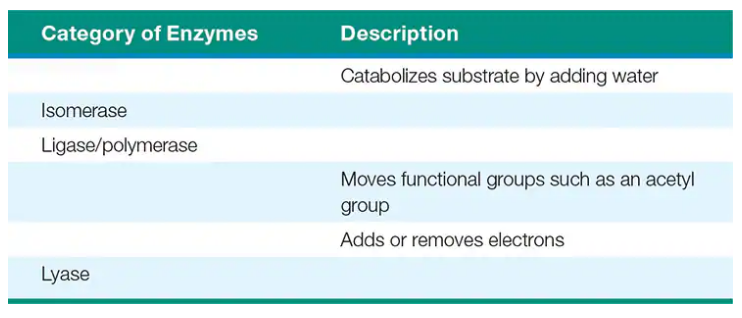
Complete the following chart:

The main coenzymes that carry electrons in catabolic pathways are _______ and ________.

검증된 단계별 안내
1
Step 1: Understand the enzyme categories and their functions. The chart lists enzyme categories such as Isomerase, Ligase/polymerase, and Lyase, with some descriptions missing. Begin by recalling the general functions of these enzymes: Isomerases rearrange molecules, Ligases/polymerases join molecules, and Lyases add or remove groups without hydrolysis.
Step 2: Fill in the missing descriptions based on enzyme functions. For example, Isomerases catalyze the rearrangement of atoms within a molecule, so the description could be 'Rearranges atoms within a molecule to form isomers.' Ligases/polymerases catalyze the joining of two molecules, often using ATP, so the description could be 'Joins two molecules together, often requiring energy from ATP.'
Step 3: Identify the enzyme that 'catabolizes substrate by adding water.' This description corresponds to Hydrolases, which catalyze hydrolysis reactions. This category should be added to the chart with the description 'Catabolizes substrate by adding water.'
Step 4: Recognize that the main coenzymes carrying electrons in catabolic pathways are NAD+ (nicotinamide adenine dinucleotide) and FAD (flavin adenine dinucleotide). These coenzymes accept electrons during oxidation reactions and are essential in energy metabolism.
Step 5: Complete the sentence by filling in the blanks with the names of these coenzymes: 'The main coenzymes that carry electrons in catabolic pathways are NAD+ and FAD.' This completes the understanding of electron carriers in catabolic reactions.

비슷한 문제에 대한 검증된 영상 답변:

이 영상 해법은 위 문제에 도움이 된다고 튜터들이 추천한 것입니다.
영상 길이:
2m
도움이 되었나요?

주요 개념

질문에 올바르게 답하기 위해 반드시 이해해야 하는 핵심 개념들은 다음과 같습니다.

Coenzymes in Electron Transport

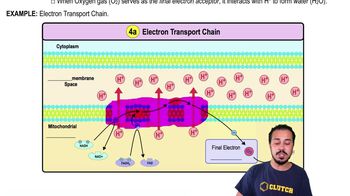
Coenzymes such as NAD+ (nicotinamide adenine dinucleotide) and FAD (flavin adenine dinucleotide) play crucial roles in catabolic pathways by carrying electrons from substrates to the electron transport chain. These molecules accept electrons during oxidation reactions, becoming reduced to NADH and FADH2, which then donate electrons to generate ATP.
추천 영상:
가이드 코스
07:41
Electron Transport Chain

Categories of Enzymes

Enzymes are classified based on the reactions they catalyze. For example, hydrolases add water to break bonds, isomerases rearrange molecules, ligases join molecules, and lyases add or remove groups without hydrolysis. Understanding these categories helps identify enzyme functions in metabolic pathways.
추천 영상:

Catabolic Pathways and Electron Transfer

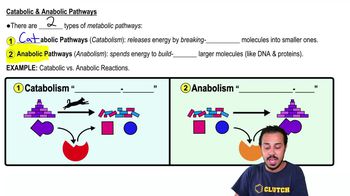
Catabolic pathways break down molecules to release energy, often transferring electrons to coenzymes. This electron transfer is essential for cellular respiration, where energy from electrons is used to produce ATP. Recognizing how electrons move through these pathways clarifies the role of coenzymes and enzymes.
추천 영상:
가이드 코스
03:25
Catabolic & Anabolic Pathways