Ch. 5 - Microbial Metabolism
Bauman - Microbiology with Diseases by Taxonomy 6th Edition
Bauman6th EditionMicrobiology with Diseases by TaxonomyISBN: 9780134832302당신이 사용하는 게 아니라요?교과서 변경
5장, 문제 1

Match the descriptions below with their corresponding terms.


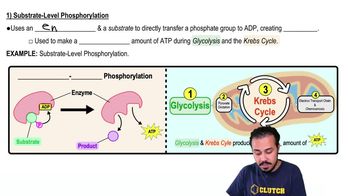
1. _____ Occurs when energy from a compound containing phosphate reacts with ADP to form ATP
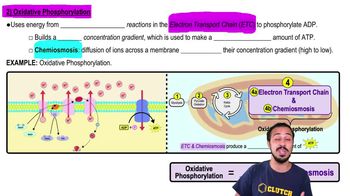
2. _____ Involves formation of ATP via reduction of coenzymes in the electron transport chain
3. _____ Begins with glycolysis
4. _____ Occurs when all active sites on substrate molecules are filled


A. Saturation
B. Oxidative phosphorylation
C. Substrate-level phosphorylation
D. Photophosphorylation
E. Carbohydrate catabolism

검증된 단계별 안내
1
Step 1: Understand the process described in each statement. For the first statement, identify the process where energy from a phosphate-containing compound directly transfers a phosphate group to ADP to form ATP. This is a key concept in energy metabolism.
Step 2: For the second statement, focus on the process that involves the electron transport chain and the reduction of coenzymes, which ultimately leads to ATP formation. This process is central to cellular respiration and energy production.
Step 3: The third statement mentions a process that begins with glycolysis. Recall that glycolysis is the initial step in breaking down carbohydrates to release energy, so identify the term related to carbohydrate breakdown.
Step 4: The fourth statement describes a condition where all active sites on substrate molecules are occupied, which is a concept related to enzyme activity and kinetics. Identify the term that matches this description.
Step 5: Match each description to the correct term from the list (A to E) based on your understanding of biochemical processes: substrate-level phosphorylation, oxidative phosphorylation, carbohydrate catabolism, and saturation. Photophosphorylation is related to light-driven ATP synthesis and can be ruled out if not fitting any description.

비슷한 문제에 대한 검증된 영상 답변:

이 영상 해법은 위 문제에 도움이 된다고 튜터들이 추천한 것입니다.
영상 길이:
4m
도움이 되었나요?

주요 개념

질문에 올바르게 답하기 위해 반드시 이해해야 하는 핵심 개념들은 다음과 같습니다.

Substrate-level phosphorylation

This is a process where ATP is formed directly by transferring a phosphate group from a high-energy substrate molecule to ADP. It occurs during glycolysis and the Krebs cycle, without involving the electron transport chain. It is a quick way to generate ATP in cells.
추천 영상:
가이드 코스
03:00
Substrate-Level Phosphorylation

Oxidative phosphorylation

Oxidative phosphorylation is the production of ATP using energy derived from the electron transport chain, where electrons are transferred through protein complexes and coenzymes. This process creates a proton gradient that drives ATP synthase to convert ADP to ATP, mainly occurring in aerobic respiration.
추천 영상:
가이드 코스
06:27
Oxidative Phosphorylation

Saturation

Saturation refers to the state when all active sites of enzymes or substrate molecules are fully occupied, meaning no additional substrate can bind until some active sites are freed. This concept is important in enzyme kinetics and affects the rate of biochemical reactions.
추천 영상: