

Ch. 7 - Microbial Genetics
Bauman - Microbiology with Diseases by Taxonomy 6th Edition
Bauman6th EditionMicrobiology with Diseases by TaxonomyISBN: 9780134832302당신이 사용하는 게 아니라요?교과서 변경
7장, 문제 2

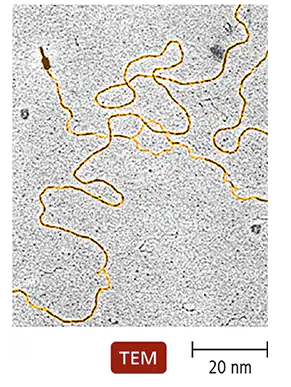
This bacteriophage DNA molecule has been warmed. Label the portions that likely have a higher ratio of GC base pairs and the portions that have a higher ratio of AT base pairs.

검증된 단계별 안내
1
Understand that DNA regions rich in GC base pairs have three hydrogen bonds, making them more thermally stable and less likely to denature (separate) when warmed, compared to AT-rich regions which have only two hydrogen bonds.
Examine the image for areas where the DNA appears double-stranded (thicker, more condensed regions) versus single-stranded (thinner, more extended or looped regions). The double-stranded regions likely correspond to GC-rich areas because they resist denaturation.
Identify the thinner, more extended or looped portions of the DNA molecule as regions that have likely denatured due to warming, indicating a higher ratio of AT base pairs.
Label the thicker, more intact double-stranded portions as GC-rich regions, since these areas remain stable and do not separate easily upon warming.
Summarize by marking the DNA molecule with labels indicating 'GC-rich' on the stable, double-stranded segments and 'AT-rich' on the denatured, single-stranded loops or thinner segments.

비슷한 문제에 대한 검증된 영상 답변:

이 영상 해법은 위 문제에 도움이 된다고 튜터들이 추천한 것입니다.
영상 길이:
3m
도움이 되었나요?

주요 개념

질문에 올바르게 답하기 위해 반드시 이해해야 하는 핵심 개념들은 다음과 같습니다.

Base Pairing in DNA

DNA consists of two strands held together by base pairs: adenine (A) pairs with thymine (T), and guanine (G) pairs with cytosine (C). The A-T pairs form two hydrogen bonds, while G-C pairs form three, making G-C pairs more thermally stable.
추천 영상:
가이드 코스
02:30
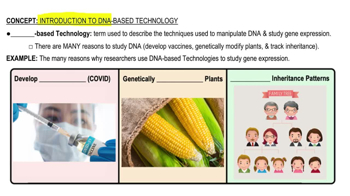
Introduction to DNA-Based Technology

Thermal Stability and Melting Temperature of DNA

Regions of DNA with higher G-C content have higher melting temperatures because the triple hydrogen bonds require more heat to break. Conversely, A-T rich regions melt at lower temperatures due to fewer hydrogen bonds, which affects DNA denaturation patterns.
추천 영상:
가이드 코스
04:07
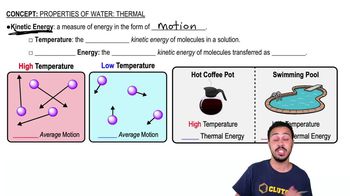
Properties of Water- Thermal

Transmission Electron Microscopy (TEM) Imaging of DNA

TEM allows visualization of DNA molecules at the nanoscale, showing structural features like loops and bends. In this image, the DNA appears as a single strand, and understanding the scale (20 nm) helps relate physical structure to molecular composition.
추천 영상:
가이드 코스
04:23
Transmission Electron Microscope (TEM)