Ch. 8 - Recombinant DNA Technology
Bauman - Microbiology with Diseases by Taxonomy 6th Edition
Bauman6th EditionMicrobiology with Diseases by TaxonomyISBN: 9780134832302당신이 사용하는 게 아니라요?교과서 변경
8장, 문제 1

Indicate which of the following are true and which are false. Rewrite any false statements to make them true by changing the underlined words.
__________ Restriction enzymes inhibit the movement of DNA at specific sites.

검증된 단계별 안내
1
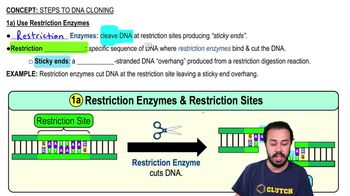
Step 1: Understand the role of restriction enzymes in molecular biology. Restriction enzymes, also known as restriction endonucleases, are proteins that recognize specific sequences of DNA and cut the DNA at or near these sites.
Step 2: Analyze the statement: 'Restriction enzymes inhibit the movement of DNA at specific sites.' Consider whether restriction enzymes function by inhibiting movement or by cutting DNA.
Step 3: Recognize that restriction enzymes do not inhibit movement of DNA; instead, they cleave DNA at specific recognition sites, which is a key step in many molecular biology techniques such as cloning.
Step 4: Rewrite the false statement to make it true by replacing 'inhibit the movement of DNA' with 'cut DNA at specific sites.' The corrected statement should read: 'Restriction enzymes cut DNA at specific sites.'
Step 5: Summarize that restriction enzymes are molecular scissors that recognize specific DNA sequences and cleave the DNA, rather than inhibiting its movement.

비슷한 문제에 대한 검증된 영상 답변:

이 영상 해법은 위 문제에 도움이 된다고 튜터들이 추천한 것입니다.
영상 길이:
2m
도움이 되었나요?

주요 개념

질문에 올바르게 답하기 위해 반드시 이해해야 하는 핵심 개념들은 다음과 같습니다.

Restriction Enzymes

Restriction enzymes, also known as restriction endonucleases, are proteins that recognize specific DNA sequences and cut the DNA at or near these sites. They do not inhibit movement but cleave DNA, which is essential in molecular cloning and genetic analysis.
추천 영상:
가이드 코스
03:27
1a) Use Restriction Enzymes

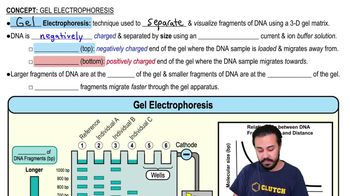
DNA Mobility in Gel Electrophoresis

DNA mobility refers to the movement of DNA fragments through a gel matrix during electrophoresis, influenced by size and charge. Restriction enzymes generate DNA fragments of specific lengths, which then separate based on size, but the enzymes themselves do not inhibit DNA movement.
추천 영상:
가이드 코스
07:58
Gel Electrophoresis

Function of Restriction Sites

Restriction sites are specific nucleotide sequences recognized by restriction enzymes where DNA is cut. These sites allow precise cleavage, enabling the study and manipulation of DNA fragments, but they do not act to inhibit DNA movement.
추천 영상:
가이드 코스
06:04
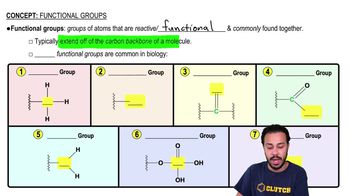
Functional Groups