Ch. 9 - Controlling Microbial Growth in the Environment
Bauman - Microbiology with Diseases by Taxonomy 6th Edition
Bauman6th EditionMicrobiology with Diseases by TaxonomyISBN: 9780134832302당신이 사용하는 게 아니라요?교과서 변경
9장, 문제 1

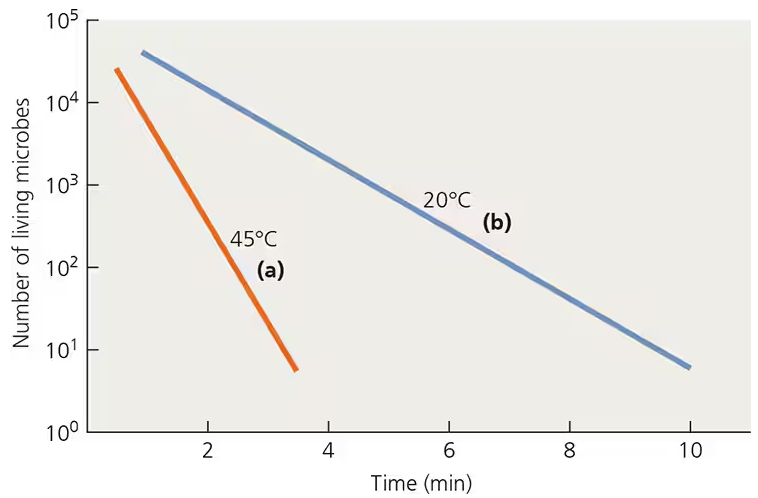
Calculate the decimal reduction time (D) for the two temperatures in the following graph.
Graph showing the decline in number of living microbes over time at 45°C and 20°C on a logarithmic scale.

검증된 단계별 안내
1
Identify the decimal reduction time (D) definition: it is the time required at a certain temperature to reduce the number of living microbes by 90%, which corresponds to a 1-log reduction on a logarithmic scale.
On the graph, locate the initial number of living microbes for each temperature (45°C and 20°C) at the starting time point.
For each temperature, find the time it takes for the number of living microbes to decrease by one logarithmic unit (i.e., from 10^4 to 10^3, or from 10^3 to 10^2, etc.). This time interval corresponds to the decimal reduction time (D).
Calculate the difference in time between these two points on the x-axis (time in minutes) for each temperature curve. This difference is the decimal reduction time (D) for that temperature.
Repeat the process for both the 45°C and 20°C curves to find their respective D values, noting that the steeper slope (45°C) will have a smaller D value compared to the gentler slope (20°C).

비슷한 문제에 대한 검증된 영상 답변:

이 영상 해법은 위 문제에 도움이 된다고 튜터들이 추천한 것입니다.
영상 길이:
1m
도움이 되었나요?

주요 개념

질문에 올바르게 답하기 위해 반드시 이해해야 하는 핵심 개념들은 다음과 같습니다.

Decimal Reduction Time (D-value)

The decimal reduction time (D-value) is the time required at a specific temperature to reduce the microbial population by 90%, or one log cycle. It is a key measure of microbial resistance to heat and is used to compare the effectiveness of different temperatures in killing microbes.
추천 영상:
05:48
Calculating Generation Times

Logarithmic Scale in Microbial Death Curves

Microbial death over time is often plotted on a logarithmic scale to linearize the exponential decline in the number of living microbes. This allows easier calculation of the D-value by measuring the time interval for a one-log reduction in microbial count.
추천 영상:
08:59
Microbial Growth Curves in a Closed System

Effect of Temperature on Microbial Death Rate

Higher temperatures generally increase the rate of microbial death, resulting in a shorter D-value. The graph shows two temperatures (20°C and 45°C), illustrating that microbes die faster at 45°C compared to 20°C, which is reflected in the steeper slope of the 45°C line.
추천 영상:
04:16
Temperature Requirements for Microbial Growth