Ch. 10 - Host Microbe Interactions and Pathogenesis
Norman-McKay- Microbiology: Basic and Clinical Principles 2nd Edition
Norman-McKay2nd EditionMicrobiology: Basic and Clinical PrinciplesISBN: 9780137661619당신이 사용하는 게 아니라요?교과서 변경
6장, 문제 10

A pathogen that makes endotoxin, enters through the fecal–oral route, and lacks a nucleus is most likely a
a. Virus.
b. Gram-positive bacterium.
c. Gram-negative bacterium.
d. Protozoan pathogen.
e. There is not enough information to answer this question.

검증된 단계별 안내
1
Step 1: Identify the key characteristics given in the problem: the pathogen produces endotoxin, enters through the fecal–oral route, and lacks a nucleus.
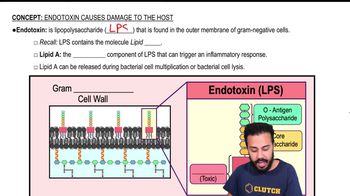
Step 2: Recall that endotoxins are components of the outer membrane of Gram-negative bacteria, specifically lipopolysaccharides (LPS), which are not produced by viruses, Gram-positive bacteria, or protozoa.
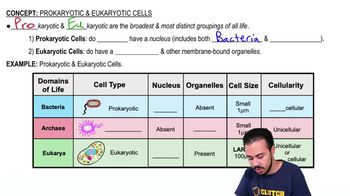
Step 3: Understand that organisms lacking a nucleus are prokaryotes, which include bacteria, while viruses and protozoa do not fit this description (viruses are acellular, protozoa are eukaryotic with nuclei).
Step 4: Combine these facts: since the pathogen produces endotoxin (a feature of Gram-negative bacteria) and lacks a nucleus (prokaryotic), it is most consistent with being a Gram-negative bacterium.
Step 5: Therefore, the best answer choice corresponds to the Gram-negative bacterium option.

비슷한 문제에 대한 검증된 영상 답변:

이 영상 해법은 위 문제에 도움이 된다고 튜터들이 추천한 것입니다.
영상 길이:
1m
도움이 되었나요?

주요 개념

질문에 올바르게 답하기 위해 반드시 이해해야 하는 핵심 개념들은 다음과 같습니다.

Endotoxins and Their Source

Endotoxins are toxic components found in the outer membrane of Gram-negative bacteria, specifically lipopolysaccharides (LPS). They are released when the bacterial cell wall breaks down, causing strong immune responses. Understanding endotoxins helps identify the type of pathogen involved.
추천 영상:

Fecal–Oral Route of Transmission

The fecal–oral route is a common transmission pathway where pathogens in fecal matter contaminate food or water and enter a new host through ingestion. Many gastrointestinal pathogens, including certain bacteria, viruses, and protozoa, spread this way, influencing infection control and diagnosis.
추천 영상:
가이드 코스
04:23
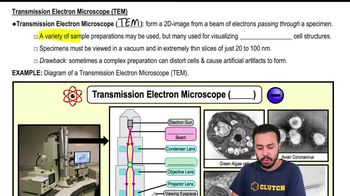
Transmission Electron Microscope (TEM)

Prokaryotic vs. Eukaryotic Cell Structure

Prokaryotes, such as bacteria, lack a nucleus, while eukaryotes, like protozoa, have a defined nucleus. Identifying whether a pathogen has a nucleus helps distinguish between bacterial and protozoan infections, which is critical for accurate classification and treatment.
추천 영상:
가이드 코스
05:54
Prokaryotic & Eukaryotic Cells