Ch. 10 - Host Microbe Interactions and Pathogenesis
Norman-McKay- Microbiology: Basic and Clinical Principles 2nd Edition
Norman-McKay2nd EditionMicrobiology: Basic and Clinical PrinciplesISBN: 9780137661619당신이 사용하는 게 아니라요?교과서 변경
6장, 문제 7

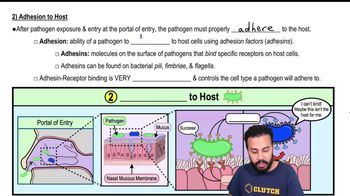
Pili, fimbriae, and sialic acid binding factors are examples of ________, which are virulence factors that allow pathogens to ________ host tissues––an essential early step in pathogenesis. In contrast, flagella, collagenases, and coagulases tend to act as ________, which help pathogens spread deeper into host tissues.

검증된 단계별 안내
1
Understand the role of pili, fimbriae, and sialic acid binding factors: These are surface structures or molecules that help pathogens attach to host cells. Therefore, they are examples of adhesins.
Recognize the function of adhesins: Adhesins allow pathogens to adhere or stick to host tissues, which is a crucial initial step in establishing infection.
Identify the role of flagella, collagenases, and coagulases: These factors are involved in helping pathogens move through or break down host tissues, facilitating deeper invasion.
Classify flagella, collagenases, and coagulases as invasins: Invasins are virulence factors that promote the spread of pathogens within host tissues.
Fill in the blanks accordingly: Pili, fimbriae, and sialic acid binding factors are examples of adhesins, which allow pathogens to adhere to host tissues. In contrast, flagella, collagenases, and coagulases act as invasins, helping pathogens spread deeper into host tissues.

비슷한 문제에 대한 검증된 영상 답변:

이 영상 해법은 위 문제에 도움이 된다고 튜터들이 추천한 것입니다.
영상 길이:
1m

주요 개념

질문에 올바르게 답하기 위해 반드시 이해해야 하는 핵심 개념들은 다음과 같습니다.

Adhesins

Adhesins are surface structures or molecules on pathogens, such as pili and fimbriae, that enable them to attach specifically to host cell receptors. This attachment is crucial for colonization and establishing infection, as it allows the pathogen to resist flushing mechanisms and initiate pathogenesis.
추천 영상:
03:59
2) Adhesion to Host

Virulence Factors

Virulence factors are molecules produced by pathogens that enhance their ability to cause disease. These include adhesins for attachment, enzymes for tissue invasion, and toxins that damage host cells, all contributing to the pathogen's survival and proliferation within the host.
추천 영상:
03:05
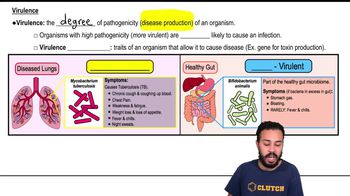
Virulence

Invasins

Invasins are virulence factors like flagella, collagenases, and coagulases that facilitate the spread of pathogens through host tissues. They help pathogens penetrate deeper by breaking down tissue barriers or aiding movement, thus promoting dissemination beyond the initial site of infection.
관련 실천
교과서 질문

Indicate the true statements and then correct the false statements so that they are true.

a. HIV is transmitted by a parenteral route.

b. Candida albicans is an opportunistic pathogen that can cause disease in an immune-competent host if the normal microbiota are disrupted.

c. Gram-positive bacteria may produce endotoxin.

d. Siderophores help pathogens obtain calcium.

e. Emerging pathogens tend to exhibit expanded tropism.

f. The more toxic a substance is, the higher its LD50.

g. Virulence is the ability of a microbe to cause disease.

h. Gram-negative bacteria may produce exotoxins.

31
views
교과서 질문

A pathogen that makes endotoxin, enters through the fecal–oral route, and lacks a nucleus is most likely a

a. Virus.

b. Gram-positive bacterium.

c. Gram-negative bacterium.

d. Protozoan pathogen.

e. There is not enough information to answer this question.

1294
views
교과서 질문

Select the false statement about normal microbiota.

a. They compete with pathogens.

b. They do not include potential pathogens.

c. They make vitamins for the host.

d. They train the immune system.

e. A disruption in their balance can lead to disease.

1594
views
교과서 질문

What is a reservoir, and why can C. difficile use a fomite as an effective environmental reservoir?

1434
views
교과서 질문

Toxigenic microbes produce _______. A high ID50 would suggest _______, and a low LD50 would suggest _______.

1270
views
교과서 질문

Which of the following is true regarding tropism?

a. It is the preference of a pathogen for a given tissue.

b. It is constant for a given microbe.

c. It limits a pathogen to infecting only one host.

d. It is determined by portal of entry.

e. It is independent of host factors.

846
views