Antigen ________ is a scenario in which pathogen antigens resemble host antigens. Antigen ________ is a scenario in which the pathogen changes its antigens. These are just a couple of ways that pathogens may avoid host immune system detection.
Ch. 12 - Adaptive Immunity

Norman-McKay2nd EditionMicrobiology: Basic and Clinical PrinciplesISBN: 9780137661619당신이 사용하는 게 아니라요?교과서 변경
8장, 문제 17a
Select all the false statements about artificially acquired immunity.
a. It can be passive
b. It can be active
c. It may be generated by vaccines
d. It is a form of autoimmunity
e. It may generate memory cells
f. An example includes the transfer of antibodies across the placenta
검증된 단계별 안내1
Step 1: Understand the definition of artificially acquired immunity. It refers to immunity gained through medical intervention, such as vaccines or antibody injections, rather than through natural infection or maternal transfer.
Step 2: Analyze each statement in the context of artificially acquired immunity: (a) It can be passive — this is true because passive immunity can be given artificially via antibody injections.
Step 3: (b) It can be active — this is true because vaccines stimulate the body's own immune system to produce a response, generating active immunity.
Step 4: (c) It may be generated by vaccines — this is true since vaccines are a common method to artificially induce active immunity.
Step 5: (d) It is a form of autoimmunity — this is false because autoimmunity involves the immune system attacking the body's own cells, which is unrelated to artificially acquired immunity.

비슷한 문제에 대한 검증된 영상 답변:
이 영상 해법은 위 문제에 도움이 된다고 튜터들이 추천한 것입니다.
영상 길이:
2m도움이 되었나요?
주요 개념
질문에 올바르게 답하기 위해 반드시 이해해야 하는 핵심 개념들은 다음과 같습니다.
Artificially Acquired Immunity
Artificially acquired immunity is immunity gained through deliberate exposure to antigens, such as vaccines or antibody injections. It can be active, where the body produces its own antibodies, or passive, where pre-formed antibodies are introduced. This immunity is distinct from natural immunity, which occurs through natural infection or maternal transfer.
추천 영상:
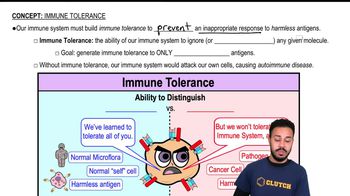
Immune Tolerance
Active vs. Passive Immunity
Active immunity involves the activation of the immune system to produce memory cells and antibodies after exposure to an antigen, providing long-term protection. Passive immunity involves receiving antibodies from an external source, offering immediate but temporary protection without memory cell formation.
추천 영상:
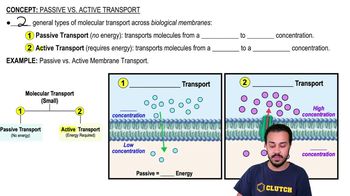
Passive vs. Active Transport
Autoimmunity
Autoimmunity occurs when the immune system mistakenly attacks the body's own cells, leading to autoimmune diseases. It is unrelated to artificially acquired immunity, which targets foreign antigens and does not involve self-reactivity or immune system malfunction.
추천 영상:
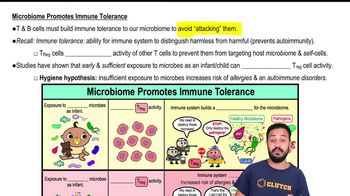
Microbiome Promotes Immune Tolerance
관련 실천
교과서 질문
1462
views
교과서 질문
What is IgA protease, and what effect would it possibly have on host immune function?
1650
views
교과서 질문
List the antibody isotype(s) that exhibit the stated feature. Some features will be assigned to more than one antibody.
Feature:
Most abundant antibody in serum
Made as a dimer
Stimulates allergic responses
Does not cross the placenta
Considered a complement activator
Rare antibody that’s poorly characterized
Main antibody in breast milk and mucus
Dominates the secondary immune response
Made early in the course of infection
Made in a primary immune response
1576
views
교과서 질문
Label the indicated parts of the antibody.
1515
views
교과서 질문
What is opsonization, and which antibodies have opsonizing activity?
2123
views
교과서 질문
Why is a second signal useful in T cell activation?
1889
views
