Ch. 12 - Adaptive Immunity
Norman-McKay- Microbiology: Basic and Clinical Principles 2nd Edition
Norman-McKay2nd EditionMicrobiology: Basic and Clinical PrinciplesISBN: 9780137661619당신이 사용하는 게 아니라요?교과서 변경
12장, 문제 16

Why is a second signal useful in T cell activation?

검증된 단계별 안내
1
Understand that T cell activation requires more than just recognition of the antigen; it involves multiple signals to ensure proper immune response.
Identify the first signal as the interaction between the T cell receptor (TCR) and the antigen-MHC complex presented by an antigen-presenting cell (APC). This signal alone is not sufficient for full activation.
Recognize that the second signal, often called the co-stimulatory signal, is provided by interactions between co-stimulatory molecules on the APC (such as CD80/CD86) and receptors on the T cell (such as CD28).
Explain that the second signal is crucial because it confirms that the antigen is presented in a proper context, preventing accidental activation of T cells that could lead to autoimmunity.
Conclude that the second signal promotes T cell proliferation, survival, and differentiation, ensuring a robust and controlled immune response.

비슷한 문제에 대한 검증된 영상 답변:

이 영상 해법은 위 문제에 도움이 된다고 튜터들이 추천한 것입니다.
영상 길이:
1m
도움이 되었나요?

주요 개념

질문에 올바르게 답하기 위해 반드시 이해해야 하는 핵심 개념들은 다음과 같습니다.

T Cell Activation

T cell activation is a critical immune response process where T cells recognize antigens presented by antigen-presenting cells (APCs). This recognition initiates signaling pathways that lead to T cell proliferation, differentiation, and immune function. Proper activation ensures an effective defense against pathogens.
추천 영상:
가이드 코스
03:29
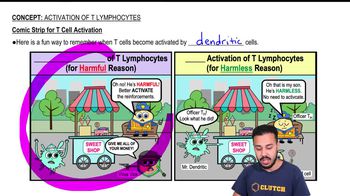
Comic Strip for T Cell Activation

Signal 1: Antigen Recognition

The first signal in T cell activation occurs when the T cell receptor (TCR) binds to a specific antigen presented on major histocompatibility complex (MHC) molecules of APCs. This signal alone is insufficient for full activation and can lead to T cell anergy or tolerance if not accompanied by a second signal.
추천 영상:
가이드 코스
04:24
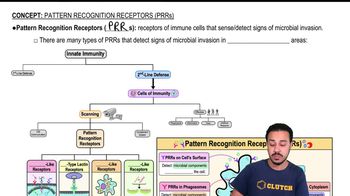
Pattern Recognition Receptors

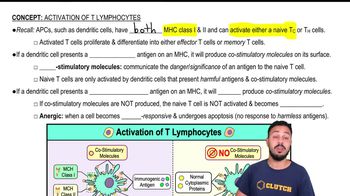
Signal 2: Costimulatory Signal

The second signal, or costimulatory signal, is provided by interactions between costimulatory molecules on APCs (e.g., CD80/CD86) and receptors on T cells (e.g., CD28). This signal confirms the presence of a genuine threat, preventing inappropriate activation and promoting full T cell activation, survival, and cytokine production.
추천 영상:
가이드 코스
07:33
Activation of T Lymphocytes