Ch. 12 - Adaptive Immunity
Norman-McKay- Microbiology: Basic and Clinical Principles 2nd Edition
Norman-McKay2nd EditionMicrobiology: Basic and Clinical PrinciplesISBN: 9780137661619당신이 사용하는 게 아니라요?교과서 변경
8장, 문제 12

Which of the following is not a function of antibodies?
a. Opsonization
b. Activating complement proteins
c. Activating T helper cells
d. Enhancing phagocytosis
e. Antigen neutralization

검증된 단계별 안내
1
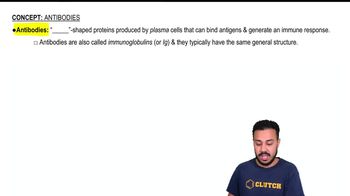
Step 1: Understand the role of antibodies in the immune system. Antibodies, also known as immunoglobulins, are proteins produced by B cells that specifically recognize and bind to antigens (foreign molecules). Their main functions include neutralizing pathogens, opsonization, activating complement proteins, and enhancing phagocytosis.
Step 2: Define each option in the context of antibody function: a) Opsonization is the process where antibodies coat pathogens to enhance their recognition and ingestion by phagocytes. b) Activating complement proteins involves antibodies triggering the complement cascade to destroy pathogens. c) Activating T helper cells refers to stimulating T helper cells, which is primarily a function of antigen-presenting cells, not antibodies. d) Enhancing phagocytosis is closely related to opsonization, where antibodies facilitate the engulfment of pathogens by phagocytes. e) Antigen neutralization is when antibodies bind to pathogens or toxins to block their harmful effects.
Step 3: Analyze which function is not directly performed by antibodies. While antibodies can bind antigens and activate complement or opsonize pathogens, the activation of T helper cells is generally mediated by antigen-presenting cells presenting processed antigen fragments to T cells, not by antibodies themselves.
Step 4: Conclude that the function 'activating T helper cells' is not a direct role of antibodies, distinguishing it from the other listed functions.
Step 5: Summarize that antibodies primarily function in neutralization, opsonization, complement activation, and enhancing phagocytosis, but do not directly activate T helper cells.

비슷한 문제에 대한 검증된 영상 답변:

이 영상 해법은 위 문제에 도움이 된다고 튜터들이 추천한 것입니다.
영상 길이:
3m
도움이 되었나요?

주요 개념

질문에 올바르게 답하기 위해 반드시 이해해야 하는 핵심 개념들은 다음과 같습니다.

Functions of Antibodies

Antibodies are proteins produced by B cells that recognize and bind specific antigens. Their main functions include neutralizing pathogens, opsonization (marking pathogens for phagocytosis), activating the complement system, and enhancing phagocytosis to help clear infections.
추천 영상:
00:48
Antibodies

Complement System Activation

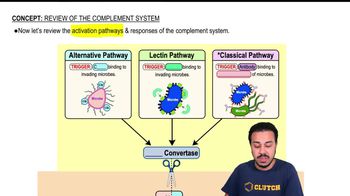
Antibodies, especially IgM and IgG, can activate the complement cascade by binding to antigens. This activation leads to pathogen lysis, inflammation, and enhanced phagocytosis, playing a crucial role in immune defense.
추천 영상:
05:15
Review of the Complement System

Role of T Helper Cells in Immunity

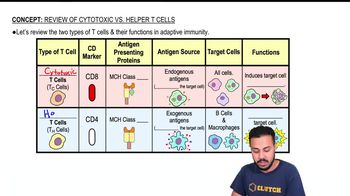
T helper cells are activated by antigen-presenting cells, not directly by antibodies. They coordinate immune responses by releasing cytokines that stimulate B cells and other immune cells, but antibodies themselves do not activate T helper cells.
추천 영상:
04:27
Review of Cytotoxic vs Helper T Cells