Ch. 12 - Adaptive Immunity
Norman-McKay- Microbiology: Basic and Clinical Principles 2nd Edition
Norman-McKay2nd EditionMicrobiology: Basic and Clinical PrinciplesISBN: 9780137661619당신이 사용하는 게 아니라요?교과서 변경
8장, 문제 9

Compare and contrast T-dependent and T-independent antigens.

검증된 단계별 안내
1
Start by defining what antigens are: molecules that elicit an immune response, specifically by activating B cells to produce antibodies.
Explain T-dependent antigens: these require the help of T helper cells to activate B cells. Typically, these are protein antigens that induce a strong, long-lasting immune response with memory cell formation.
Describe T-independent antigens: these can activate B cells without T cell help. Usually, they are polysaccharides or repeating epitopes that cross-link B cell receptors, leading to a faster but generally weaker immune response without memory cell formation.
Compare the immune responses: T-dependent antigens lead to class switching (e.g., from IgM to IgG), affinity maturation, and memory B cell generation, whereas T-independent antigens mainly produce IgM antibodies with limited class switching and no memory.
Summarize the biological significance: T-dependent responses are crucial for long-term immunity and vaccine effectiveness, while T-independent responses provide rapid defense against certain pathogens but lack lasting immunity.

비슷한 문제에 대한 검증된 영상 답변:

이 영상 해법은 위 문제에 도움이 된다고 튜터들이 추천한 것입니다.
영상 길이:
4m
도움이 되었나요?

주요 개념

질문에 올바르게 답하기 위해 반드시 이해해야 하는 핵심 개념들은 다음과 같습니다.

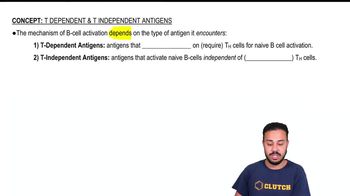
T-Dependent Antigens

T-dependent antigens require help from T helper cells to activate B cells. These antigens are typically proteins that induce a strong immune response, including class switching and memory B cell formation, leading to long-lasting immunity.
추천 영상:
02:08
T Dependent & T Independent Antigens

T-Independent Antigens

T-independent antigens can activate B cells without T cell assistance. Usually polysaccharides or repeating epitopes, they trigger a rapid but weaker immune response, mainly producing IgM antibodies without significant memory cell development.
추천 영상:
02:08
T Dependent & T Independent Antigens

Immune Response Differences

The main differences between T-dependent and T-independent responses lie in the involvement of T cells, antibody class switching, and memory formation. T-dependent responses are more robust and long-lasting, while T-independent responses are quicker but less durable.
추천 영상:
02:57
Intro to Immune Response Damage