Ch. 2 - Biochemistry Basics
Norman-McKay- Microbiology: Basic and Clinical Principles 2nd Edition
Norman-McKay2nd EditionMicrobiology: Basic and Clinical PrinciplesISBN: 9780137661619당신이 사용하는 게 아니라요?교과서 변경
1장, 문제 3

Select all of the compounds from the following list. If it is not a compound, then state what it is.
a. H2O
b. HCO3-
c. O2
d. H2
e. Li2+
f. C6H12O6
g. H+

검증된 단계별 안내
1
Step 1: Understand the definition of a compound. A compound is a substance formed when two or more different elements are chemically bonded together in fixed proportions.
Step 2: Analyze each item in the list to determine if it contains more than one type of element bonded together (compound) or if it is a molecule of a single element or an ion.
Step 3: For each item, identify the elements present: a. H2O contains hydrogen and oxygen (different elements) → compound; b. HCO3 contains hydrogen, carbon, and oxygen (different elements) → compound; c. O2 contains only oxygen atoms (same element) → molecule, not a compound; d. H2 contains only hydrogen atoms (same element) → molecule, not a compound; e. Li2+ is a lithium ion with a charge, consisting of only lithium atoms (same element) → ion, not a compound; f. C6H12O6 contains carbon, hydrogen, and oxygen (different elements) → compound; g. H+ is a hydrogen ion (single element) → ion, not a compound.
Step 4: Summarize the classification: compounds are those with multiple different elements chemically bonded; molecules of a single element are not compounds; ions are charged species and not compounds unless they contain multiple elements.
Step 5: Conclude by listing which are compounds and stating the nature of the others (molecule of single element or ion).

비슷한 문제에 대한 검증된 영상 답변:

이 영상 해법은 위 문제에 도움이 된다고 튜터들이 추천한 것입니다.
영상 길이:
1m
도움이 되었나요?

주요 개념

질문에 올바르게 답하기 위해 반드시 이해해야 하는 핵심 개념들은 다음과 같습니다.

Definition of a Chemical Compound

A chemical compound is a substance formed when two or more different elements chemically bond in fixed proportions. Compounds have unique properties distinct from their constituent elements. For example, H2O (water) is a compound made of hydrogen and oxygen atoms bonded together.
추천 영상:
02:27
Phenolic Compounds

Difference Between Elements, Ions, and Molecules

Elements consist of only one type of atom, such as O2 (oxygen molecule) or H2 (hydrogen molecule). Ions are charged particles, like Li2+, which is a lithium ion with a positive charge. Molecules can be elements (O2) or compounds (H2O), depending on whether they contain one or multiple element types.
추천 영상:
04:55
Types of Small Molecule Transport Review

Chemical Formulas and Their Interpretation

Chemical formulas represent the types and numbers of atoms in a substance. For example, HCO3 is the bicarbonate ion, not a neutral compound, while C6H12O6 is glucose, a compound with carbon, hydrogen, and oxygen. Understanding formulas helps identify whether a substance is a compound, element, or ion.
추천 영상:
06:53
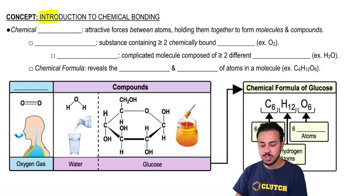
Introduction to Chemical Bonding