Ch. 2 - Biochemistry Basics
Norman-McKay- Microbiology: Basic and Clinical Principles 2nd Edition
Norman-McKay2nd EditionMicrobiology: Basic and Clinical PrinciplesISBN: 9780137661619당신이 사용하는 게 아니라요?교과서 변경
2장, 문제 6

Write the molecular formula for a substance that contains two oxygen molecules, two carbons, and four hydrogen atoms. Be sure to follow the standard conventions of writing molecular formulas.

검증된 단계별 안내
1
Identify the elements present and their quantities: 2 oxygen atoms, 2 carbon atoms, and 4 hydrogen atoms.
Recall the standard convention for writing molecular formulas: list carbon (C) atoms first, hydrogen (H) atoms second, and then all other elements in alphabetical order.
Apply the convention to the given elements: carbon (C) comes first, hydrogen (H) second, and oxygen (O) last.
Write the molecular formula by placing the element symbols followed by their respective quantities as subscripts: C with 2 atoms, H with 4 atoms, and O with 2 atoms.
Combine these into the final molecular formula: \(C_2H_4O_2\).

비슷한 문제에 대한 검증된 영상 답변:

이 영상 해법은 위 문제에 도움이 된다고 튜터들이 추천한 것입니다.
영상 길이:
1m
도움이 되었나요?

주요 개념

질문에 올바르게 답하기 위해 반드시 이해해야 하는 핵심 개념들은 다음과 같습니다.

Molecular Formula

A molecular formula represents the exact number and types of atoms in a molecule, using element symbols and numerical subscripts. It does not show the arrangement of atoms but indicates the composition, such as C2H4O2 for acetic acid.
추천 영상:
가이드 코스
03:20
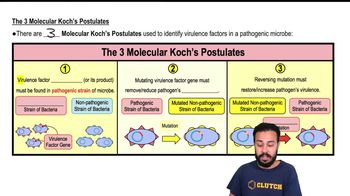
The 3 Molecular Koch's Postulates

Element Symbols and Subscripts

Element symbols are one- or two-letter abbreviations of elements (e.g., C for carbon, H for hydrogen, O for oxygen). Subscripts following these symbols indicate the number of atoms of each element in the molecule, with no subscript meaning one atom.
추천 영상:
가이드 코스
03:36
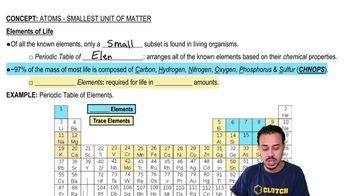
Elements of Life

Standard Conventions for Writing Molecular Formulas

Molecular formulas are written with carbon atoms first, hydrogen second, and then other elements in alphabetical order. This convention helps maintain consistency and clarity, so a molecule with 2 carbons, 4 hydrogens, and 2 oxygens is written as C2H4O2.
추천 영상:
가이드 코스
01:32
Intro to Molecular Koch's Postulates
관련 실천
교과서 질문

Acids donate _______________________ to an aqueous solution, which will lead to a(n) _______________________ in pH. In contrast, bases donate _______________________ to an aqueous solution and will _______________________ the pH. The pH of a solution with more OH

than H+ will have a(n) _______________________ pH.

1395
views
교과서 질문

Determine the following:

a. The molarity of a solution with 0.5 moles of glucose per liter of water.

b. The concentration (in weight/volume percent) of a solution that contains 20 grams of sodium chloride per liter of water.

c. The concentration (in mg/dL) of a solution with 1 gram of lactic acid per 100 mL of solution.

d. The molarity of a solution with 1 mmol of solute in 1 L of water.

1386
views
교과서 질문

Indicate the true statements and then correct the false statements so that they are true.

a. Isotopes are atoms with differing numbers of protons and the same number of neutrons.

b. A cation is a positive ion.

c. Redox reactions create ions.

d. Equal sharing of electrons leads to polar covalent bonds.

e. Ions are charged atoms.

f. CO2 is an inorganic molecule.

g. Isomers have the same molecular formula but different structures.

h. Adding a base to a solution will decrease the pH.

1333
views
교과서 질문

Select all of the compounds from the following list. If it is not a compound, then state what it is.

a. H2O

b. HCO3-

c. O2

d. H2

e. Li2+

f. C6H12O6

g. H+

1341
views
교과서 질문

In each of the following reactions, identify the products and reactants, and state what class of reaction is shown.

1353
views
교과서 질문

Select the false statement about salts.

a. Salts are ionic compounds.

b. Salts are formed when an acid and a base react with each other.

c. Salts consist of an anion and a cation component.

d. Salts may be inorganic.

e. Salts are usually acids.

f. Salts are usually hydrophilic.

1407
views