Ch. 4 - Introduction to Eukaryotic Cells
Norman-McKay- Microbiology: Basic and Clinical Principles 2nd Edition
Norman-McKay2nd EditionMicrobiology: Basic and Clinical PrinciplesISBN: 9780137661619당신이 사용하는 게 아니라요?교과서 변경
2장, 문제 2

Which of the following are not characteristics of eukaryotes? Select all that apply.
a. They are generally simpler than prokaryotes.
b. They can be multicellular.
c. They all have a nucleus.
d. They tend to have multiple chromosomes.
e. They can have a cell wall.
f. They include pathogens.
g. They divide by mitosis.
h. They make up the Domain Archaea.
i. They make up the Domain Bacteria.
j. They make up the Domain Eukarya.

검증된 단계별 안내
1
Step 1: Understand the definition of eukaryotes. Eukaryotic cells have a true nucleus enclosed by a nuclear membrane, multiple linear chromosomes, and membrane-bound organelles. They can be unicellular or multicellular organisms.
Step 2: Evaluate each statement against eukaryotic characteristics. For example, statement (a) says 'They are generally simpler than prokaryotes.' Since eukaryotes are typically more complex, this statement is not a characteristic of eukaryotes.
Step 3: Consider statements about domains. Eukaryotes belong to the Domain Eukarya, so statements claiming they make up Domains Archaea or Bacteria (h and i) are incorrect for eukaryotes.
Step 4: Analyze statements about cell division and structure. Eukaryotes divide by mitosis (g), have nuclei (c), and tend to have multiple chromosomes (d). Some eukaryotes have cell walls (e.g., plants and fungi), so that is a characteristic.
Step 5: Summarize which statements do not apply to eukaryotes by identifying those that contradict the known features of eukaryotic cells, such as (a), (h), and (i).

비슷한 문제에 대한 검증된 영상 답변:

이 영상 해법은 위 문제에 도움이 된다고 튜터들이 추천한 것입니다.
영상 길이:
2m

주요 개념

질문에 올바르게 답하기 위해 반드시 이해해야 하는 핵심 개념들은 다음과 같습니다.

Differences Between Prokaryotes and Eukaryotes

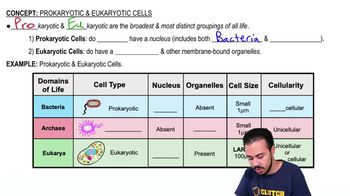
Prokaryotes are simpler, unicellular organisms without a nucleus, while eukaryotes have complex cells with a defined nucleus and membrane-bound organelles. Understanding these structural differences helps distinguish characteristics unique to eukaryotes.
추천 영상:
05:54
Prokaryotic & Eukaryotic Cells

Eukaryotic Cell Features

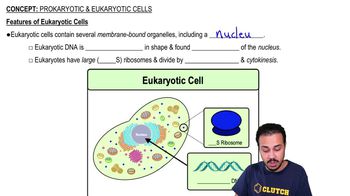
Eukaryotic cells typically have multiple linear chromosomes, can be multicellular or unicellular, may have cell walls (in plants and fungi), and divide by mitosis. These features contrast with prokaryotes, which usually have a single circular chromosome and divide by binary fission.
추천 영상:
04:17
Features of Eukaryotic Cells

Biological Classification Domains

Life is classified into three domains: Bacteria and Archaea (both prokaryotic) and Eukarya (eukaryotic). Eukaryotes belong exclusively to the Domain Eukarya, which includes animals, plants, fungi, and protists, while Bacteria and Archaea are prokaryotic domains.
추천 영상:
02:10
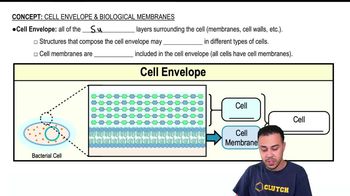
Biological Membranes