Ch. 6 - Viruses and Prions
Norman-McKay- Microbiology: Basic and Clinical Principles 2nd Edition
Norman-McKay2nd EditionMicrobiology: Basic and Clinical PrinciplesISBN: 9780137661619당신이 사용하는 게 아니라요?교과서 변경
6장, 문제 11

Why don’t bacteriophages undergo an “uncoating” step during replication?

검증된 단계별 안내
1
Understand the concept of "uncoating" in viral replication: it refers to the removal of the viral capsid to release the viral genome into the host cell.
Recognize that bacteriophages inject their genetic material directly into the bacterial host cell, unlike many animal viruses that enter the host cell entirely.
Since bacteriophages do not enter the host cell as complete virions, their capsid remains outside the bacterial cell surface during infection.
Because the viral genome is directly delivered into the bacterial cytoplasm, there is no need for a separate uncoating step to release the genome inside the host.
Conclude that the absence of an uncoating step in bacteriophage replication is due to their unique infection mechanism involving direct genome injection rather than whole virion entry.

비슷한 문제에 대한 검증된 영상 답변:

이 영상 해법은 위 문제에 도움이 된다고 튜터들이 추천한 것입니다.
영상 길이:
1m
도움이 되었나요?

주요 개념

질문에 올바르게 답하기 위해 반드시 이해해야 하는 핵심 개념들은 다음과 같습니다.

Bacteriophage Structure and Genome Delivery

Bacteriophages are viruses that infect bacteria by injecting their genetic material directly into the host cell, leaving the protein coat outside. This direct genome delivery means the viral nucleic acid is already inside the host cytoplasm, eliminating the need for an uncoating step.
추천 영상:
가이드 코스
03:18
Genome Variability

Uncoating in Viral Replication

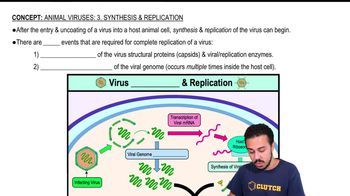
Uncoating is the process where a virus removes its protein coat to release its genome inside a host cell. This step is essential for many animal viruses that enter the cell enclosed in their capsid, but is unnecessary for bacteriophages due to their injection mechanism.
추천 영상:
가이드 코스
05:12
Persistent Viral Infections

Differences Between Animal Viruses and Bacteriophages

Animal viruses typically enter host cells via endocytosis or membrane fusion, requiring uncoating to access the genome. In contrast, bacteriophages inject their genome through the bacterial cell wall, bypassing the need for uncoating and streamlining replication.
추천 영상:
가이드 코스
04:26
Animal Viruses: 3. Synthesis & Replication