Ch. 8 - Microbial Metabolism
Norman-McKay- Microbiology: Basic and Clinical Principles 2nd Edition
Norman-McKay2nd EditionMicrobiology: Basic and Clinical PrinciplesISBN: 9780137661619당신이 사용하는 게 아니라요?교과서 변경
4장, 문제 10

_______________________ is a process that uses light energy to drive an electron transport chain to make ATP.

검증된 단계별 안내
1
Identify the key components of the process described: it uses light energy and involves an electron transport chain to produce ATP.
Recall that in microbiology, the process where light energy is used to drive an electron transport chain for ATP synthesis is known as photophosphorylation.
Understand that photophosphorylation occurs in photosynthetic organisms, such as plants, algae, and certain bacteria, where light energy excites electrons that move through the electron transport chain.
Recognize that this process results in the generation of a proton gradient across a membrane, which drives ATP synthase to produce ATP from ADP and inorganic phosphate.
Conclude that the blank in the sentence should be filled with the term 'Photophosphorylation' to accurately describe this light-driven ATP synthesis process.

비슷한 문제에 대한 검증된 영상 답변:

이 영상 해법은 위 문제에 도움이 된다고 튜터들이 추천한 것입니다.
영상 길이:
2m
도움이 되었나요?

주요 개념

질문에 올바르게 답하기 위해 반드시 이해해야 하는 핵심 개념들은 다음과 같습니다.

Photophosphorylation

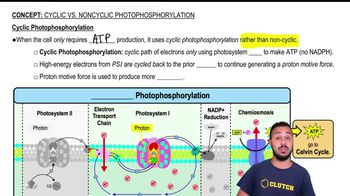
Photophosphorylation is the process by which light energy is used to drive an electron transport chain, resulting in the synthesis of ATP. It occurs in photosynthetic organisms, where light excites electrons that move through membrane proteins, creating a proton gradient that powers ATP synthase.
추천 영상:
04:36
Cyclic Photophosphorylation

Electron Transport Chain (ETC)

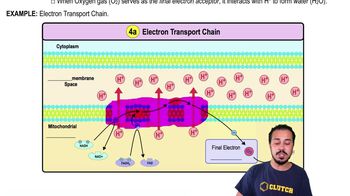
The electron transport chain is a series of protein complexes and electron carriers embedded in membranes that transfer electrons through redox reactions. This transfer creates a proton gradient across the membrane, which is essential for ATP production during cellular respiration and photosynthesis.
추천 영상:
07:41
Electron Transport Chain

ATP Synthesis

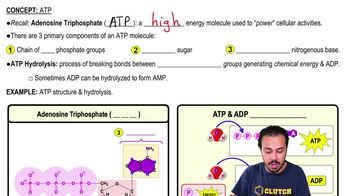
ATP synthesis is the process of producing adenosine triphosphate (ATP), the cell's energy currency. In photophosphorylation, ATP synthase uses the proton gradient generated by the electron transport chain to convert ADP and inorganic phosphate into ATP, providing energy for cellular activities.
추천 영상:
관련 실천
교과서 질문

Why do human cells require oxygen? Select all relevant statements.

a. To carry out glycolysis

b. To carry out fermentation

c. To carry out cellular respiration

d. To oxidize fats

e. To carry out substrate-level phosphorylation

f. To carry out oxidative phosphorylation

g. To carry out photophosphorylation

1125
views
교과서 질문

The photo shows an organism growing in glucose fermentation broth. What can you conclude about this specimen with regard to its ability (or lack thereof) to ferment the sugar sucrose? Explain your answer.

<IMAGE>

1005
views
교과서 질문

The _______________________ test detects if an organism can convert hydrogen peroxide to water and oxygen. The test result is usually _______________________ in anaerobic microbes and usually _______________________ in aerobic microbes. You know the test is positive by _______________________.

1417
views
1
rank
교과서 질문

_______________________ is a process that relies on a phosphorylated intermediate to directly convert ADP to ATP.

1479
views
교과서 질문

Draw and then fill out a Venn diagram (see sample version here) that compares and contrasts anaerobic respiration to aerobic respiration. The middle section of the diagram is where you should list the features these processes have in common. Include as many details as possible in this diagram to make this a useful exercise.

1226
views
교과서 질문

_______________________ is a process that uses energy from nutrients to fuel an electron transport chain to make ATP.

1378
views