Ch. 8 - Microbial Metabolism
Norman-McKay- Microbiology: Basic and Clinical Principles 2nd Edition
Norman-McKay2nd EditionMicrobiology: Basic and Clinical PrinciplesISBN: 9780137661619당신이 사용하는 게 아니라요?교과서 변경
4장, 문제 8

Why do human cells require oxygen? Select all relevant statements.
a. To carry out glycolysis
b. To carry out fermentation
c. To carry out cellular respiration
d. To oxidize fats
e. To carry out substrate-level phosphorylation
f. To carry out oxidative phosphorylation
g. To carry out photophosphorylation

검증된 단계별 안내
1
Step 1: Understand the role of oxygen in human cells. Oxygen is primarily used as the final electron acceptor in the electron transport chain during cellular respiration, which is essential for efficient ATP production.
Step 2: Evaluate each option based on the biochemical processes in human cells: a. Glycolysis does not require oxygen and occurs in the cytoplasm. b. Fermentation occurs in the absence of oxygen and is not the primary pathway in human cells under normal conditions. c. Cellular respiration includes glycolysis, the Krebs cycle, and oxidative phosphorylation, and requires oxygen for the latter stages. d. Oxidation of fats (beta-oxidation) occurs in mitochondria and ultimately feeds into cellular respiration, which requires oxygen. e. Substrate-level phosphorylation occurs during glycolysis and the Krebs cycle and does not directly require oxygen. f. Oxidative phosphorylation depends on oxygen as the final electron acceptor to generate ATP. g. Photophosphorylation occurs in plants and some bacteria during photosynthesis, not in human cells.
Step 3: Identify which processes explicitly require oxygen: cellular respiration (especially oxidative phosphorylation) and the oxidation of fats, since these processes depend on oxygen to accept electrons and produce ATP efficiently.
Step 4: Recognize that glycolysis, fermentation, and substrate-level phosphorylation can occur without oxygen, so they are not processes that require oxygen in human cells.
Step 5: Conclude that the correct statements are those related to oxygen-dependent processes: cellular respiration, oxidation of fats, and oxidative phosphorylation.

비슷한 문제에 대한 검증된 영상 답변:

이 영상 해법은 위 문제에 도움이 된다고 튜터들이 추천한 것입니다.
영상 길이:
2m
도움이 되었나요?

주요 개념

질문에 올바르게 답하기 위해 반드시 이해해야 하는 핵심 개념들은 다음과 같습니다.

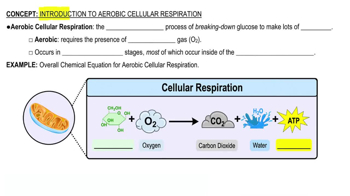
Cellular Respiration

Cellular respiration is the process by which cells convert glucose and oxygen into energy (ATP), carbon dioxide, and water. Oxygen acts as the final electron acceptor in the electron transport chain, enabling efficient ATP production. This process is essential for most human cells to meet their energy demands.
추천 영상:
가이드 코스
05:11
Introduction to Aerobic Cellular Respiration

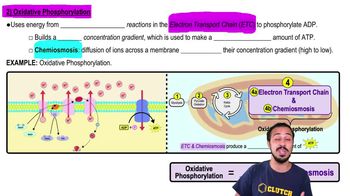
Oxidative Phosphorylation

Oxidative phosphorylation is the stage of cellular respiration where ATP is produced using energy from electrons transferred through the electron transport chain to oxygen. This process generates the majority of ATP in aerobic organisms and depends directly on oxygen availability.
추천 영상:
가이드 코스
06:27
Oxidative Phosphorylation

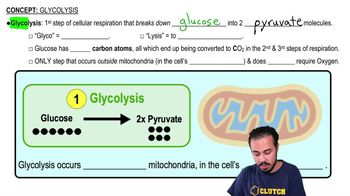
Glycolysis and Fermentation

Glycolysis is the anaerobic breakdown of glucose into pyruvate, producing a small amount of ATP without requiring oxygen. Fermentation occurs when oxygen is absent, allowing cells to regenerate NAD+ but producing less energy. Human cells primarily rely on oxygen for energy, so fermentation is not a major pathway.
추천 영상: