
Ch. 10 - Classification of Microorganisms
Tortora - Microbiology: An Introduction 14th Edition
Tortora14th EditionMicrobiology: An IntroductionISBN: 9780138200398당신이 사용하는 게 아니라요?교과서 변경
10장, 문제 2

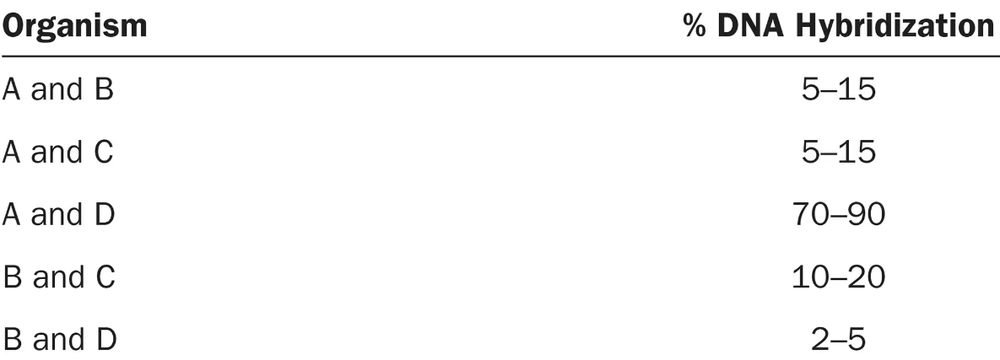
Here is some additional information on the organisms in question 1:
Table showing DNA hybridization percentages between organism pairs, highest similarity between A and D at 70–90%.
Which of these organisms are most closely related? Compare this answer with your response to review question 1.

검증된 단계별 안내
1
Identify the organisms presented in the image or information provided, noting their key characteristics such as morphology, genetic markers, metabolic traits, or other distinguishing features.
Recall or review the criteria used to determine relatedness among microorganisms, such as genetic similarity (e.g., 16S rRNA gene sequences), phenotypic traits, or evolutionary lineage.
Compare the characteristics of each organism pairwise to assess which share the most similarities, focusing on traits that indicate close evolutionary relationships.
Use a phylogenetic tree or similarity matrix if available, or construct a simple comparison table to visualize which organisms cluster together based on shared features.
Conclude which organisms are most closely related based on the highest degree of similarity, and then compare this conclusion with your previous answer from review question 1 to check for consistency or discrepancies.

비슷한 문제에 대한 검증된 영상 답변:

이 영상 해법은 위 문제에 도움이 된다고 튜터들이 추천한 것입니다.
영상 길이:
3m
도움이 되었나요?

주요 개념

질문에 올바르게 답하기 위해 반드시 이해해야 하는 핵심 개념들은 다음과 같습니다.

Phylogenetic Relationships

Phylogenetic relationships describe the evolutionary connections between organisms, often depicted as a tree showing common ancestors. Understanding these relationships helps determine which organisms share a more recent common ancestor and are thus more closely related.
추천 영상:
가이드 코스
05:59
Symbiotic Relationships

Molecular and Genetic Comparison

Comparing genetic material, such as DNA or RNA sequences, is a key method to assess relatedness among organisms. Similarities in gene sequences or molecular markers indicate closer evolutionary relationships.
추천 영상:

Morphological and Physiological Traits

Physical characteristics and metabolic features can provide clues about organism relatedness. While useful, these traits may be influenced by environmental factors and convergent evolution, so they are often combined with molecular data for accurate classification.
추천 영상:
가이드 코스
02:44
Types of Bacterial Cell Morphology
관련 실천
교과서 질문

Bacillus and Lactobacillus are not in the same order. This indicates that which one of the following is not sufficient to assign an organism to a taxon?

a. Biochemical characteristics

b. Amino acid sequencing

c. Phage typing

d. Serology

e. Morphological characteristics

1478
views
교과서 질문

Which of the following is false about scientific nomenclature?

a. Each name is specific.

b. Names vary with geographical location.

c. The names are standardized.

d. Each name consists of a genus and specific epithet.

e. It was first designed by Linnaeus.

1652
views
교과서 질문

Which of the following is used to classify organisms into the Kingdom Fungi?

a. Ability to photosynthesize; possess a cell wall

b. Unicellular; possess cell wall; prokaryotic

c. Unicellular; lacking cell wall; eukaryotic

d. Absorptive; possess cell wall; eukaryotic

e. Ingestive; lacking cell wall; multicellular; prokaryotic

1602
views
교과서 질문

Which of the following organisms are most closely related? Are any two the same species? On what did you base your answer?

1451
views
교과서 질문

Bergey’s Manual of Systematics of Archaea and Bacteria differs from Bergey’s Manual of Determinative Bacteriology in that the former

a. Groups bacteria into species

b. Groups bacteria according to phylogenetic relationships

c. Groups bacteria according to pathogenic properties

d. Groups bacteria into 19 species

e. All of the above

1697
views
교과서 질문

DRAW IT Use the following rRNA information to construct a cladogram for some of the organisms used in question 4. What is the purpose of a cladogram? How does your cladogram differ from a dichotomous key for these organisms?

1361
views