
Ch. 10 - Classification of Microorganisms
Tortora - Microbiology: An Introduction 14th Edition
Tortora14th EditionMicrobiology: An IntroductionISBN: 9780138200398당신이 사용하는 게 아니라요?교과서 변경
6장, 문제 1

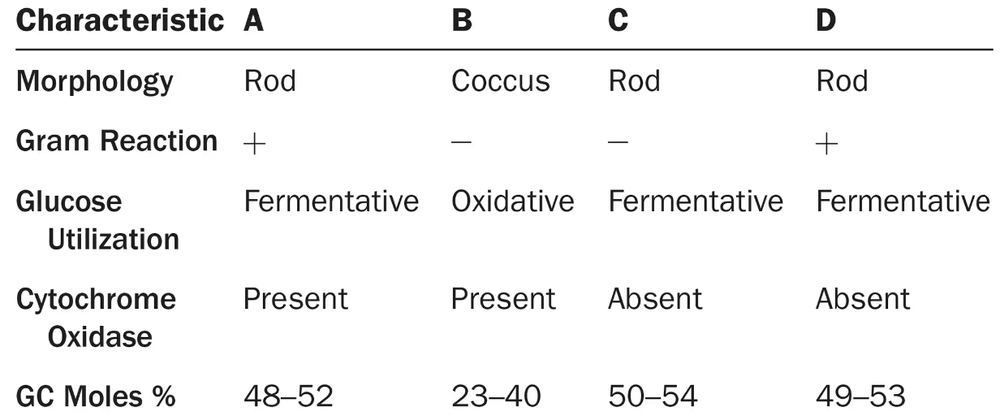
Which of the following organisms are most closely related? Are any two the same species? On what did you base your answer?

검증된 단계별 안내
1
Step 1: Identify the organisms presented in the image or problem statement. Note their names, characteristics, or any genetic information provided to compare them effectively.
Step 2: Understand the criteria used to determine relatedness among organisms. This often involves comparing genetic sequences (such as 16S rRNA gene sequences), morphological traits, or biochemical characteristics.
Step 3: Compare the genetic similarity or other relevant data between the organisms. Typically, organisms with very high genetic similarity (e.g., >97% similarity in 16S rRNA gene sequences) are considered closely related, and those with even higher similarity (e.g., >98.7-99%) might be the same species.
Step 4: Determine if any two organisms meet the threshold to be classified as the same species based on the data. This involves checking if their genetic or phenotypic differences fall within accepted species boundaries.
Step 5: Summarize your conclusion by stating which organisms are most closely related and whether any are the same species, clearly explaining the basis of your decision using the comparison criteria.

비슷한 문제에 대한 검증된 영상 답변:

이 영상 해법은 위 문제에 도움이 된다고 튜터들이 추천한 것입니다.
영상 길이:
3m
도움이 되었나요?

주요 개념

질문에 올바르게 답하기 위해 반드시 이해해야 하는 핵심 개념들은 다음과 같습니다.

Phylogenetic Relationships

Phylogenetic relationships describe the evolutionary connections between organisms, often depicted in a tree diagram. Organisms that share a recent common ancestor are more closely related. Understanding these relationships helps determine how species diverged over time.
추천 영상:
05:59
Symbiotic Relationships

Species Definition in Microbiology

In microbiology, species are often defined by genetic similarity, such as DNA-DNA hybridization or 16S rRNA gene sequence identity, typically above 97%. Phenotypic characteristics and ecological niches also contribute to species classification, but genetic criteria are primary.
추천 영상:
07:27
Introduction to Microbiology

Molecular Markers for Relatedness

Molecular markers like 16S rRNA gene sequences are used to assess relatedness among microorganisms. High sequence similarity indicates close relationships, while significant differences suggest distinct species. These markers provide a reliable basis for taxonomic classification.
추천 영상:
03:20
The 3 Molecular Koch's Postulates