Ch. 19 - Disorders Associated with the Immune System
Tortora - Microbiology: An Introduction 14th Edition
Tortora14th EditionMicrobiology: An IntroductionISBN: 9780138200398당신이 사용하는 게 아니라요?교과서 변경
15장, 문제 3

Cytotoxic autoimmunity differs from immune complex autoimmunity in that cytotoxic reactions
a. Involve antibodies
b. Do not involve complement
c. Are caused by T cells
d. Do not involve IgE antibodies
e. None of the above

검증된 단계별 안내
1
Step 1: Understand the two types of autoimmunity mentioned: cytotoxic autoimmunity and immune complex autoimmunity. Cytotoxic autoimmunity typically involves direct destruction of cells by antibodies, while immune complex autoimmunity involves the formation of antigen-antibody complexes that deposit in tissues.
Step 2: Recall that cytotoxic autoimmunity is primarily mediated by antibodies, especially IgG or IgM, which bind to antigens on the surface of target cells, leading to cell destruction via complement activation or phagocytosis.
Step 3: Recognize that immune complex autoimmunity involves soluble antigen-antibody complexes that circulate and deposit in tissues, causing inflammation and tissue damage, rather than direct cell killing.
Step 4: Analyze each answer choice in the context of cytotoxic autoimmunity: (a) involves antibodies — this aligns with cytotoxic mechanisms; (b) do not involve complement — cytotoxic reactions often do involve complement; (c) are caused by T cells — cytotoxic autoimmunity is antibody-mediated, not T cell-mediated; (d) do not involve IgE antibodies — IgE is more related to allergic responses, not cytotoxic autoimmunity; (e) none of the above — consider if any previous options are correct.
Step 5: Conclude which option correctly distinguishes cytotoxic autoimmunity from immune complex autoimmunity based on the involvement of antibodies and complement.

비슷한 문제에 대한 검증된 영상 답변:

이 영상 해법은 위 문제에 도움이 된다고 튜터들이 추천한 것입니다.
영상 길이:
2m
도움이 되었나요?

주요 개념

질문에 올바르게 답하기 위해 반드시 이해해야 하는 핵심 개념들은 다음과 같습니다.

Cytotoxic Autoimmunity

Cytotoxic autoimmunity involves antibodies that directly target and destroy the body's own cells, often through mechanisms like complement activation or antibody-dependent cellular cytotoxicity. This type II hypersensitivity reaction leads to cell damage or death by marking cells for immune attack.
추천 영상:
04:27
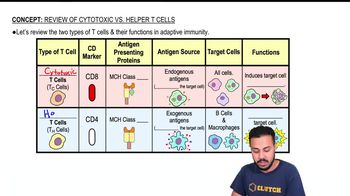
Review of Cytotoxic vs Helper T Cells

Immune Complex Autoimmunity

Immune complex autoimmunity is characterized by the formation of antigen-antibody complexes that deposit in tissues, triggering inflammation and tissue damage. This type III hypersensitivity reaction involves complement activation and recruitment of inflammatory cells, causing damage at sites of complex deposition.
추천 영상:
02:59
Complex Media

Role of Antibodies and T Cells in Autoimmune Reactions

Autoimmune reactions can be mediated by antibodies or T cells. Cytotoxic autoimmunity primarily involves antibodies targeting cells, while some autoimmune responses are T cell-mediated. Understanding which immune components are involved helps differentiate types of autoimmune mechanisms and their effects.
추천 영상:
03:53
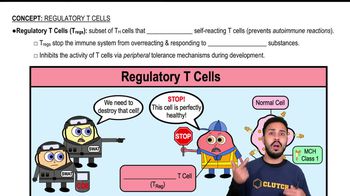
Regulatory T Cells