


Ch. 23 - Microbial Diseases of the Cardiovascular and Lymphatic Systems
Tortora - Microbiology: An Introduction 14th Edition
Tortora14th EditionMicrobiology: An IntroductionISBN: 9780138200398당신이 사용하는 게 아니라요?교과서 변경
19장, 문제 4

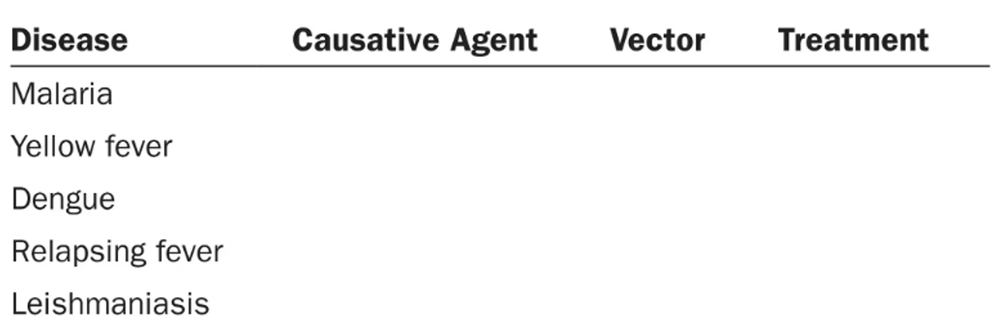
Complete the following table.
Table with columns for disease, causative agent, vector, and treatment, listing five infectious diseases.

검증된 단계별 안내
1
Identify the parameters or variables that the table requires you to complete. Typically, in microbiology, such tables might involve growth rates, generation times, or population sizes at different times.
Recall the relevant formulas for microbial growth, such as the formula for the number of cells after a certain number of generations: \(N = N_0 \times 2^n\), where \(N\) is the final number of cells, \(N_0\) is the initial number of cells, and \(n\) is the number of generations.
If the table involves generation time, use the relationship between time, number of generations, and generation time: \(n = \frac{t}{g}\), where \(t\) is the total time and \(g\) is the generation time.
Use the given data in the table to calculate missing values step-by-step by substituting known values into the formulas. For example, if you know \(N_0\) and \(n\), calculate \(N\); or if you know \(N_0\), \(N\), and \(t\), solve for \(g\).
Double-check your calculations for consistency and ensure that units are correct. Fill in the table with the calculated values accordingly.

비슷한 문제에 대한 검증된 영상 답변:

이 영상 해법은 위 문제에 도움이 된다고 튜터들이 추천한 것입니다.
영상 길이:
2m

주요 개념

질문에 올바르게 답하기 위해 반드시 이해해야 하는 핵심 개념들은 다음과 같습니다.

Microbial Classification and Taxonomy

Understanding how microorganisms are classified based on characteristics such as morphology, genetic makeup, and metabolic properties is essential. Taxonomy helps organize microbes into groups like bacteria, archaea, fungi, and viruses, which is crucial for completing classification tables.
추천 영상:
02:23
Introduction to Taxonomy

Microbial Physiology and Metabolism

Knowledge of microbial metabolic pathways, energy sources, and growth requirements is important to differentiate microbes. This includes understanding aerobic vs. anaerobic respiration, fermentation, and nutrient utilization, which often appear in comparative tables.
추천 영상:
02:17
Introduction to Metabolism

Microscopic and Staining Techniques

Familiarity with methods like Gram staining, acid-fast staining, and microscopy helps identify microbial cell structures and types. These techniques provide key traits used in tables to distinguish between different microorganisms.
추천 영상:
03:46
Light Microscopy: Bright-Field Microscopes