Ch. 27 - Environmental Microbiology
Tortora - Microbiology: An Introduction 14th Edition
Tortora14th EditionMicrobiology: An IntroductionISBN: 9780138200398당신이 사용하는 게 아니라요?교과서 변경
23장, 문제 7

Use the following choices to answer the question:
a. Aerobic respiration
b. Anaerobic respiration
c. Anoxygenic photosynthesis
d. Oxygenic photosynthesis
Chemical equation showing sulfate ions reacting with protons and electrons to form hydrogen sulfide and water.

검증된 단계별 안내
1
Step 1: Carefully examine the image provided in the problem to identify key features such as the presence or absence of oxygen production, types of electron donors and acceptors, and the environment where the process occurs.
Step 2: Recall the definitions and characteristics of each process: (a) aerobic respiration uses oxygen as the final electron acceptor; (b) anaerobic respiration uses a molecule other than oxygen as the final electron acceptor; (c) anoxygenic photosynthesis does not produce oxygen and uses molecules like hydrogen sulfide as electron donors; (d) oxygenic photosynthesis produces oxygen and uses water as the electron donor.
Step 3: Match the observed features in the image with the characteristics of each process. For example, if oxygen is produced and water is the electron donor, it suggests oxygenic photosynthesis.
Step 4: Eliminate options that do not fit the observed features. For instance, if the process involves oxygen production, anaerobic respiration and anoxygenic photosynthesis can be ruled out.
Step 5: Select the most appropriate process from the choices based on your analysis of the image and the characteristics of each metabolic pathway.

비슷한 문제에 대한 검증된 영상 답변:

이 영상 해법은 위 문제에 도움이 된다고 튜터들이 추천한 것입니다.
영상 길이:
2m

주요 개념

질문에 올바르게 답하기 위해 반드시 이해해야 하는 핵심 개념들은 다음과 같습니다.

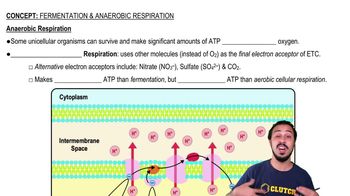
Aerobic and Anaerobic Respiration

Aerobic respiration uses oxygen as the final electron acceptor to produce energy efficiently, while anaerobic respiration uses other molecules like nitrate or sulfate in the absence of oxygen. Both processes involve electron transport chains but differ in their electron acceptors and energy yields.
추천 영상:
03:35
Anaerobic Respiration

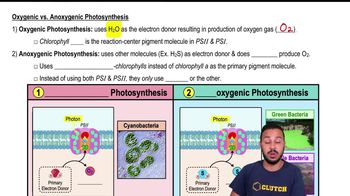
Oxygenic and Anoxygenic Photosynthesis

Oxygenic photosynthesis produces oxygen by splitting water molecules and uses light energy to convert CO2 into organic compounds, typical of plants and cyanobacteria. Anoxygenic photosynthesis does not produce oxygen and uses other electron donors like hydrogen sulfide, common in certain bacteria.
추천 영상:
05:23
Oxygenic vs. Anoxygenic Photosynthesis

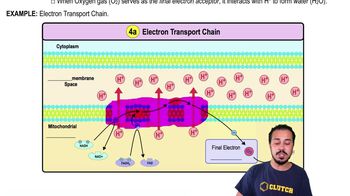
Electron Transport Chain and Energy Production

The electron transport chain (ETC) is a series of protein complexes that transfer electrons to generate a proton gradient, driving ATP synthesis. Both respiration and photosynthesis rely on ETCs, but the source of electrons and final acceptors differ, influencing the organism's metabolism and energy efficiency.
추천 영상:
07:41
Electron Transport Chain