The following processes are used in wastewater treatment. Match the stage of treatment with the processes. Each choice can be used once, more than once, or not at all.
Ch. 27 - Environmental Microbiology

23장, 문제 8
Use the following choices to answer the question:
a. Aerobic respiration
b. Anaerobic respiration
c. Anoxygenic photosynthesis
d. Oxygenic photosynthesis

검증된 단계별 안내1
Step 1: Carefully examine the image provided in the problem to identify key features such as the presence or absence of oxygen production, types of pigments, electron donors, or any other metabolic indicators.
Step 2: Recall the definitions and characteristics of each metabolic process: (a) aerobic respiration uses oxygen as the final electron acceptor; (b) anaerobic respiration uses a molecule other than oxygen as the final electron acceptor; (c) anoxygenic photosynthesis does not produce oxygen and uses electron donors like H2S; (d) oxygenic photosynthesis produces oxygen and uses water as the electron donor.
Step 3: Match the observed features in the image to the characteristics of each process. For example, if oxygen production is indicated, it suggests oxygenic photosynthesis; if sulfur compounds are involved, it may indicate anoxygenic photosynthesis.
Step 4: Use the process of elimination by ruling out options that do not fit the observed data from the image, such as excluding aerobic respiration if no oxygen is involved or anaerobic respiration if photosynthesis is clearly depicted.
Step 5: Assign the correct letter choice (a, b, c, or d) to each question based on your analysis and understanding of the metabolic processes illustrated.

비슷한 문제에 대한 검증된 영상 답변:
이 영상 해법은 위 문제에 도움이 된다고 튜터들이 추천한 것입니다.
영상 길이:
2m주요 개념
질문에 올바르게 답하기 위해 반드시 이해해야 하는 핵심 개념들은 다음과 같습니다.
Aerobic and Anaerobic Respiration
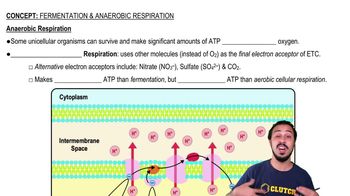
Aerobic respiration uses oxygen as the final electron acceptor to produce energy efficiently, while anaerobic respiration uses other molecules like nitrate or sulfate in the absence of oxygen. Both processes generate ATP but differ in energy yield and environmental conditions.
추천 영상:
Anaerobic Respiration
Oxygenic and Anoxygenic Photosynthesis
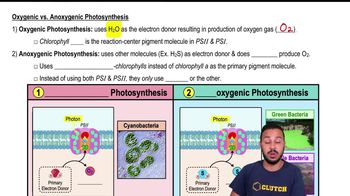
Oxygenic photosynthesis produces oxygen by splitting water molecules and is performed by plants, algae, and cyanobacteria. Anoxygenic photosynthesis does not produce oxygen and uses other electron donors like hydrogen sulfide, common in certain bacteria.
추천 영상:
Oxygenic vs. Anoxygenic Photosynthesis
Electron Transport Chain and Energy Production
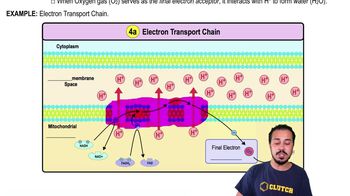
The electron transport chain (ETC) is a series of protein complexes that transfer electrons to generate a proton gradient, driving ATP synthesis. The type of electron acceptor (oxygen or other molecules) determines whether respiration is aerobic or anaerobic, affecting energy output.
추천 영상:
Electron Transport Chain
관련 실천
교과서 질문
1639
views
교과서 질문
Use the following choices to answer the question:
a. Aerobic respiration
b. Anaerobic respiration
c. Anoxygenic photosynthesis
d. Oxygenic photosynthesis
1019
views
교과서 질문
These nitrogen-fixing prokaryotes provide nitrogen fertilizer in rice paddies; they live symbiotically in the cells of the freshwater plant Azolla.
1375
views
교과서 질문
Outline the treatment process for drinking water.
1872
views
교과서 질문
Bioremediation refers to the use of living organisms to remove pollutants. Describe three examples of bioremediation.
1736
views
교과서 질문
All of the following are effects of water pollution except
a. The spread of infectious diseases.
b. Increased eutrophication.
c. Increased BOD.
d. Increased growth of algae.
e. None of the above; all of these are effects of water pollution.
1571
views