Ch. 4 - Functional Anatomy of Prokaryotic and Eukaryotic Cells
Tortora - Microbiology: An Introduction 14th Edition
Tortora14th EditionMicrobiology: An IntroductionISBN: 9780138200398당신이 사용하는 게 아니라요?교과서 변경
4장, 문제 7

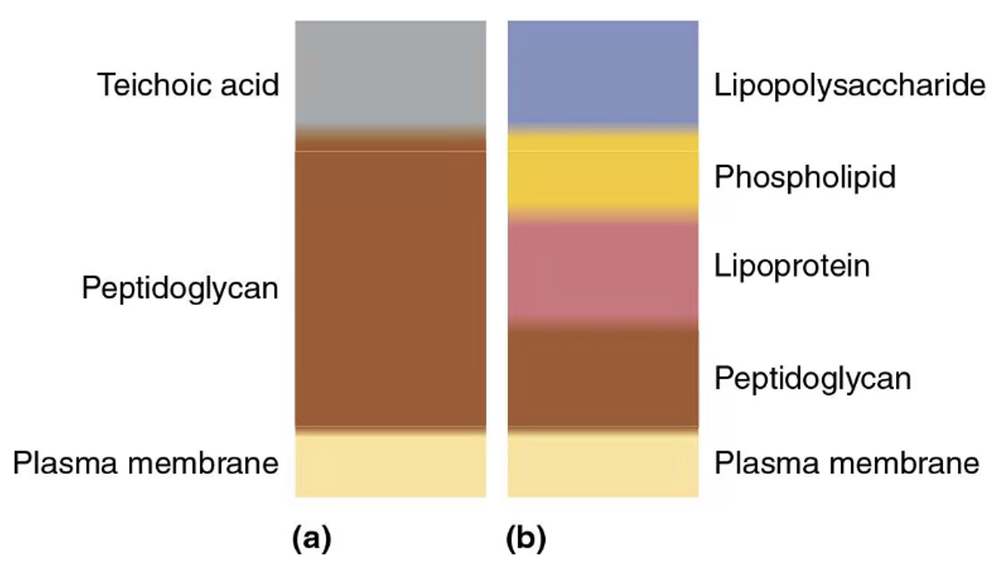
Answer the following questions using the diagrams provided, which represent cross sections of bacterial cell walls.
a. Which diagram represents a gram-positive bacterium? How can you tell?
Diagram comparing gram-positive and gram-negative bacterial cell walls with labeled structural layers.
b. Explain how the Gram stain works to distinguish these two types of cell walls.
c. Why does penicillin have no effect on most gram-negative cells?
d. How do essential molecules enter cells through each wall?
e. Which cell wall is toxic to humans?

검증된 단계별 안내
1
For part (a), identify the diagram with a thick peptidoglycan layer and no outer membrane as the gram-positive bacterium. Gram-positive bacteria have a thick, multilayered peptidoglycan cell wall that retains the crystal violet stain, appearing purple under a microscope.
For part (b), explain the Gram stain process: crystal violet dye is applied first, then iodine, which forms a complex with the dye. In gram-positive bacteria, the thick peptidoglycan traps this complex, so the cells remain purple after a decolorizer is applied. In gram-negative bacteria, the thinner peptidoglycan and outer membrane allow the dye to be washed out, so they take up the counterstain (usually safranin) and appear pink/red.
For part (c), discuss that penicillin targets the synthesis of peptidoglycan by inhibiting enzymes involved in cross-linking. Gram-negative bacteria have an outer membrane that acts as a barrier, preventing penicillin from reaching the peptidoglycan layer effectively, making them less susceptible or resistant to penicillin.
For part (d), describe how essential molecules enter each cell type: in gram-positive bacteria, molecules pass through the thick but porous peptidoglycan layer directly into the plasma membrane. In gram-negative bacteria, molecules must pass through porin proteins located in the outer membrane before reaching the periplasmic space and then the plasma membrane.
For part (e), identify the gram-negative cell wall as toxic to humans because it contains lipopolysaccharides (LPS) in the outer membrane. LPS acts as an endotoxin that can trigger strong immune responses, leading to symptoms such as fever and septic shock.

비슷한 문제에 대한 검증된 영상 답변:

이 영상 해법은 위 문제에 도움이 된다고 튜터들이 추천한 것입니다.
영상 길이:
2m
도움이 되었나요?

주요 개념

질문에 올바르게 답하기 위해 반드시 이해해야 하는 핵심 개념들은 다음과 같습니다.

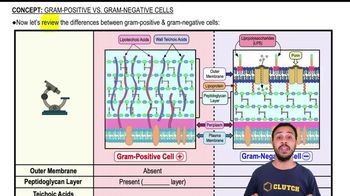
Gram-Positive vs. Gram-Negative Cell Walls

Gram-positive bacteria have a thick peptidoglycan layer in their cell walls, which retains the crystal violet stain, appearing purple under a microscope. Gram-negative bacteria have a thinner peptidoglycan layer and an outer membrane containing lipopolysaccharides, causing them to appear pink after Gram staining. These structural differences are key to identifying and classifying bacteria.
추천 영상:
가이드 코스
04:46
Gram-Positive vs. Gram-Negative Cell Walls

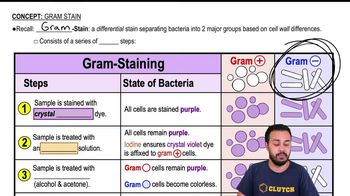
Mechanism of the Gram Stain

The Gram stain differentiates bacteria based on cell wall composition. Crystal violet dye penetrates all cells, but the thick peptidoglycan in gram-positive cells traps the dye after iodine treatment. Alcohol decolorization removes the dye from gram-negative cells due to their outer membrane, allowing counterstaining with safranin to show pink color. This process highlights structural differences.
추천 영상:

Antibiotic Action and Cell Wall Permeability

Penicillin targets peptidoglycan synthesis, which is abundant in gram-positive bacteria, making them susceptible. Gram-negative bacteria resist penicillin because their outer membrane blocks the drug's access to the peptidoglycan layer. Additionally, essential molecules enter gram-positive cells mainly through the thick peptidoglycan, while gram-negative cells use porin proteins in their outer membrane for selective permeability.
추천 영상:
가이드 코스
03:44
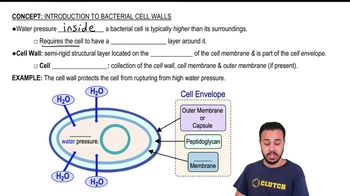
Introduction to Bacterial Cell Walls
관련 실천
교과서 질문

Starch is readily metabolized by many cells, but a starch molecule is too large to cross the plasma membrane. How does a cell obtain the glucose molecules from a starch polymer? How does the cell transport these glucose molecules across the plasma membrane?

1388
views
교과서 질문

Which of the following is false about fimbriae?

a. They are composed of protein.

b. They may be used for attachment.

c. They are found on gram-negative cells.

d. They are composed of pilin.

e. They may be used for motility.

1540
views
교과서 질문

Compare and contrast the following:

a. Simple diffusion and facilitated diffusion

b. Active transport and facilitated diffusion

c. Active transport and group translocation

1392
views
교과서 질문

Which of the following statements best describes what happens to a cell exposed to polymyxins that destroy phospholipids?

a. In an isotonic solution, nothing will happen.

b. In a hypotonic solution, the cell will lyse.

c. Water will move into the cell.

d. Intracellular contents will leak from the cell.

e. Any of the above might happen.

1392
views
교과서 질문

Which of the following pairs is mismatched?

a. Metachromatic granules—stored phosphates

b. Polysaccharide granules—stored starch

c. Lipid inclusions—poly-β-hydroxybutyric acid

d. Sulfur granules—energy reserve

e. Ribosomes—protein storage

1676
views
교과서 질문

Which of the following pairs is mismatched?

a. Glycocalyx—adherence

b. Pili—reproduction

c. Cell wall—toxin

d. Cell wall—protection

e. Plasma membrane—transport

1924
views